The Skeleton Coast: Namibia's Shore of Wreck and Fog
Stretching five hundred kilometres along Namibia's northern Atlantic shore, the Skeleton Coast is one of the most forbidding and beautiful edges of the African continent — a place where the cold Benguela Current drives fog onto burning desert, and where the bones of ships and whales still bleach in the dunes.
The Skeleton Coast has been accumulating names for as long as people have tried to pass it. The Bushmen called it 'The Land God Made in Anger.' Portuguese sailors who sighted it from their caravels in the fifteenth century noted the surf crashing over submerged reefs with no safe harbour in sight, and moved on. Later, when whaling ships began working these waters, the shore earned its bleak English name from the whale bones left by rendering stations and from the skeletons of sailors whose ships broke up on the rocks and who, even if they made it ashore, faced a desert too waterless and hot to walk out of. The Cape Cross Seal Reserve, near the coast's southern end, still holds what may be the largest single aggregation of Cape fur seals in the world — over a hundred thousand animals at the peak season — their sounds and smell reaching a vessel offshore long before the coast comes into view.
Today the Skeleton Coast is divided into a southern section accessible by road from Swakopmund and Henties Bay, and the remote Skeleton Coast National Park to the north — a wilderness area so strictly controlled that it can only be visited by fly-in safari on a licensed concession. It is this northern zone, above the Hoanib River mouth, that holds the experiences most likely to rearrange a traveller's understanding of what a wild coast can be: desert-adapted lions padding through coastal dunes, brown hyenas raiding seal colonies at night, shipwrecks rusting into the sand beside the Benguela surf, and fog so dense and persistent that the line between land and sea disappears entirely.
The Benguela Current and the fog ecology
The Skeleton Coast's character begins in the deep ocean. The Benguela Current is an upwelling system — cold, nutrient-rich water from the depths of the South Atlantic rises to the surface along Namibia's coast, producing one of the world's most productive marine ecosystems and, by meeting the heat of the Namib Desert, the fog that defines the Skeleton Coast's atmosphere. This fog — advection fog formed as warm moist air flows over the cold current — rolls inland most mornings, sometimes reaching fifty kilometres into the desert before the heat burns it off. It almost never rains on the Skeleton Coast, but the fog deposits enough moisture on rocks, dunes, and vegetation to sustain a surprising density of life.
Fog-basking beetles collect moisture on their backs in the morning hours; the endemic Namib dune grasses have waxy surfaces that channell fog droplets to their roots; lichen fields that stretch for kilometres along the coastal flats derive most of their water from fog alone. Seabirds crowd the cold water offshore — Cape gannets, Cape cormorants, African penguins, and thousands of hunting terns work the upwelling current that is one of the richest fishing grounds on the planet. The same current that drowned the sailors and stranded the ships is, ecologically speaking, the coast's greatest gift.
Desert-adapted lions and the apex predators of the coast
The desert-adapted lions of the Skeleton Coast and the adjacent Kunene region are among the rarest and most studied lion populations in the world. Genetically they are the same species as lions elsewhere in Africa, but generations of survival in extreme aridity have produced animals with notably different behaviour: they travel enormous home ranges (some individuals cover over a thousand kilometres in a season), eat fish and Cape fur seals when ungulate prey is scarce, and have been observed swimming in coastal lagoons. Their populations fluctuate severely with rainfall cycles, and as recently as 2020 the population was estimated at only around 150 individuals.
Brown hyenas, found nowhere else in such density, are the other apex scavengers of the coast, padding in from the desert at night to work the seal colonies and strand lines. Desert-adapted elephants move seasonally from the Hoanib and Hoarusib river valleys to the coast, drinking from springs exposed by low tide in extraordinary behaviour documented in recent decades. Spotted hyenas, black-backed jackals, and — in exceptional circumstances — African wild dogs round out a predator community operating in conditions that would extinguish most large mammals. This is the Skeleton Coast's deepest strangeness: that such animals exist at all, here, at the edge of two extremes.
Shipwrecks and human history on the shore
The wrecks of the Skeleton Coast are among its most photographed and most melancholy features. The Eduard Bohlen, a German cargo ship that ran aground in 1909, now sits not on the waterline but in open desert — the coastline has shifted seaward over the past century, and the rusting hulk lies several hundred metres from the present surf, half-buried in sand, its stern and bow visible from the air but unreachable by land except on guided fly-in expeditions. The Dunedin Star, a British cargo liner that grounded in 1942 while carrying armaments and passengers, became a protracted rescue operation that itself resulted in further losses — a tug and an aircraft were lost trying to rescue the survivors.
The human communities of the coast's history are equally stark. The Topnaar (Khoekhoen) people have lived along the Kuiseb River mouth at the coast's southern end for centuries, and their traditional rights over the nara melon — a native desert plant whose fruits were a staple food — are still legally recognised. The Himba, further north in the Kunene region, are among the most distinctive pastoralist peoples in Africa, their culture of cattle and goat herding, ochre-and-fat body coating, and elaborate jewellery representing a way of life that has negotiated the desert's demands across many generations.
The national park and fly-in access
The northern Skeleton Coast National Park, covering roughly 16,000 square kilometres above the Ugab River, is one of the most restricted protected areas in Africa. Entry by private vehicle is not permitted; the only authorised access is by fly-in on a small number of licensed concessions. This restriction, while logistically demanding and expensive, has the effect of keeping visitor numbers so low that the landscape and its wildlife are effectively undisturbed. A fly-in camp in the northern park offers the rare experience of large mammal sightings in a coastline desert, without another vehicle within a hundred kilometres.
The flights into the park are themselves an experience — small aircraft following the dune lines north from Swakopmund or Windhoek, crossing the geological boundary where the red dunes of the central Namib meet the clay pans and rocky outcrops of the far north, before dropping down to a gravel airstrip beside a dry riverbed camp. Activities are foot- and vehicle-based: tracking desert-adapted elephants along the Hoanib, visiting seal colonies on the coast, exploring the ruins of fishing stations, or simply sitting in the dunes at dusk watching the fog roll in from the Atlantic. The silence is remarkable.
The southern zone: what road access offers
The section of the Skeleton Coast reachable by road — from Swakopmund north past the Cape Cross Seal Reserve to Möwe Bay — is dramatically less controlled and considerably less expensive, and it offers its own character. Cape Cross is one of the most sensory wildlife experiences in Africa: the seal colony is so large and so loud, so pungent and so alive, that it overwhelms ordinary categories of wildlife encounter. Hundreds of thousands of seals occupy every available rock and beach for kilometres, pups calling, bulls fighting in the surf, carcasses of the dead serving as food for the jackals and brown hyenas that patrol the colony edge.
Further north, the wrecks and old fish-processing stations that dot the road to Möwe Bay can be explored independently. The landscape along this stretch alternates between gravel plains, low dunes, and the extraordinary lichen fields that cover the coastal flats in grey-green crusts — do not drive off the track here, since lichen communities that took centuries to establish can be destroyed by a single vehicle tyre. The coastal road in fog — which is most mornings — reduces visibility to a few metres and creates an atmosphere of total disorientation that is somehow appropriate to the coast's reputation.
When to visit and how to organise the journey
The Skeleton Coast has no bad season, but the experience changes significantly by month. Fog is most persistent and dramatic between June and September, when the cold Benguela is at maximum upwelling and morning visibility can drop to near zero. This is also the best time for the Cape fur seal colony, when large numbers of pups are present. October to December offers clearer days and is the season when desert-adapted lions and elephants are most likely to be moving toward the coast in search of water. The summer months of January to March bring heat and occasional moisture to the inland desert but leave the coast itself relatively cool.
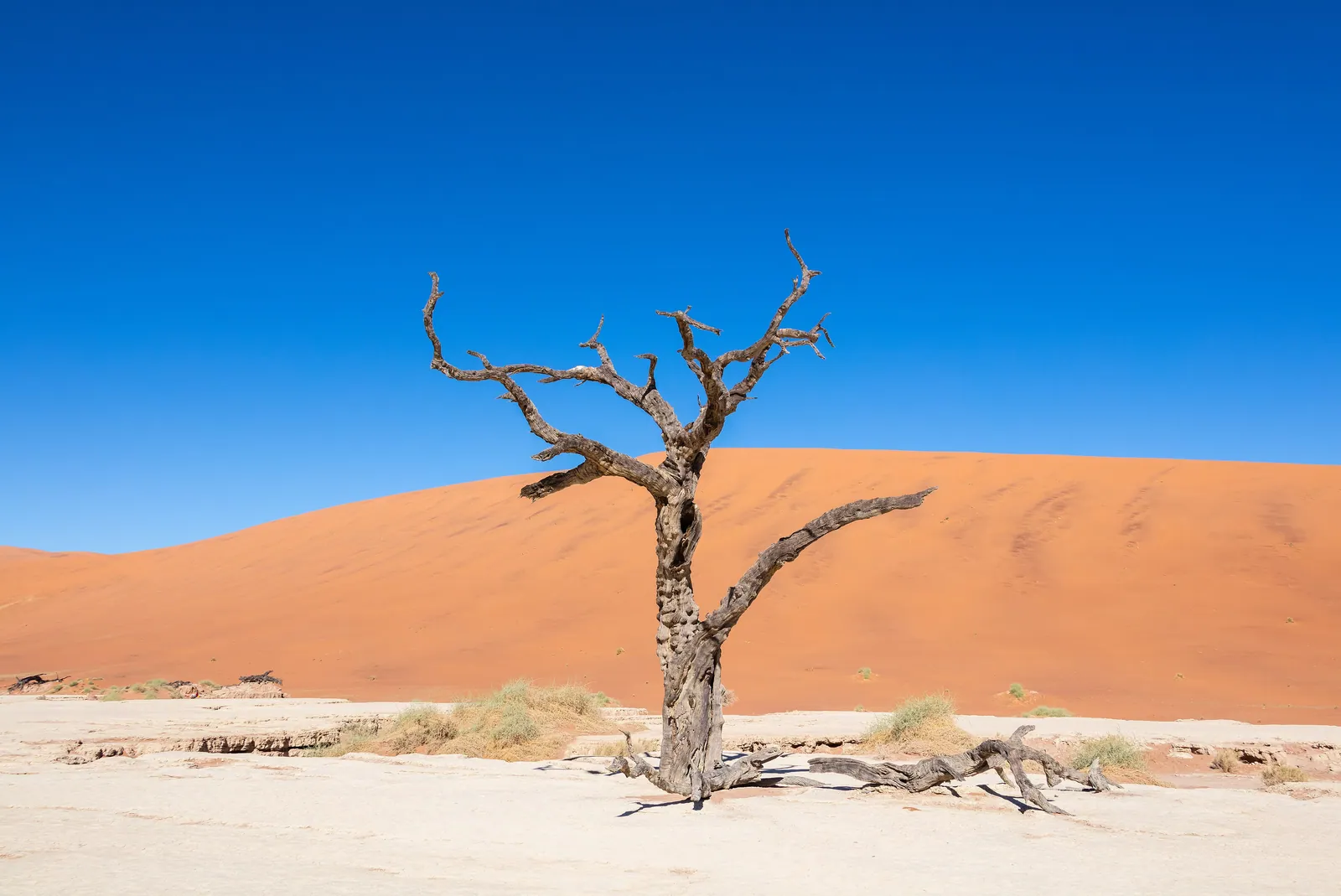
Combining the Skeleton Coast with Namibia's other major landscapes makes logistical sense — the most natural pairing is with Sossusvlei and Deadvlei to the south (red dunes and dead trees, an entirely different register of desert beauty), Etosha National Park to the northeast (classic savanna game viewing in a salt pan landscape), and the Kaokoland highlands of Himba territory to the east. A two-week itinerary can reasonably hold all of these, though spending fewer days in more places produces only the surface of what each demands.
Quick answers
Can I visit the Skeleton Coast independently?
The southern section (Cape Cross to Möwe Bay) is accessible by self-drive in a 4WD vehicle with good ground clearance. A permit is required and obtained at the gate. The northern Skeleton Coast National Park above the Ugab River is only accessible by fly-in safari on licensed concessions — no private vehicle entry is permitted. If you plan to self-drive any part of the coast, inform someone of your route and carry ample water; the coast offers no facilities outside of the main gates and Cape Cross.
What wildlife can I expect to see?
Cape fur seals in enormous numbers at Cape Cross, Cape gannets, cormorants and African penguins offshore, black-backed jackals along the beach, and brown hyenas especially near seal colonies. Desert-adapted elephants move seasonally along the Hoanib and Hoarusib river systems. Desert-adapted lions, while present in the north, are rare and encounters are not guaranteed — they cover vast ranges and sightings require time and a skilled tracker. The northern fly-in camps offer the best access to the full predator community.
What makes the Skeleton Coast's fog different from ordinary sea fog?
The fog is caused by the Benguela Current, one of the world's major oceanic upwelling systems. Cold nutrient-rich water rises to the surface from the deep South Atlantic along Namibia's coast, producing a sea surface temperature dramatically colder than the adjacent land. When moist oceanic air flows over this cold water, it condenses into dense advection fog that rolls inland most mornings. The fog rarely produces rain but deposits enough moisture to support a unique ecology — lichen fields, fog-basking beetles, and desert grasses all depend on it.
How far in advance should I book a fly-in safari in the northern park?
The number of licensed fly-in concessions in the northern Skeleton Coast is very small — two or three operate at any given time, each with limited capacity. For the peak season (June to October), booking six to twelve months ahead is strongly advised. Some camps take only eight to twelve guests at a time. The combination of restricted permits, remote access, and small camp sizes means availability is genuinely limited, and the best camps fill early.
Let the reading become a route.
When an article sparks something, our planners are the next step. Tell us what you are dreaming of.