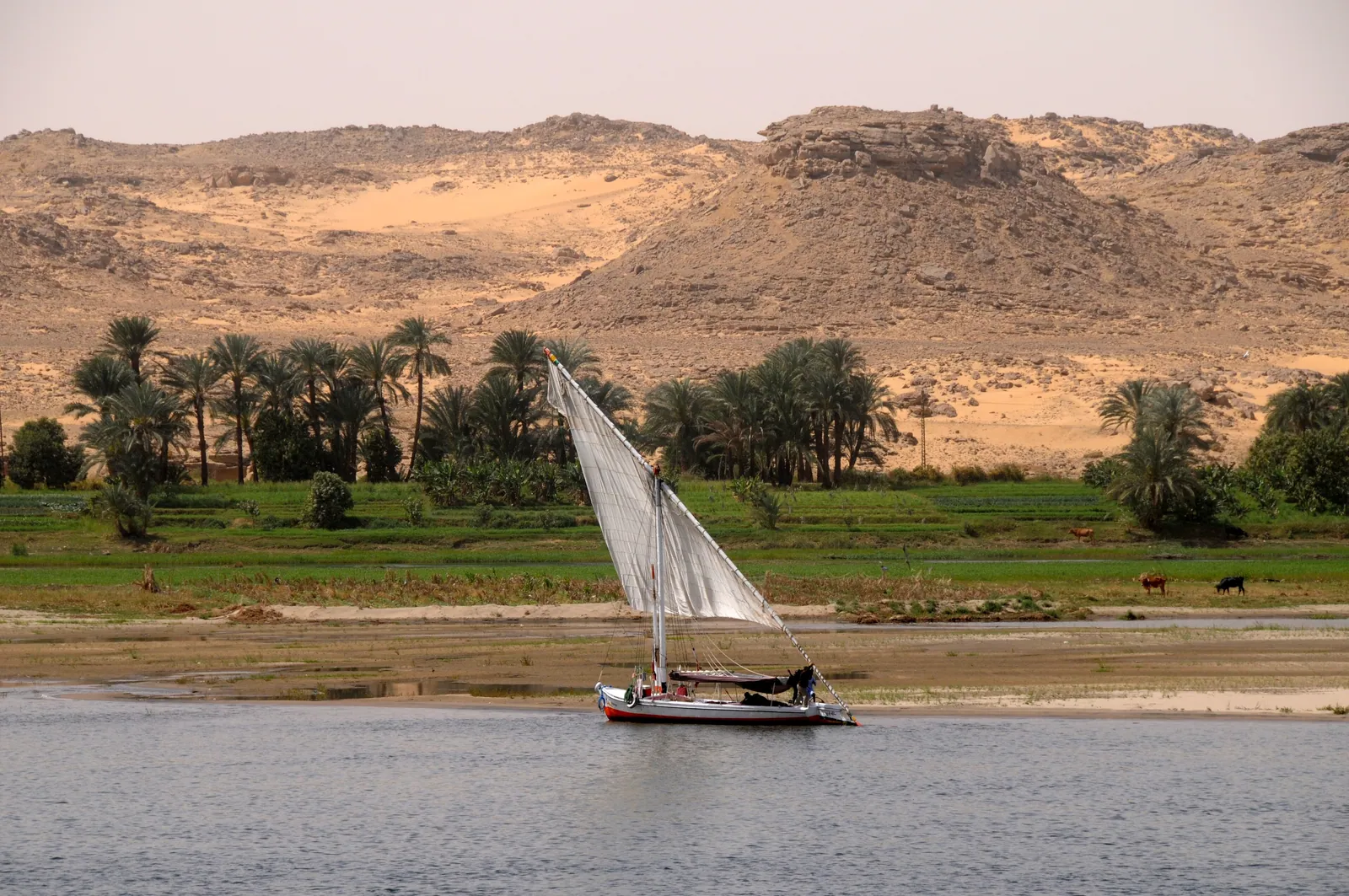
The Slow Boat Up the Nile: Travelling Egypt Under Sail
Before the engine, travellers saw Egypt from the deck of a sailing boat moving with the wind and the current. It is still the truest way to read the river.
For much of the nineteenth century, travelling in Egypt meant living aboard a dahabiya — a broad, twin-masted Nile sailing boat — and drifting between the temples at the speed of the wind. Florence Nightingale and a generation of writers saw the country this way. The traditional sailing boat never quite disappeared, and a quiet revival has returned it to the river as a way to travel slowly.
Choosing to sail the Nile rather than take a large engine-driven cruiser is choosing a different relationship with the river. It is slower, quieter and weather-dependent, and it carries a handful of guests rather than hundreds. What it offers in return is the Nile as Egyptians have always known it: the unhurried procession of the banks, moorings at places no big ship can reach, and the particular silence of a boat under sail.
The traditional Nile sailing boat
The dahabiya — the name comes from an Arabic word for golden, after the gilded barges of Ottoman rulers — is a flat-bottomed Nile boat carrying two lateen sails, the great triangular sails of the river. Boats built today for travellers are intimate vessels, usually with somewhere between four and a dozen cabins, a shaded sundeck, and a small crew who know the river closely.
The shallow draft is the whole point. Such a boat can slip into moorings and side channels a deep-hulled cruise ship cannot approach, which is why a sailing itinerary touches sandbanks, islands and small villages rather than only the main quays. It is a boat built to the scale of the river itself, and it moves accordingly.
Moving with the wind and the current
The Nile flows from south to north, while the prevailing wind blows from north to south — a geographical gift that made the river navigable in both directions for thousands of years. A boat drifts north on the current and sails south against it on the wind. A traditional sailing boat works exactly this way, which is why most sailing itineraries run upstream, southward, between Luxor and Aswan, using the very wind that helped build Egyptian civilisation.
Because the boat depends on the wind, the schedule is gentle rather than exact. When the breeze is good the boat sails; when it drops, a small tender may give a quiet tow, but the rhythm stays unhurried. Days are short stretches of sailing punctuated by long, calm moorings — the opposite of a vessel grinding to a fixed timetable. You travel at the pace the river allows, which is the essence of the experience.
What you see that a large ship misses
The large cruise ships are confined to the main channel and the principal docks, and they moor in lines, hull against hull, at the busy sites. A sailing boat travels and moors differently. It can tie up against an empty bank for the night, anchor off a quiet island, and reach the smaller temples between Luxor and Aswan that the big ships pass — places where you may be almost the only visitors.
Just as important is the texture of ordinary river life. From a low, slow deck you see farmland worked as it has been for millennia, the ferrymen and fishermen, the buffalo at the water's edge, children calling from the bank. A sailing boat does not merely carry you between monuments; it immerses you in the living river that connects them — which is precisely the slow-travel argument made visible.
Life aboard, and what to expect
Life on a Nile sailing boat is unhurried and sociable on a small scale. Meals are usually shared, often Egyptian home cooking, taken on deck. The awning-shaded sundeck is where most of the day passes — reading, watching the banks, dozing in the heat. Cabins are comfortable but the boat is not a floating hotel; the appeal is the deck, the quiet and the closeness to the water.
A few practicalities. The Nile is hot for much of the year, with winter the most comfortable season and high summer demanding; sun protection and light layers matter. The wind-dependent pace means a relaxed attitude to timing is essential — a sailing boat rewards travellers who treat the sailing itself as the experience, not as transit between temples. On an Egyptian itinerary, the Luxor-to-Aswan sailing leg is best placed so it sets the unhurried tone for the whole stretch.
Sailing boat, felucca or cruise ship: choosing your Nile
Three boats, three different experiences. The felucca is the small open sailing boat of the Nile — wonderful for a short sail or a sunset hour, but without cabins it is not a multi-day option for most travellers. The large river cruiser is comfortable and efficient, with many cabins, a pool and a fixed schedule, but it travels the busy channel with the crowds and cannot reach the quiet places.
The traditional dahabiya sits between them, and for slow travel it is the natural choice: the intimacy and sailing character of a felucca with the cabins and comfort to live aboard for several days. If your priority is a predictable, amenity-rich ship, a cruiser suits. If your priority is the river itself — its quiet, its small sites, its everyday life — the sailing boat is the vessel the Nile was meant to be seen from.
Quick answers
What is the difference between a dahabiya and a felucca?
Both are traditional Nile sailing boats, but they serve different purposes. A felucca is a small open boat, ideal for a short sail or a sunset, with no cabins or facilities for living aboard. A dahabiya is larger, with private cabins, a shaded sundeck and a small crew, designed for multi-day journeys. For a several-night sail between Luxor and Aswan, the dahabiya is the practical traditional option.
Which direction does a Nile sailing trip go, and why?
Most sailing itineraries go upstream — southward, typically Luxor to Aswan. The Nile flows north while the prevailing wind blows south, so a sailing boat uses that wind to travel against the current. This is the same principle that made the river navigable for ancient Egypt, and it is why the southbound, upstream direction is the classic sailing route.
Is a Nile sailing boat better than a large cruise ship?
It depends on what you want. A large cruiser offers more amenities, more cabins and a fixed, predictable schedule, but it travels the main channel with the crowds. A traditional sailing boat is smaller, quieter and wind-dependent, and can reach quiet moorings and smaller temples the big ships miss. For travellers who want the river itself rather than a floating hotel, the sailing boat is the stronger choice.

Let the reading become a route.
When an article sparks something, our planners are the next step. Tell us what you are dreaming of.