The Temples of Luxor and Karnak
Ancient Thebes left two of the greatest temples on Earth, joined by an avenue of sphinxes. Here is how Karnak and Luxor differ, what to look for in each, and why they were built where they were.
Luxor stands on the site of ancient Thebes, the capital and great religious centre of Egypt at the height of its power. On the east bank of the Nile it left two enormous temple complexes — Karnak and Luxor Temple — both dedicated chiefly to the god Amun and once linked by a stone avenue lined with sphinxes nearly three kilometres long.
The two are easily confused but were never the same thing. Karnak was the vast working sanctuary of the state god, enlarged by pharaoh after pharaoh over some 2,000 years. Luxor Temple, smaller and more unified, was the stage for a single great annual festival. Understanding that division of labour is the key to reading both — and to seeing why Thebes was the spiritual heart of the ancient world.
Karnak — a temple built over 2,000 years
Karnak is less a temple than a sacred precinct, the largest religious building ever raised. Its core is the Temple of Amun-Ra, but the site also holds precincts for the goddess Mut and the god Montu, along with chapels, obelisks, a sacred lake and a procession of monumental gateways called pylons.
Crucially, no single pharaoh built Karnak. From the Middle Kingdom to the Ptolemaic period — more than two millennia — kings added, enlarged and rebuilt, each wanting to leave his mark on the home of the state god. The result is not one design but a stratigraphy of ambition, which is exactly why a good guide is worth so much here: the site only makes sense as a sequence.
The Great Hypostyle Hall
The single most overwhelming space at Karnak is the Great Hypostyle Hall, begun under Seti I and completed by his son Ramesses II in the Nineteenth Dynasty. It is a forest of 134 sandstone columns covering some 5,000 square metres — the twelve along the central aisle rising about 21 metres, tall enough that a small crowd could stand on a single capital.
The hall was roofed in its day, lit only by stone-grilled clerestory windows, so the original effect was of moving from blinding sun into a shadowed, painted thicket of stone. Traces of the colour survive high up, out of the reach of weather and hands. Walk the central aisle slowly: it is built to make a human being feel exactly as small as the god intended.
Luxor Temple and the Opet Festival
Luxor Temple, two and a half kilometres south, is a more coherent monument, built largely by Amenhotep III in the Eighteenth Dynasty and extended by Ramesses II, whose colossal seated statues and a single surviving obelisk front the entrance pylon. Its twin obelisk has stood in the Place de la Concorde in Paris since 1836.
The temple existed above all for the Opet Festival, when the sacred images of Amun, Mut and their son Khonsu were carried in procession from Karnak to Luxor each year to renew the divine power of the reigning king. Luxor Temple was, in effect, the destination of that pilgrimage — a building designed around a single annual journey rather than daily worship.
The Avenue of Sphinxes
The two temples were physically joined by the Avenue of Sphinxes, a paved processional way nearly three kilometres long once lined by hundreds of ram-headed and human-headed sphinxes. Along it the festival procession moved between Karnak and Luxor, pausing at small way-station chapels built for the resting barques of the gods.
Long buried beneath the modern city, the avenue was excavated and reopened in 2021, so it is once again possible to grasp the temples as two ends of a single ceremonial axis. Seeing them as connected — rather than as two unrelated ruins — is the difference between a checklist and an understanding.
Luxor on a Nile journey
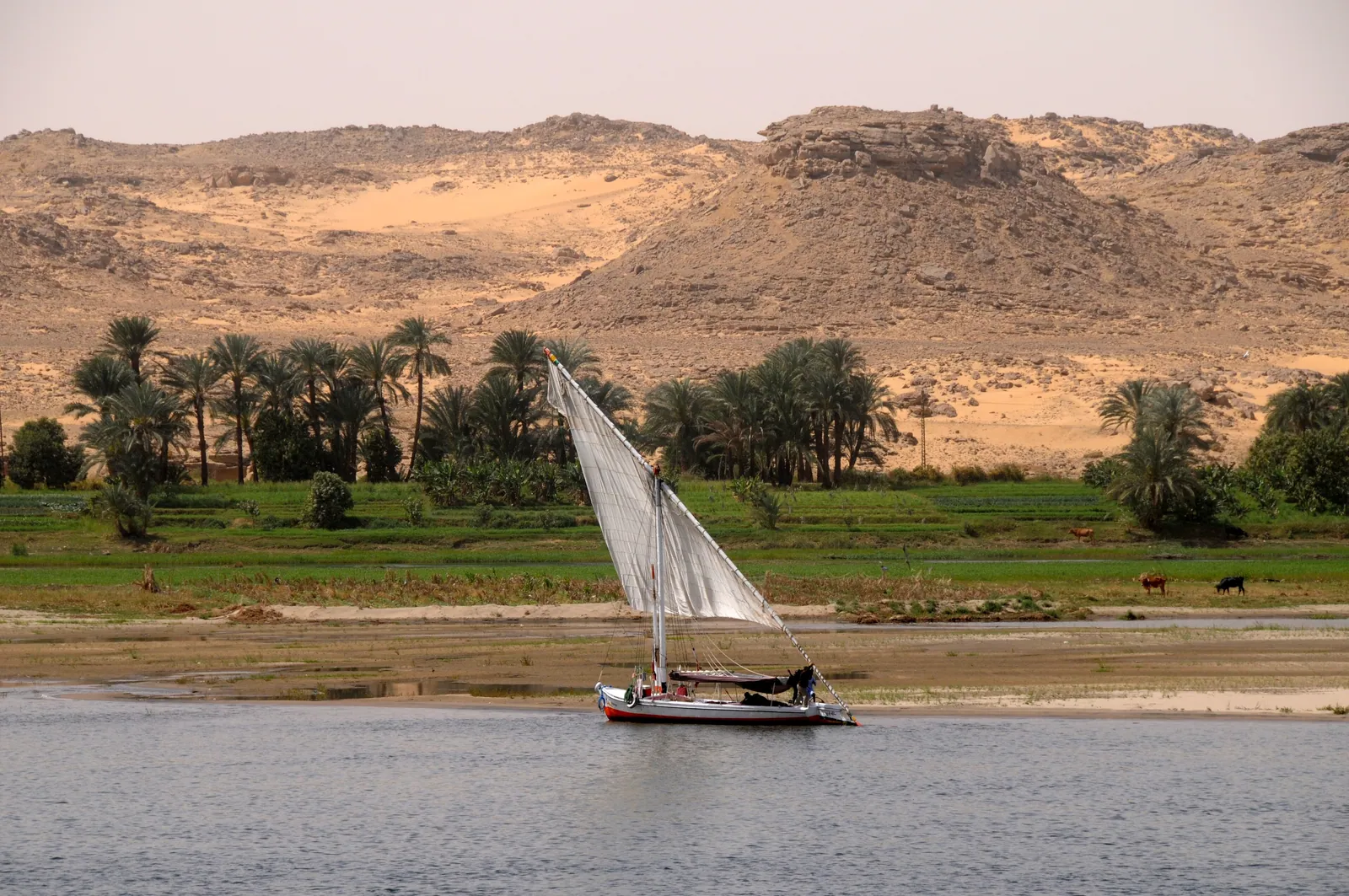
Luxor is the northern anchor of the dahabiya stretch on The Great Rift, the river leg that sails between Luxor and Aswan. We give the east-bank temples their own unhurried time, deliberately apart from the west-bank tombs, so that Karnak and Luxor are visited as living places of worship rather than ticked off in a single exhausting circuit.
Where we can, we time Karnak for the softer light of early morning or late afternoon, when the columns throw long shadows and the heat eases. The temples reward patience: an hour longer in the Hypostyle Hall does more for a traveller than a third site rushed before lunch.
Quick answers
What is the difference between Karnak and Luxor Temple?
Karnak is a vast sacred precinct enlarged by many pharaohs over more than 2,000 years and serving as the working temple of the state god Amun-Ra. Luxor Temple is smaller and more unified, built mainly by Amenhotep III and Ramesses II, and existed chiefly as the destination of the annual Opet Festival procession. The two stood about two and a half kilometres apart and were joined by the Avenue of Sphinxes.
Can you walk between Karnak and Luxor Temple?
Since the Avenue of Sphinxes was excavated and reopened in 2021, it is once again possible to follow the ancient processional route between the two temples. The walk is nearly three kilometres along a paved way lined with sphinxes, best done in the cooler hours of the day.
How much time do you need for Luxor's temples?
The east-bank temples — Karnak and Luxor Temple — comfortably fill a half to a full day. Luxor's west bank, with the Valley of the Kings and the mortuary temples, deserves a separate day of its own. Visiting all of it in a single rushed day is the most common mistake travellers make at Luxor.
Let the reading become a route.
When an article sparks something, our planners are the next step. Tell us what you are dreaming of.