The Trans-Mongolian Railway: Crossing a Continent by Train
The Trans-Mongolian branch of the Trans-Siberian railway connects Moscow to Beijing across 7,621 kilometres of steppe, taiga, desert and mountain — passing through Russia, Mongolia and China in a journey of six to seven days that remains one of the great train experiences on Earth.
There are long train journeys, and there is the Trans-Siberian. The main line from Moscow to Vladivostok, completed in 1916 after 25 years of construction across some of the most remote terrain on the planet, runs for 9,289 kilometres and takes about six days without stops — the longest single unbroken railway line in the world. But the branch that most travellers now choose is the Trans-Mongolian: departing Moscow, running east through Siberia and Lake Baikal, then turning south into Mongolia, crossing the Gobi Desert and entering China to terminate in Beijing. This line covers 7,621 kilometres, passes through three countries and four time zones, and offers — if you sit with it, if you resist the urge to abbreviate it — an uninterrupted education in the geography of the Eurasian continent.
The train is a specific literary and experiential tradition as much as a means of transport. Paul Theroux wrote about it; Eric Newby wrote about it; generations of travellers since the 1960s have discovered that six days in a compartment, with the steppe or the taiga sliding past the window and the social geography of the carriage shifting at every major stop, produces a kind of slowness and attention that faster travel cannot replicate. The compartment becomes, after a day or two, a temporary home; the dining car becomes a social institution; and the landscape outside becomes something you have earned by staying with it, hour after hour, as the world changes beneath a sky that seems larger than any sky you have seen before.
Moscow: where the journey begins
Yaroslavsky Station in Moscow, from which the Trans-Mongolian departs, is one of the great railway termini of the world: an Art Nouveau confection of towers and painted tiles completed in 1904, designed by Fyodor Schechtel with decorative programme by Konstantin Korovin, standing at the northeast corner of the Komsomolskaya Square that also holds the Leningradsky and Kazansky stations — three competing masterpieces of early 20th-century station architecture arranged around a single public space. To stand in front of Yaroslavsky and understand that behind it lies a single track running nearly 10,000 kilometres to the Pacific is to feel something of the imperial ambition that built it.
Most travellers who use the Trans-Mongolian spend at least two to three days in Moscow before departure, and this is time well spent. The Kremlin, the Tretyakov Gallery (the finest collection of Russian art in the world), the GUM arcade on Red Square, and the extraordinary collection of Gothic Revival and Constructivist architecture scattered through the centre and suburbs of the city constitute a cultural education in themselves. The metro, a network of stations built to Stalin-era grandeur with marble halls and mosaic ceilings, is one of the architectural experiences of the 20th century — and happens, incidentally, to be one of the most efficient urban transport systems on Earth.
Siberia and the taiga
The first days out of Moscow cross the Ural Mountains — the nominal border between Europe and Asia, a low and anticlimactic ridge — and then enter the Western Siberian Plain, one of the largest flat regions on Earth. The landscape is hypnotic in its simplicity: birch forests, occasional rivers, scattered settlements of wooden houses with elaborately carved window frames and vegetable gardens running to the edge of the forest. The towns come and go with little variation — Yekaterinburg, Tyumen, Omsk, Novosibirsk — each providing a pause of twenty minutes or an hour in which passengers disembark onto the platform to buy provisions from the babushki (elderly women) who appear with home-cooked food, pickled vegetables and beer at every significant station.
East of Novosibirsk, Siberia begins to assert its scale more forcefully. The taiga — the boreal forest of Siberia, the largest forest on Earth, stretching from the Urals to the Pacific across more than 13 million square kilometres — closes in around the track, and for many hours there is nothing visible but trees. The effect is both oppressive and clarifying: you understand, as you cannot from a map, what the word 'vast' means when applied to the Russian interior. Lake Baikal, reached after roughly three days from Moscow, is the great reward: the world's deepest lake (1,642 metres at its maximum) and the largest freshwater lake by volume, its southern shore hugged by the railway for nearly 200 kilometres, the water a shifting blue-green that seems lit from below.
Ulan-Ude to the Mongolian border
Ulan-Ude, capital of Buryatia (the republic within Russia whose population is predominantly Buddhist and ethnically related to the Mongolians), is the junction where the main Trans-Siberian line and the Trans-Mongolian branch diverge. The city holds the largest head of Lenin in the world — a colossal bronze, 7.7 metres tall, mounted on a plinth in the main square — and the Datsan Rinpoche Bagsha, a large and active Buddhist monastery on a hillside above the city that is the most important Buddhist centre in Russia. The combination of Lenin's head and Tibetan Buddhist chanting from the monastery a few kilometres away encapsulates something essential about the cultural palimpsest of this region.
South of Ulan-Ude, the landscape changes from taiga to rolling steppe and the train crosses the Russian-Mongolian border at Naushki (Russia) and Sukhbaatar (Mongolia). The border crossing is an event in itself: the train stops for several hours while customs officials work through the carriages and engineers change the wheel bogies — the track gauge is different in Russia (1,520 mm broad gauge) from that used in Mongolia and China (1,435 mm standard gauge), so the carriage bodies are literally lifted from their wheels and new bogies fitted beneath them. This mechanical procedure, conducted in a shed at night, gives the traveller a chance to stretch their legs and experience the peculiar intimacy of a halt in the middle of nowhere.
Mongolia: the steppe from the window
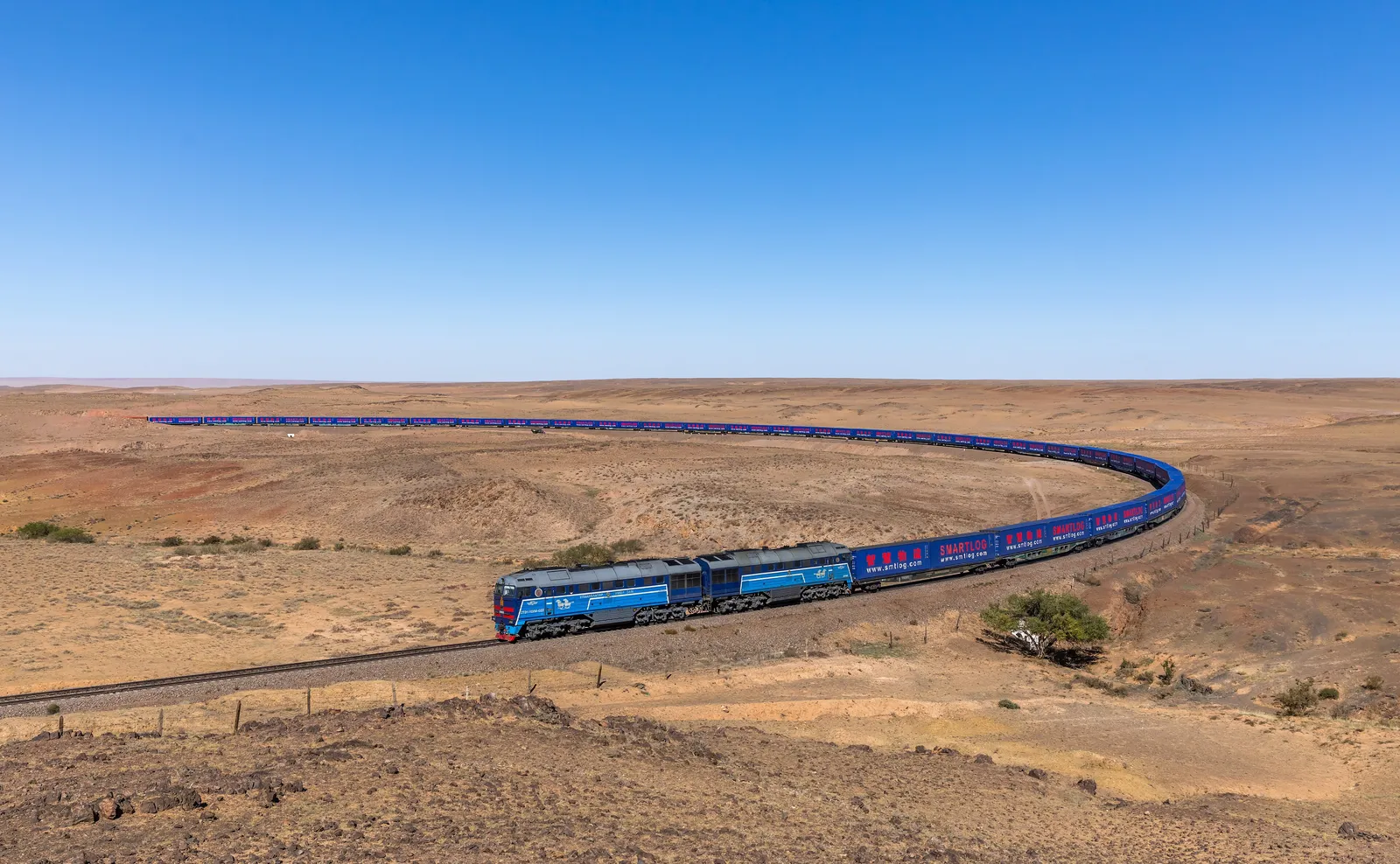
The stretch through Mongolia is the most cinematically powerful of the entire journey. The train descends from the Russian border onto the open steppe and for most of the Mongolian section there is literally nothing between the track and the horizon except grass and sky. The occasional ger appears, white against the tawny ground; a herd of horses streams away from the noise of the train; a camel — sometimes — stands in supreme indifference. The light in Mongolia has a quality that photographers describe and struggle to explain: a clarity and amplitude that has something to do with the altitude, the absence of humidity and the sheer distance to the nearest source of air pollution.
Ulaanbaatar, Mongolia's capital and the largest city on the Trans-Mongolian, provides a stopover of one night in the classic itinerary, though most serious travellers extend this to at least three or four days to explore the city and make day trips to the surrounding valley. The city will be covered in detail in our companion piece on Mongolia and the Great Steppe; here it suffices to say that the contrast between the socialist-era capital and the open wilderness through which you have just travelled produces a particular kind of double vision. The crossing of the Mongolian section takes roughly thirty hours of track time, of which the passage through the Gobi Desert occupies the southern portion: a landscape of increasing aridity, pale brown and ochre, as the train descends toward the Chinese border.
China and the arrival in Beijing
The Mongolian-Chinese border crossing at Erlian (Inner Mongolia, China) involves another wheel-bogie exchange — the reverse of the one at the Russian-Mongolian border — and an immigration process conducted with the brisk efficiency of Chinese border administration. The train then travels through Inner Mongolia and northern China, the landscape shifting from steppe to farmland to the more intensively developed corridors of the North China Plain, until it reaches Beijing's main station at the end of a journey that, including stopovers, typically runs between two and four weeks depending on how long one lingers at each major stop.
The arrival in Beijing is the full stop of one of the great overland journeys. The city is enormous and inexhaustible as a destination in itself: the Forbidden City, the Temple of Heaven, the hutong neighbourhoods of the old city, the Great Wall in its most dramatic sections (Mutianyu, Jinshanling) within easy reach of the capital, and the food culture of a city that encompasses every Chinese regional cuisine under its gastronomic umbrella. To arrive by train from across the continent — from Moscow, from the taiga and the steppe and the Gobi — and to find oneself in this teeming, ancient, modern, contradictory city is to feel the full span of what the Eurasian landmass contains.
Practical matters: tickets, classes and the best approach
The Trans-Mongolian train (train number 4 westbound, 3 eastbound) departs Moscow's Yaroslavsky Station once a week and Beijing's main station once a week, arriving after approximately six days of continuous travel. Tickets can be booked through the Russian Railways (RZD) website or through specialist rail booking services; for foreigners, a booking agent who understands the Mongolian and Chinese visa requirements as well as the rail logistics is strongly advisable. Three classes are available: SV (two-berth first-class compartment), kupé (four-berth second-class compartment), and platzkart (open-plan third class with 54 berths per carriage). Kupé is the standard choice for most independent travellers: private enough for sleep and storage, social enough to facilitate the carriage conversations that are a central part of the experience.
Visas for Russia, Mongolia and China must all be arranged in advance — each country has its own requirements and processing times, and getting all three in order is the most complex part of planning the journey. Most experienced Trans-Mongolian travellers choose to break the journey at Ulaanbaatar for several days and at Irkutsk (near Lake Baikal) for two to three days, adding a week or more to the total journey time but transforming the experience from a marathon train ride into a genuine expedition. The best time to travel is May to September for the steppe and Siberia; October can be excellent for the light, though cold. November to February is extreme — temperatures in Siberia can reach minus 40 and below.
Quick answers
What is the difference between the Trans-Siberian, Trans-Mongolian and Trans-Manchurian railways?
The Trans-Siberian is the main line from Moscow to Vladivostok, running entirely through Russia. The Trans-Mongolian is the branch that diverges from the main line at Ulan-Ude and runs south through Mongolia to Beijing. The Trans-Manchurian is a third variant that diverges at Tarskaya (before Ulan-Ude), crosses into China via Manchuria, and also terminates in Beijing — but does not pass through Mongolia. The Trans-Mongolian is the most popular with international travellers because it adds the extraordinary Mongolian steppe section and Ulaanbaatar as a stop.
How difficult is it to arrange the visas for the full Trans-Mongolian journey?
Arranging visas for Russia, Mongolia and China simultaneously is the most logistically complex element of the journey. Each country has different requirements, processing times and documentation needs, and the order in which you apply matters (some Russian visa applications require confirmation of your itinerary, which depends on having booked the train, which depends on having the visa). Most travellers use a specialist travel agent or Trans-Siberian booking service that handles the visa paperwork alongside the tickets. Start planning at least three months before your intended departure.
What food is available on the train?
Each country's section of the train has its own dining car, staffed and provisioned according to national convention. The Russian dining car serves hot meals of the borscht, pelmeni and kasha variety, and is a social institution worth visiting for the atmosphere alone. The Mongolian dining car offers mutton-based dishes, noodle soups and airag (fermented mare's milk) if you are lucky. The Chinese dining car serves Chinese staples at reasonable prices. Many experienced travellers supplement the dining car with food bought from platform vendors at stops — this is cheaper, often more delicious, and deeply part of the experience.
Is the journey comfortable in kupé (four-berth compartment)?
Kupé compartments are functional rather than luxurious: four fold-down berths (two upper, two lower), a small table by the window, and a communal samovar of boiling water in the corridor for tea. Bedding is provided (or rented from the provodnik, the carriage attendant). Bathrooms are shared between the carriage. The upper berths have more privacy but require climbing; the lower berths double as seats during the day and have storage space beneath them. After a day or two, the compartment begins to feel surprisingly adequate — the intimacy it enforces with fellow travellers is often the most memorable part of the journey.
Should I travel Moscow to Beijing or Beijing to Moscow?
Most travellers choose Moscow to Beijing to follow the historical direction of the Silk Road and to experience the dramatic transition from the taiga to the Mongolian steppe to the Chinese farmland in that sequence. Beijing to Moscow works equally well and has the advantage of starting in a city with excellent rail infrastructure and relatively easy logistics. Some travellers choose to do the western half (Moscow–Ulaanbaatar) on one trip and the eastern half (Ulaanbaatar–Beijing) on another, building in more time in Mongolia. Either direction, the journey itself is the destination.
Let the reading become a route.
When an article sparks something, our planners are the next step. Tell us what you are dreaming of.