The Uyuni Mirror: When the Salt Flat Becomes a Sky
The Salar de Uyuni’s famous mirror is not a year-round phenomenon — it is a brief, weather-dependent gift. Here is exactly how the reflection forms, when to chase it, and what it asks of a traveller.
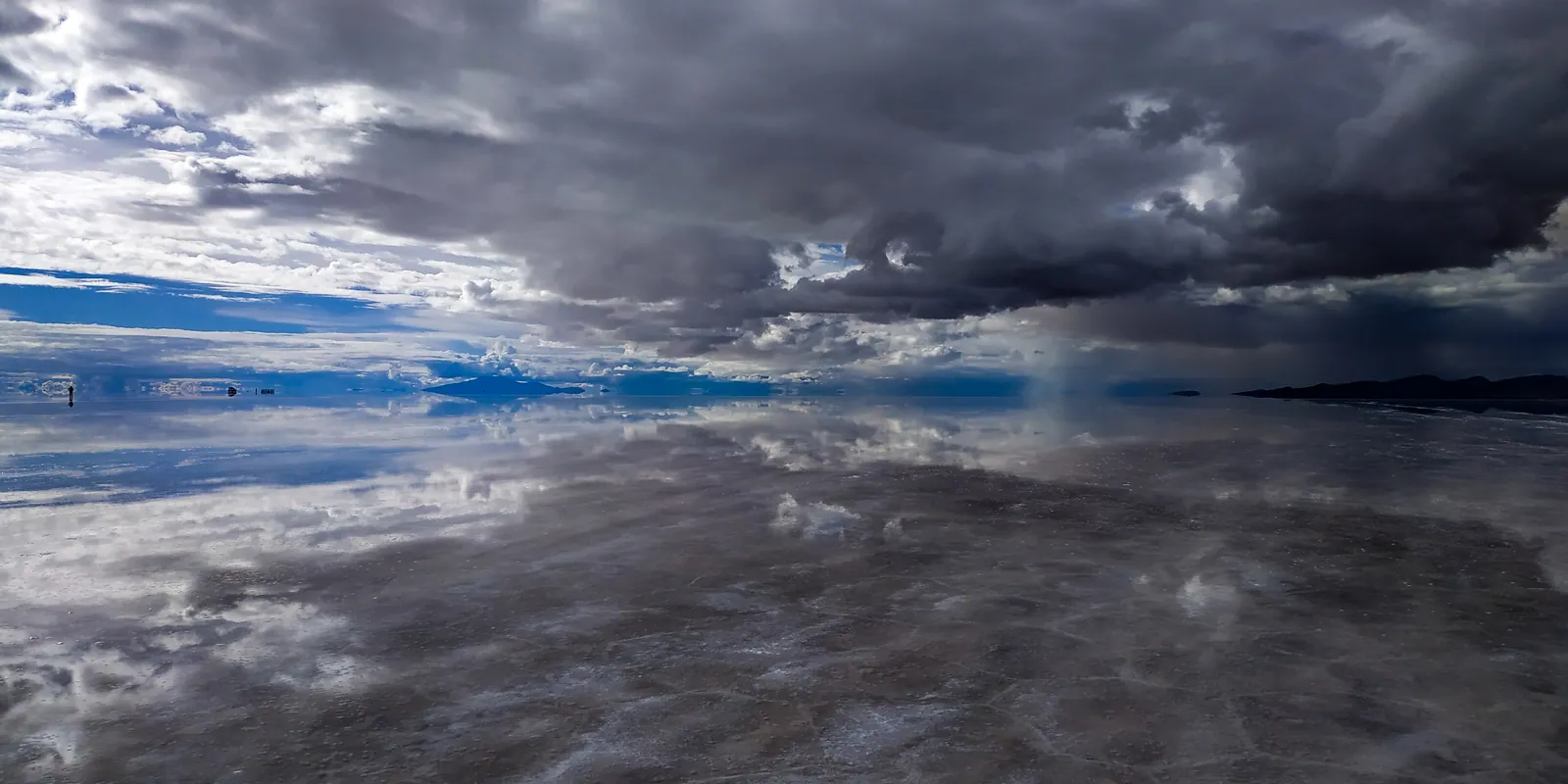
The mirror of the Salar de Uyuni — that disorienting sheet in which cloud and ground become a single seamless image — appears only when a thin film of water lies still over the salt. In practice that means the rainy season, roughly December to March or early April, with the most reliable reflections in late January, February and early March. Outside those months the salar is dry and white, beautiful in a wholly different way, but it does not mirror.
The effect needs three things at once: standing water just deep enough to reflect, a salt surface flat enough that the water spreads evenly, and calm air, because wind ripples the surface and breaks the image. Mornings and the hour around sunset, when the breeze typically drops, give the cleanest mirror. The reward is one of the strangest sensory experiences in travel — walking, apparently, across the sky.
Why the salar reflects at all
The Salar de Uyuni covers roughly 10,500 square kilometres of the Bolivian altiplano at about 3,656 metres above sea level, and it is astonishingly level — its surface varies by less than a metre across that entire expanse. That flatness is the whole secret. When seasonal rain falls, it cannot pool in low spots, because there are effectively none; instead it forms a continuous, gleaming skin a few centimetres deep over hundreds of square kilometres.
A water layer that thin, lying over a pale and uniform floor, behaves like an enormous horizontal mirror. With no fixed point of reference — no horizon line you can trust, no shoreline nearby — the brain stops distinguishing up from down. Photographs lose their sense of scale entirely, which is why the salar has become one of the most photographed landscapes on Earth.
When to come for the mirror
The wet season runs broadly from December to March, occasionally stretching into April. December tends to be patchy; the water arrives unevenly and the salar may be only partly flooded. The dependable window is late January through early March, when accumulated rain has spread a consistent film across large sections of the flat.
Even within that window, the mirror is a daily lottery decided by weather. A dry, windy spell can thin or ripple the water; a fresh downpour can deepen it past the ideal. This is why a good itinerary builds in flexibility — a guide who knows which sectors are flooded that week, and the willingness to drive to them, matters far more than a fixed plan.
The dry-season alternative
From roughly May to November the salar dries out, and the water gives way to a hard white crust scored into a honeycomb of polygons — the salt’s natural fracture pattern. There is no reflection, but the dry salar opens up: vehicles can cross freely to Incahuasi island and its giant cacti, the light is crisp, and the famous forced-perspective photographs are easiest on the firm, featureless ground.
Neither season is better; they are simply different journeys. Travellers set on the mirror should come in the wet months and accept some logistical give. Those who want reliable blue skies, easy access across the whole flat and cooler, drier nights are well served by the dry season.
Reading the day for the cleanest reflection
Wind is the enemy of the mirror. The altiplano tends to be calmest in the early morning and again as the sun lowers, so those are the hours to be standing on the water. Midday often brings a breeze that stipples the surface and softens the reflection, though it never fully disappears in flooded sectors.
Sunrise and sunset deliver the colour — the whole sky, doubled — while a clear night turns the salar into a field of stars above and below. Cloud is not a setback here: a dramatic sky simply gives the mirror something dramatic to copy.
Walking the salar with care
Standing water on the salt is shallow but cold, and the surface beneath is firm crust rather than soft mud. Waterproof boots, or sandals you do not mind soaking, make the experience far more comfortable; the brine is hard on leather and on camera gear, so a dry bag is sensible. At 3,656 metres the sun is fierce and reflects upward off both salt and water, so high-factor sunscreen, sunglasses and a brimmed hat are not optional.
On the Andes to Antarctica journey, the salar is timed within the wider arc of the high country, with travellers already acclimatised by the time they reach it. Our guides track conditions across the flat and choose the day’s route accordingly — because the mirror cannot be booked, only met.
Quick answers
What month gives the best chance of the Uyuni mirror?
Late January through early March is the most reliable window. By then the rainy season has spread a consistent film of water across large parts of the salar. December can be hit-or-miss, and by April the water is usually receding. Even in peak months the mirror depends on day-to-day weather, so flexibility helps.
Can you still visit the Salar de Uyuni in the dry season?
Absolutely — it is simply a different experience. From around May to November the salar is a hard white crust patterned with polygons, with no reflection but full vehicle access across the flat, including to Incahuasi cactus island. Skies are typically clear and nights cold and dry.
Is the water on the flooded salar deep?
No. The mirror forms in a film usually only a few centimetres deep — enough to reflect, not enough to wade through with difficulty. The surface underneath is firm salt crust. Heavier rain can deepen it, which is one reason conditions vary week to week.
Let the reading become a route.
When an article sparks something, our planners are the next step. Tell us what you are dreaming of.