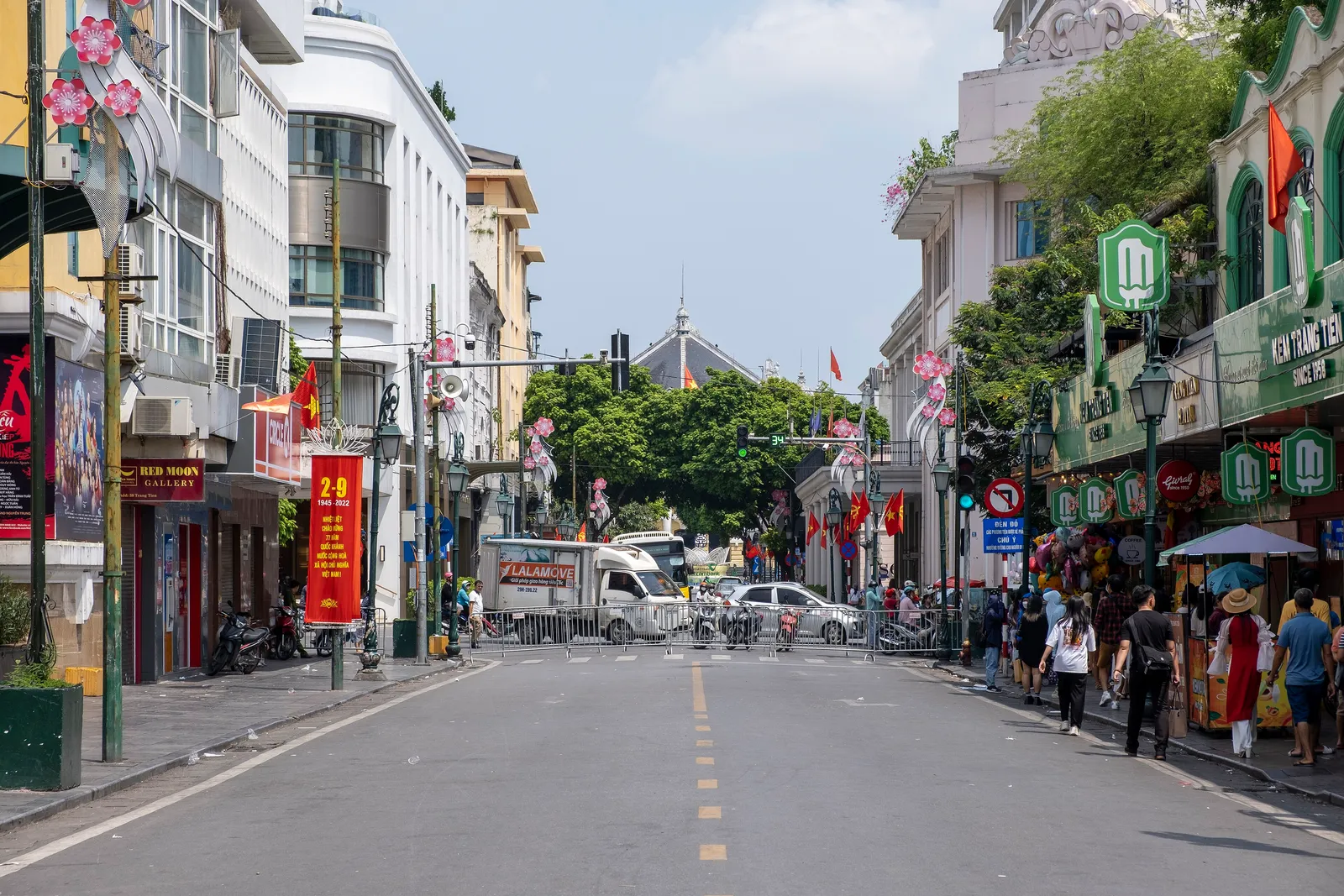
The Vietnamese Table: Pho, Bánh Mì and the Art of Balance
Vietnamese cooking is among the most elegant in the world — light, herbal, insistently fresh, built on the balance of five flavours and the art of eating in the street.
No cuisine in the world does as little with as much as the Vietnamese. A bowl of pho — bone broth simmered for hours, perfumed with star anise, cardamom and charred ginger, ladled over rice noodles and thin-sliced beef — appears simple until you have drunk it, at which point you realise that the simplicity of its appearance is an illusion built by precise, patient work. Vietnamese cooking is like that: what arrives at the table seems light, almost weightless, but what lies behind it is culinary philosophy.
The principle that organises it is the balance of five flavours — sweet, salty, sour, bitter and umami — and, more broadly, of the five elements that in Vietnamese medicine and cosmology correspond to organs, seasons and colours. It is not a principle that Vietnamese cooks necessarily articulate while they are cooking, any more than a carpenter names the laws of physics while hammering a nail; but it is present in every dish, in the fresh herb that counterbalances the meat, in the squeeze of lime that opens up the broth, in the chilli that sharpens the rest of the flavours.
Pho: broth as national identity
Pho is Vietnam's national dish in the same way that paella is Spain's: everyone knows it and defends it, and at the same time there are as many versions as there are cooks. Pho bò (beef) is the original, emerging from northern Vietnam in the early twentieth century in the Nam Định region, probably from the influence of French colonial cooks and the pot-au-feu. Pho gà (chicken) came later. North and south prepare it in noticeably different ways: Hà Nội pho is cleaner, drier, with fewer garnishes; Hồ Chí Minh City pho is sweeter, more opulent, served with a table full of bean sprouts, fresh herbs, chilli and lime.
The foundation of pho is the broth, and the broth requires time. Beef bones are blanched first to remove impurities, then simmered for between six and twelve hours with ginger and onion previously charred directly in a flame — that charring process is responsible for the deep amber colour and the smoky depth that cannot be added any other way. Star anise, cardamom, cloves, cinnamon and coriander seeds are dry-toasted and added towards the end. The result is a broth that has layers rather than a single merged flavour.
Street food: bánh mì, bún chả and breakfast on the pavement
Vietnam is one of the world's great street-food countries, and the bánh mì is its most internationally famous product: a baguette of wheat flour and rice flour — lighter and crispier than a French baguette thanks to the proportion of rice flour — filled with some combination of pâté, Vietnamese pork sausage (chả lụa), grilled meat, cucumber, fresh coriander, pickled carrot and daikon and fresh chilli. It is the most delicious legacy of the French colonial period, transformed into something entirely different and distinctly Vietnamese.
Bún chả is the quintessential Hà Nội lunch: thin rice vermicelli served at room temperature alongside a bowl of caramelised pork meatballs and belly slices grilled over charcoal, with an abundant side of fresh herbs and nước chấm dipping sauce. The world came to know it when Barack Obama and Anthony Bourdain ate together at a plastic-stool restaurant in Hà Nội in 2016, but Hanoians had been eating it at lunch in the same form for decades before that.
The herbs: the fifth wall of Vietnamese cooking
If there is one element that separates Vietnamese cooking from any other Southeast Asian cuisine, it is the use of fresh herbs not as garnish but as a structural component of the dish. A bowl of pho arrives with a side plate of Vietnamese basil (húng quế), sawtooth coriander (ngò gai), bean sprouts and fresh chilli; the diner adds whatever they choose to the bowl, recomposing the dish to their own taste. A fresh spring roll — gỏi cuốn — is wrapped in rice paper with prawns, pork, rice vermicelli, lettuce and mint leaves; the herb is not decoration but half the dish.
This architecture of fresh herbs extends to virtually the entire Vietnamese menu: bún bò Huế (the spicy noodle soup of Huế) arrives with its own garnish of cabbage, mint and lemon grass; miến gà (glass noodle soup with chicken) with fried spring onion and coriander. There are regions of the country where main dishes are eaten literally wrapped in mustard leaves or lettuce, with the leaf functioning simultaneously as cutlery and complement.
North, centre and south: three cuisines in one country
Vietnam stretches more than 1,600 kilometres from north to south, and its cooking reflects that journey with genuinely large differences. The north — centred on Hà Nội — is more austere, with fewer spices and less sweetness, greater fidelity to clear broth and natural flavour: Hà Nội pho, bún chả, chả cá (river fish with turmeric and dill). The centre — centred on Huế, the former imperial city — is the most complex and the spiciest: the imperial court recipes that developed there over the eighteenth and nineteenth centuries introduced levels of elaboration that still persist in Huế's meticulous culinary culture.
The south — Hồ Chí Minh City and the Mekong Delta — is the opposite of the north in several respects: sweeter, more exuberant, with more herbs, more tropical fruit and more Cantonese Chinese influence. The floating markets of the Mekong Delta, where boats sell goods to each other using items lashed to their masts as advertisement, are one of the most extraordinary food spectacles in the world: mangosteen, rambutan, durian, dragon fruit, pomelo and breadfruit drifting among boats of hot noodle soup and improvised diners on the water.
Vietnamese coffee: cà phê and the culture of the filter
Vietnam is one of the world's largest coffee producers — the second-largest exporter after Brazil — and has a deep coffee culture that is entirely its own. Cà phê phin is the default Vietnamese coffee: dark robusta ground coarsely, brewed in an individual metal drip filter directly over the cup, served with sweetened condensed milk at the bottom. Strong, sweet and dark, it is the coffee of slow mornings in a plastic chair on the pavement in Hà Nội or Sài Gòn.
Cà phê trứng — egg coffee — is a Hà Nội creation born in the scarcity of the 1940s: with milk unavailable, a bartender named Nguyễn Văn Giảng whipped egg yolk with sugar and coffee into a creamy foam and served it on hot black coffee. It is still made this way at Café Giảng, the shop he later founded, and it is one of those historical accidents of which food history is full. Cà phê muối, or salt coffee, is a more recent speciality of Huế that has gained national popularity: a pinch of salt transforms the bitterness of the coffee entirely.
How to eat in Vietnam: the principles of the table
The traditional Vietnamese table is not organised into individual courses served in sequence but into a series of shared dishes that arrive together: rice, stir-fried vegetables, a protein cooked some way, soup, and some kind of pickle. Each diner has their own rice bowl and chopsticks, and serves from the central dishes in small quantities so as not to combine flavours undesirably. The order is not that of a European restaurant; it is the order of balance.
Eating well in Vietnam requires little money and great willingness to sit where local people eat, which is almost always at small chairs on the pavement or at unnamed plastic-table eateries. Expensive tourist restaurants rarely surpass the street cook who has been making the same dish for thirty years. Some of the world's greatest food writers — Bourdain among them — have written that the best meal of their lives was at a nameless stall in a Vietnamese city. It is not hyperbole.
Quick answers
What is the most representative Vietnamese dish and where is it best eaten?
Pho is the most internationally known and remains the best entry point. For northern pho in its purest form, Hà Nội is the destination; the best bowls are at family-run eateries in the Old Quarter that open only in the morning. For southern pho, richer in garnishes, Hồ Chí Minh City has thousands of options. Hội An pho, in the centre, is less famous but very refined.
Is Vietnamese food very spicy?
Northern Vietnamese cooking (Hà Nội) is relatively moderate in heat; central Vietnamese cooking (Huế) is the spiciest in the country by a significant margin. Chilli is always served alongside so that each diner adds it to their own taste: fresh chilli and sriracha accompany dishes but are rarely incorporated into the cooking itself, except in the northern part of the central region. Travellers with low heat tolerance will be more comfortable in the north and south than the centre.
Is street food safe to eat in Vietnam?
Yes, with judgement. Stalls with high turnover of local customers, clean bowls and a strong local following are invariably safer than empty establishments. The boiling broth of pho and freshly cooked dishes present no concern; raw salads and fresh rolls require a stall with a local reputation. Covered markets with fixed stalls are generally safer than mobile street vendors without permanent fixtures.
What is nước chấm and what is it used for?
Nước chấm is the universal dipping sauce of the Vietnamese table: fish sauce (nước mắm) diluted with water, lime juice, sugar, garlic and chilli. It is used as a dipping sauce for spring rolls, chả giò (fried rolls), bánh xèo (crispy turmeric crêpes) and dozens of other dishes. Every cook has their own proportions; it is sweeter in the south and saltier in the north. It is the flavour that unifies Vietnamese cooking more than any single spice or ingredient.
Are there good vegetarian or vegan options in Vietnamese cooking?
Yes, and surprisingly good ones. Vietnam has a strong Buddhist tradition, and on the lunar full-moon and new-moon days many Vietnamese eat vegetarian (ăn chay). There are fully vegetarian restaurants in every large city, often near Buddhist temples. Dishes like bún chay, phở chay and tofu-and-vegetable bowls are genuine food rather than tourist concessions; Vietnamese tofu — especially the fried tofu of the Hội An area — is remarkably good.

Let the reading become a route.
When an article sparks something, our planners are the next step. Tell us what you are dreaming of.