The World's Best Dark-Sky Places
A genuinely dark night sky is now one of the rarest landscapes on Earth — and one of the most moving. Here are the places where the stars still come down to the horizon, and what makes each one exceptional.
The darkest skies left on the planet are not evenly scattered. They cluster in a handful of places that share three things: high, dry air; great distance from city light; and the kind of stable, cloud-free weather that lets the dark actually arrive. The Atacama in northern Chile is the most celebrated, but the Namib, the Kalahari fringe, the Australian outback, the Tibetan plateau and the deep Pacific all hold skies that will stop a traveller mid-sentence.
What you are looking for is simple to describe and hard to find: a sky in which the Milky Way is not a faint smudge but a structured band of light, bright enough to cast a shadow, with dust lanes you can trace by eye. Below are the places where that sky is still routine — and the seasons and conditions that bring out the best of each.
The Atacama Desert, Chile — the benchmark
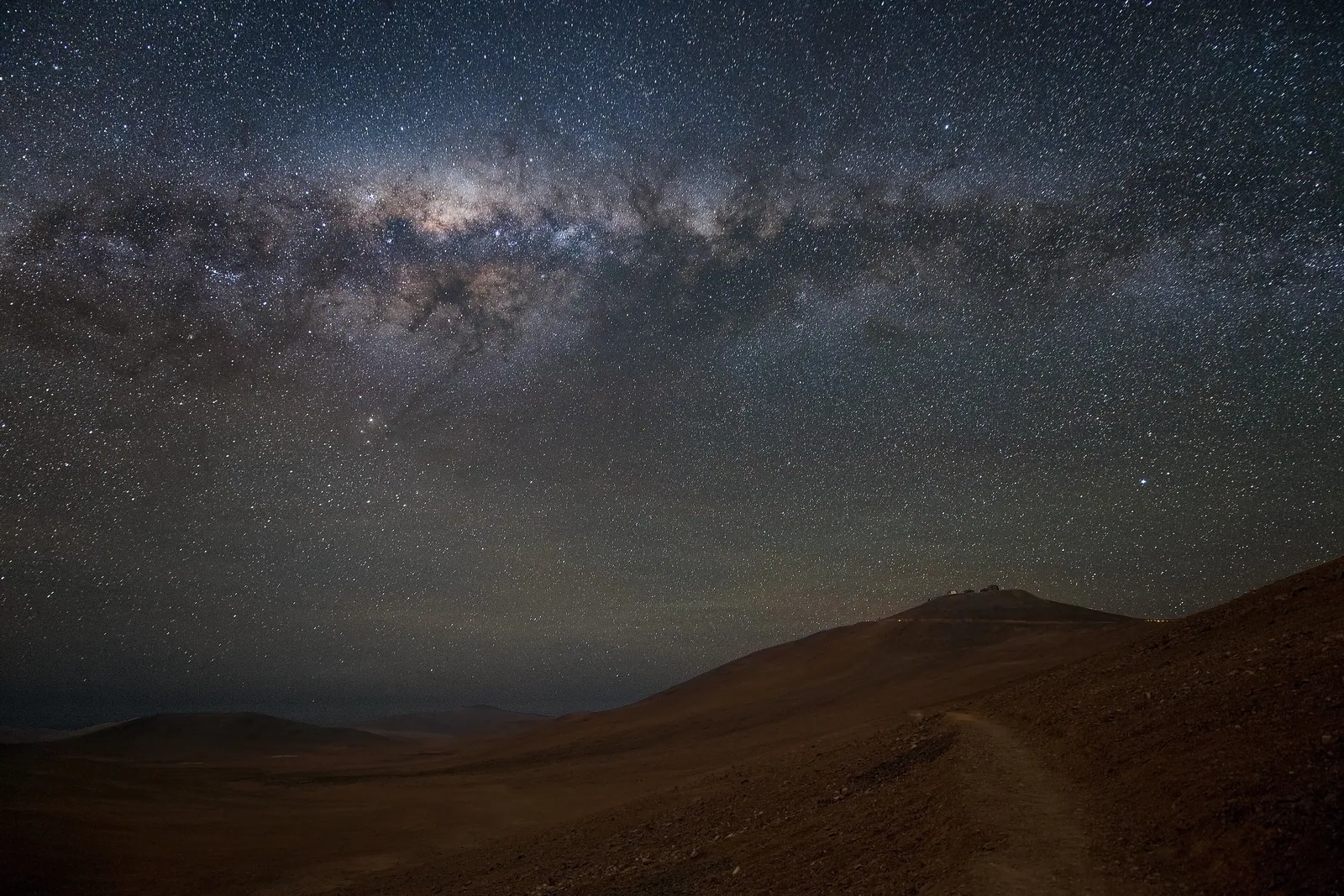
If there is a single reference point for a perfect sky, it is the Atacama. The desert combines altitude, an almost total absence of humidity, around 330 cloud-free nights a year and hundreds of kilometres of empty land between the observing sites and any significant town. The result is the cleanest, steadiest air anywhere on a populated continent.
This is not an opinion held only by travellers. The European Southern Observatory built Paranal here, and the ALMA array sits on the Chajnantor plateau above 5,000 metres, precisely because the Atacama sky is the standard against which others are measured. On Beyond the Blue, our journey to the planet's extremes, the Atacama is deliberately the first chapter — six nights to learn to look up before going anywhere else.
The Namib Desert and the NamibRand, Namibia
Southern Africa holds the darkest skies on its own continent, and the NamibRand Nature Reserve, on the eastern edge of the Namib, was one of the first places in Africa formally recognised as an International Dark Sky Reserve. The desert is high enough and dry enough to deliver Atacama-like clarity, and the nearest city glow is so distant it is effectively absent.
The southern winter, roughly May to September, brings the most reliable clear nights and the core of the Milky Way riding high after dark. The same desert gives travellers the red dunes of Sossusvlei by day — a rare landscape that is as extraordinary under the sun as it is under the stars.
The Australian outback and Aotearoa New Zealand
Australia's interior is one of the emptiest inhabited regions on Earth, and the outback sky is correspondingly dark — the more so because the Southern Hemisphere points toward the bright galactic centre. The country also has formally protected dark-sky parks, and the clarity of central Australia is genuinely world-class.
Across the Tasman, the Aoraki Mackenzie region of New Zealand's South Island is an International Dark Sky Reserve covering more than 4,000 square kilometres, with lighting controls written into local ordinance. It is one of the easiest truly dark skies in the world to reach, and a good first taste of the southern stars for travellers not yet bound for the desert.
The high plateaus — Tibet, the Andes, the altiplano
Altitude buys darkness. Every thousand metres of climb leaves more of the atmosphere — and more of its dust, water vapour and haze — beneath you. The Tibetan plateau, the Bolivian altiplano around the Salar de Uyuni, and the high Andes all sit above much of the air that dims a lowland sky.
These places ask something of the traveller in return. Nights are bitterly cold, and the same thin air that sharpens the stars also means you should arrive already acclimatised. The reward is a sky of extraordinary contrast, where faint objects the eye would lose at sea level stand out cleanly against true black.
The open ocean — the darkest place most people never think of
Hundreds of kilometres from any coast, the deep ocean at night is among the darkest accessible places on Earth. There is no settlement, no road, no glow on the horizon — only the ship, the water and the entire sky. On a moonless night far out at sea, the Milky Way meets its own reflection.
Beyond the Blue uses exactly this on its passage across the open Pacific and the Southern Ocean: between the Atacama and Antarctica, the nights at sea are themselves a dark-sky destination. It is a reminder that wild places are not only land — the planet's emptiest skies are often above its emptiest water.
What makes a sky 'dark', and how to judge one
Astronomers grade night skies on the Bortle scale, a nine-step measure running from a pristine Class 1 sky to the washed-out grey of an inner city at Class 9. A true dark-sky destination is Bortle 1 or 2: the Milky Way is detailed and bright, the zodiacal light is visible, and the sky itself is the limiting factor only because your own eyes are.
Three things spoil a sky even in a remote place: a bright Moon, high humidity and cloud. The practical lesson for a traveller is to plan around the lunar calendar — aim for the nights around new Moon — and to choose a destination's dry season. Get those right, and the difference between a good sky and an unforgettable one is enormous.
Quick answers
Which place has the darkest sky in the world?
There is no single winner, but the Atacama Desert in Chile is the most widely cited — which is why the world's great observatories are built there. Its rivals for the title include the NamibRand in Namibia, the Australian outback and the open ocean far from any coast. All can reach Bortle Class 1, the darkest grade. The best one for you depends mostly on which hemisphere's sky you want to see and what time of year you can travel.
Do I need a telescope to enjoy a dark-sky destination?
No. The single most striking thing about a Bortle 1 sky — the structured, shadow-casting Milky Way — is a naked-eye experience, and arguably the best one. Binoculars add a great deal for very little weight, opening up star clusters and the brighter nebulae. A telescope rewards specific targets but is not necessary to be moved by a genuinely dark sky.
How do I avoid a bright Moon ruining the stars?
Plan around the lunar phase. A full Moon floods even a pristine sky with light and hides all but the brightest stars; the week or so around new Moon leaves the sky truly dark. A waxing or waning crescent is a fair compromise, since the Moon is up for only part of the night. Any moon-phase calendar will tell you the dates well in advance.
Let the reading become a route.
When an article sparks something, our planners are the next step. Tell us what you are dreaming of.