Tigers of India: Ranthambore and the Last Wild Tigers
India holds more than 70 percent of the world's wild tiger population, yet a sighting still demands patience, luck, and the right guide. Inside the reserves where Project Tiger turned the tide.
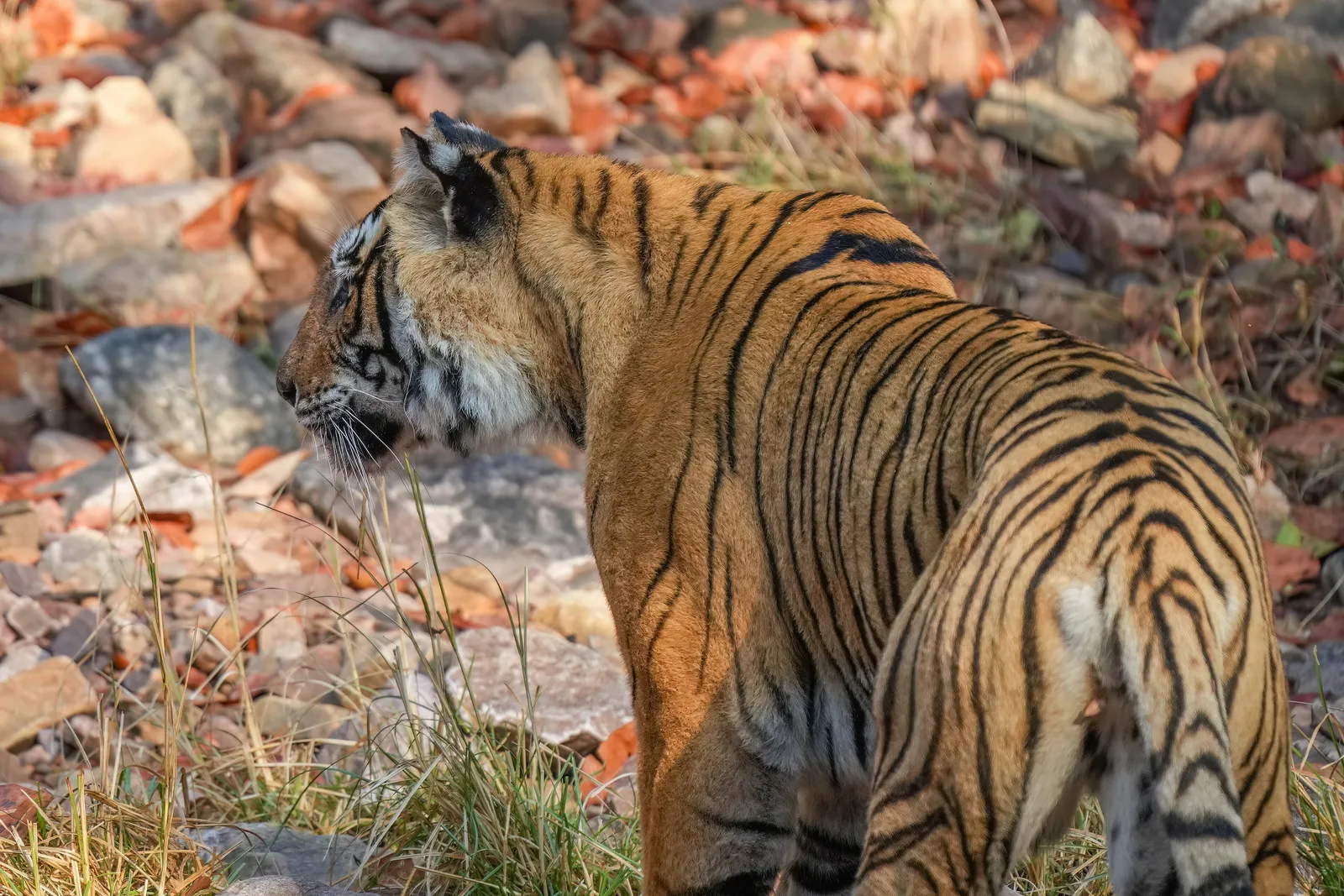
The jeep stops at the junction of two dry ravines, the driver cutting the engine without a word. In the silence — the sudden, absolute silence of an Indian jungle going still — you hear nothing at first. Then, from somewhere behind a screen of dhok trees, a sambar deer lets out a single alarm call, a hollow, carrying bark that echoes off the sandstone ridges. Everyone on board has been told this is the signal, and they lean forward as one. The tigress, when she steps out, does so with the unhurried casualness of something that owns the world she is walking through: amber and black against a strip of pale grass, massive and quiet, and utterly indifferent to the watching humans.
There are roughly 3,600 to 3,700 wild tigers left on Earth, and more than half of them live in India. That number, sobering as it is, represents one of conservation's most improbable recoveries. In 1972, a wildlife census estimated fewer than 1,800 tigers remained across the entire subcontinent. Project Tiger, launched the following year under Prime Minister Indira Gandhi, created a network of reserves with genuine buffer zones and anti-poaching enforcement that slowly, painstakingly reversed the collapse. Today, India's 53 tiger reserves constitute the single most important conservation landscape for the species, and the reserves of Rajasthan — Ranthambore above all — have made the wild tiger accessible to the world.
Ranthambore: a stage set in sandstone
Ranthambore National Park occupies some 1,300 square kilometres of scrub forest, grassland, and rocky ravine in southeastern Rajasthan, at the junction of the Aravalli and Vindhya hill ranges. The landscape is singular — open enough for visibility, dramatic enough to feel wild — and it is overlooked by a tenth-century Rajput fort whose battlements and ruined temples rise from the forested ridge as though the tigers themselves have inherited the ruins. Lakes fill in the monsoon and persist through the cold season, drawing prey species and predators alike to open water where observation is possible for hours at a time.
The resident tiger population at Ranthambore has been studied for decades, with individual animals known to researchers and guides by name and territory. This familiarity, built up over years of patient observation, means that experienced guides can predict with some confidence where particular tigers are likely to be, at which water body they tend to drink in the late afternoon, which trail they patrol at dawn. That knowledge — the accumulated ecology of a place — is the difference between a genuine wildlife experience and a drive through the jungle. Our guides at Ranthambore have spent years learning the park's rhythms, and it shows.
Bandhavgarh and Kanha: the heartland reserves
In Madhya Pradesh, India's central forested state, Bandhavgarh and Kanha national parks offer a complementary experience to Ranthambore. Bandhavgarh has one of the highest densities of tigers in any reserve in India, set within a more enclosed landscape of sal forest and tall grassland that feels primeval in a way that the Rajasthan scrub does not. The park's white tigers — once famously held at Bandhavgarh before captive breeding scattered them — gave the reserve its original fame, though the real draw today is simply the health of its wild population.
Kanha, further south, is the reserve that partly inspired Rudyard Kipling's Jungle Book: its wide meadows of golden grass, called maidans, are where barasingha deer — the swamp deer — graze in herds and where tigers hunt in the open in ways that allow prolonged, cinematic observation. Kanha's management of both predator and prey habitat has made it a model for conservation biology across Asia, and it consistently produces some of the finest sustained tiger sightings in the subcontinent.
The ecology of a tiger territory
A wild tiger holds a territory because it holds prey. The minimum area a tigress needs to sustain herself and a litter of cubs depends on the density of prey animals — chital deer, sambar, nilgai, wild boar, gaur — which in turn depends on the vegetation, water, and the absence of human disturbance. In a well-managed reserve, a tigress's territory might cover 20 to 60 square kilometres; a dominant male, whose range overlaps several females, can patrol an area several times larger. The daily life of a tiger is mostly concealment and waiting, punctuated by explosive bouts of hunting and feeding.
Tiger cubs remain with their mother for up to two and a half years, during which they learn to hunt, map their terrain, and eventually disperse to find their own ranges — sometimes moving remarkable distances across landscapes that are increasingly fragmented by agriculture and roads. This dispersal is where wild tiger conservation faces its sharpest challenge: the reserves are viable, but the corridors between them are not. Every young tiger that makes it from one reserve to another without being killed is, from a genetic standpoint, a victory.
How to maximise a tiger sighting
The open safari zones of Indian tiger reserves operate on a timed-entry system, with morning and afternoon drives available through a booking system that is competitive during peak season, particularly at Ranthambore. Arriving at the park gate in the pre-dawn dark and entering the moment the gate opens is not drama for its own sake — it is sound strategy, since tigers are most active in the hours around dawn before the heat forces them into shade. The afternoon drive, when the light softens after four o'clock, is the second-best window.
Go with the best guide you can find rather than the cheapest vehicle. A naturalist who knows the park deeply will read the jungle around you — the alarm calls of langur monkeys, the flight of a peafowl, the fresh pugmark in a dusty track — in ways that transform the landscape from backdrop to text. Patience is more important than luck: the tourists who drive steadily for five hours without pausing at points of interest miss far more than those who stop, listen, and wait. Every experienced wildlife photographer will tell you the same thing: the forest tells you where the tiger is, if you know how to listen.
Beyond the tiger: the full ecology of an Indian reserve
A tiger reserve is a whole ecosystem, and the tiger's prominence can obscure a depth of wildlife that would be remarkable anywhere else. Ranthambore's lakes hold mugger crocodiles lounging on the banks with the authority of objects rather than animals. Leopards share the landscape with tigers and are, in their own way, harder to find and stranger to watch. Sloth bears, shaggy and apparently affronted by everything, lumber out of the scrub in the late afternoon. Jackals pick over kills. Painted storks and grey herons populate the lake margins while the kingfisher's blue flash interrupts the reeds.
India's reserves also sustain a remarkable cast of raptors: crested serpent eagles, changeable hawk-eagles, and the occasional short-toed eagle quartering the grassland edges. Driving back to camp after an unsuccessful tiger search can still yield an hour of extraordinary birding if you carry a decent pair of binoculars and the willingness to look. The absence of a tiger sighting is not a failed safari — it is a reminder that the world's most charismatic predator lives inside a food web of almost improbable richness.
Planning a tiger journey: seasons and logistics
Indian tiger reserves are open broadly from October to June, with the precise dates varying by park. The high season for wildlife sightings is typically March to May, when the heat concentrates animals around water and the vegetation has thinned, improving visibility. This is also the hottest and most crowded period; the cool months of November through February offer more comfortable travel but denser cover. The monsoon, from roughly July to September, closes most reserves entirely and renews the landscape for the season ahead.
Ranthambore is accessible by rail from Delhi and Jaipur, with overnight trains making a comfortable connection. Bandhavgarh and Kanha are best reached via Jabalpur or by internal flights to Nagpur. Accommodation ranges from government-run lodges at the park boundaries to a number of well-regarded wildlife camps that combine proximity to the park gate with genuine hospitality. Book your safari zones well in advance — particularly Zone 3 and Zone 4 at Ranthambore, which have consistently been the most productive — and carry a zoom lens, a great deal of patience, and the understanding that the wait is itself half the experience.
Quick answers
What is the best tiger reserve in India for a first-time visitor?
Ranthambore in Rajasthan is the most accessible and the most consistently productive for first-time visitors. Its relatively open terrain, well-known individual tigers, and proximity to Delhi and Jaipur make it the natural starting point. Bandhavgarh in Madhya Pradesh has a higher tiger density and a wilder feel, but requires a longer journey. For travellers with time for only one reserve, Ranthambore is the recommendation.
What are the chances of actually seeing a tiger?
At a well-managed reserve like Ranthambore or Bandhavgarh during peak season (March to May), a multi-day visit with an experienced guide gives a reasonable probability of a sighting — though nothing is guaranteed. Over three or four morning and afternoon drives, most visitors see at least one tiger. Going at the right time of day, with a knowledgeable naturalist, in an open-terrain zone, is the formula that tilts the odds.
Is tiger photography possible from safari vehicles?
Yes — open-top jeeps or gypsies are used in all major reserves, and with a 300–500mm telephoto lens, very usable images are possible even from a moving vehicle. The quality of light in the early morning and late afternoon is excellent, and because tigers at well-visited reserves are habituated to vehicles, close approaches are sometimes possible. A monopod or beanbag is useful for stabilising long lenses on a moving vehicle.
Is it ethical to visit tiger reserves, and does the money go to conservation?
When managed well, wildlife tourism is one of the most powerful tools for tiger conservation: it creates economic incentives for maintaining forests, provides employment for local communities, and funds anti-poaching operations. Choosing certified naturalist-led safaris and staying at lodges with a genuine conservation commitment ensures that your visit is a positive contribution. India's Project Tiger has shown that where funding and political will are sustained, tigers recover.
Can children visit tiger reserves?
Yes, with some restrictions. Most reserves require occupants of safari vehicles to be at least five or six years old, and the drives — typically three to four hours in the early morning — require a degree of patience. Children who are curious about wildlife often have a transformative experience; the key is managing expectations about sighting certainty and preparing them to enjoy the full ecology of the reserve, not just the tiger.

Let the reading become a route.
When an article sparks something, our planners are the next step. Tell us what you are dreaming of.