Travelling Without a Phone: The Radical Act of Being Unreachable
The smartphone has become so embedded in how we travel that imagining a journey without one can feel almost impossible. It is not. And what returns when you set it aside — even for a week, even in part — is worth understanding.
Consider what a smartphone actually does to the experience of being somewhere new. It provides navigation, so you never have to ask anyone where you are. It provides translation, so you never have to gesture or stumble or laugh at yourself across a language barrier. It provides a camera, so every notable thing you see is immediately converted into content to be shared. It provides the entire social and professional world you left behind, available at a touch, insistently present. It provides, at any moment of idleness or uncertainty, a retreat — somewhere to look that is not the street, the market, the face of the person sitting across from you. All of this is useful. Some of it is wonderful. And all of it is working, consistently and quietly, against the particular quality of attention that travel is supposed to produce.
The question is not whether to leave the phone at home entirely — for most travellers, that is neither necessary nor especially desirable. The question is whether we are using the device or whether the device is using us, and whether we have ever made a deliberate, examined choice about how much of our travel attention we are willing to surrender to it. Several writers and long-distance travellers have made the experiment: setting the phone to flight mode for days at a time, leaving it in the bag, travelling for a week with no data connection. The reports are remarkably consistent. Something returns. Something that had been quietly crowded out by the constant availability of distraction and information.
What the phone actually displaces
Before the smartphone, getting lost was a normal part of travel. You consulted a map, made a best guess, asked someone, got a contradictory answer, asked someone else, developed a feel for the neighbourhood through the process. The getting-lost was how you learned the grain of a place — which streets were commercial, which were residential, where the energy of the neighbourhood concentrated. Navigation by phone eliminates this. The route is optimal, direct, and produces almost no incidental encounters with the texture of the place.
The phone also changes the relationship with uncertainty and waiting. In a bus station, waiting for a bus that is late, the pre-phone traveller had nothing to do but watch. This could be tedious. It was also an education. You noticed the hierarchy of the snack vendors, the particular authority of the woman at the information window, the way the families waiting arranged themselves differently from the solo travellers. You heard things. You made eye contact. You were, simply, present in that place. With a phone in hand, the waiting is filled. The learning is not.
Memory, photographs, and the question of experience
Photography has always changed the experience of travel; this is not a new complaint. But the smartphone camera has made the change qualitative rather than quantitative. When photographs required film, the scarcity of frames demanded selection: you waited for the right light, the right moment, the arrangement that justified using one of your thirty-six exposures. The selection was itself an act of attention. Now there is no selection — there is documentation, continuous and comprehensive, of everything that might be noteworthy. The camera is always available, which means every experience is always available to be converted into evidence that the experience occurred.
There is good research suggesting that photographing an experience reduces the memory of it: the brain, knowing the camera is doing the work of preservation, relaxes the deeper encoding that produces vivid long-term memory. The photograph is retained; the experience is less so. This is not an argument against photography — it is an argument for photographing deliberately, with selection and intention, and for also choosing, sometimes, to simply watch without reaching for the lens. The market scene, the mountain summit, the meal with someone you have just met: some of these are worth keeping with the camera, and some are worth keeping only with the mind.
The always-available elsewhere and what it costs
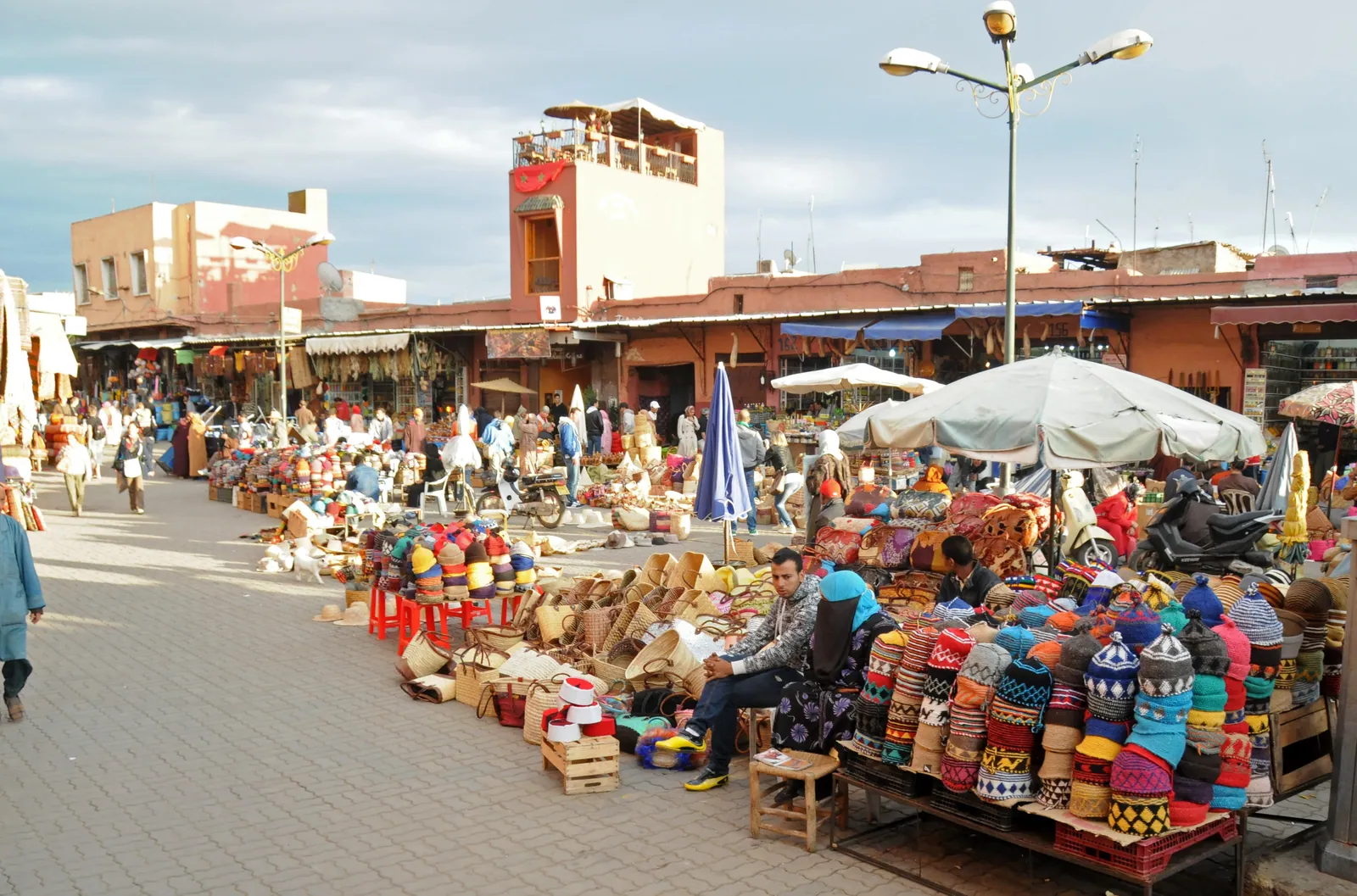
The most insidious thing the smartphone does to the slow traveller is not navigation or photography but the maintenance of the world left behind. A notification from work arrives in a souk in Marrakech. A message from home finds you on a mountain path in the Caucasus. The social media feed generates its continuous low-grade anxiety regardless of where the traveller is standing. The elsewhere is always available, and its availability means that the here — the specific, unrepeatable here that one has spent money and time and intention to reach — is always competing with it.
This is not a problem unique to travel, but travel is where it becomes most visible and most costly, because the whole point of being in Marrakech rather than your office is that Marrakech offers something that your office does not. If the phone is collapsing that distinction — if the traveller is half in the souk and half in their email inbox — the journey is diminished by the precise amount of attention surrendered to the screen. Some travellers have begun to make deliberate practices around this: checking messages only once a day, at a fixed time; leaving the phone in the room for a full day each week; using a separate camera so the phone never needs to come out.
The practical argument: what you can actually manage without
Much of what travellers believe they cannot do without a smartphone is actually manageable by other means. Paper maps — a regional map for orientation, a city map for detailed navigation — are still produced for almost every destination and are superior to phone screens in bright sunlight, in rain, and for understanding where you are in relation to the larger landscape. A dedicated camera, even a simple compact, produces better photographs than a phone and does not require you to carry your inbox into the medina. A phrasebook, used with goodwill and a tolerance for mutual laughter, opens more doors than any translation app. A notebook does what no phone app for journalling actually does: it slows the thought, forces a sentence, produces a record that is yours and not dependent on any platform.
The practical floor — the genuinely phone-dependent things — is lower than most travellers believe. Emergency contact, a backup copy of documents, the ability to make a booking when no alternative exists: these are legitimate uses that do not require the phone to be in your hand for most of the day. The practical argument for going largely phone-free on a trip is not that you will never need it but that you will need it far less than habit suggests.
Experiments in disconnection: what other travellers have found
A number of writers and thinkers who have experimented with phone-free or significantly reduced-phone travel have described what they found with a similar vocabulary: a return of something. Quietness, but also sharpness. The world becomes more present, more textured, more surprising. You notice the architecture you would otherwise have walked past while reading a map. You talk to people you would otherwise have not needed to talk to. You have an experience you would have missed because you were composing the caption for the previous one.
The writer Paul Theroux, who has been producing long-form travel narratives for over fifty years, has written about the smartphone as the enemy of travel writing not because it replaces the notebook but because it fills the silence that travel writing requires. The observation that becomes a paragraph begins in a moment of idleness — waiting for something, sitting in a café, staring out of a train window — and these moments are precisely the ones that the smartphone is designed to eliminate. The slow traveller's great gift to themselves is the willingness to be bored, to be uncertain, to be without entertainment; it is in exactly those moments that the journey begins to produce what it is capable of producing.
A practical protocol: how to travel with less screen
Complete digital abstinence is neither necessary nor especially useful — it tends to produce anxiety that is itself a distraction. A more practical approach is a set of deliberate rules, chosen before departure, that shift the phone from default mode to tool mode. Some examples that travellers have found effective: no phone before breakfast; camera apps only on the street, no social or messaging; one check-in with home per day, at a fixed time, for a fixed duration; phone in the bag on arrival in any new place, for the first hour of exploration.
The goal is not deprivation but presence. The slow traveller already understands, in principle, that the quality of attention brought to a place determines the quality of the experience. The phone question is simply a specific application of that general understanding — an invitation to choose, deliberately and repeatedly, to be where you are. The Camino pilgrim who puts the phone away for the walking day; the safari guest who watches the elephant with their eyes rather than through a screen; the market wanderer who buys the fruit from the vendor whose name they have actually learned — they are all doing the same thing. Travelling with both feet in the same place at the same time.
Quick answers
Is it actually safe to travel without a phone?
Yes, for the vast majority of travel situations. People travelled safely and richly for the entirety of human history without smartphones. The practical requirements — having emergency contact information written down, carrying a copy of key documents, knowing the address of your accommodation — are all manageable without a phone in hand at all times. In genuinely remote wilderness travel, a dedicated satellite communicator (which is not a smartphone) is the appropriate safety tool. In cities and on established routes, the risk profile of phone-free travel is negligible.
How do I navigate without Google Maps?
Buy a paper map — a regional one for orientation and a city map for detail — before you leave or on arrival. Study it before leaving your accommodation each morning so you have a mental model of where you are going. Ask people: the act of asking is itself a social interaction that often produces far more than directions. For complex multi-city trips, download offline maps before departure as a backup rather than a default. Many experienced travellers use their phones for navigation only when genuinely lost, which is rarely.
What about keeping in touch with family back home?
Agreeing a fixed check-in schedule before departure — a call or message at the same time each day, or every other day — addresses the legitimate need to stay connected without the phone becoming a constant presence. This is how travellers managed before smartphones and it worked well. Family and colleagues quickly adjust to knowing that contact will come at the agreed time, which actually tends to reduce rather than increase the anxiety of those at home.
What should I use instead of my phone camera?
A dedicated compact camera is the simplest alternative and produces noticeably better image quality than any current smartphone, particularly in low light. The psychological difference is also significant: a separate camera is a tool you pick up deliberately, not a device that is already in your hand. Many travellers who switch to a dedicated camera report that they take fewer photographs of higher quality and are more fully present in the scenes they choose not to photograph.

Let the reading become a route.
When an article sparks something, our planners are the next step. Tell us what you are dreaming of.