Trekking Without a Heavy Pack: How Supported Walking Works
You can walk for days through remote mountains carrying nothing but water, layers and a camera. Supported trekking moves your gear for you — and on thin air, a light pack is what keeps the walking joyful.
Many travellers picture multi-day trekking as it appears on a heavy backpack: tent, sleeping bag, stove, food and several days of clothing, all carried on your own shoulders. That is one way to walk, but it is not the way most great trekking journeys are done, and it is not how we do them. On a supported trek you carry only a daypack while a team moves everything else.
The short version: porters, pack animals or vehicles carry your main bag, the camp and the food, so you walk with five to eight kilograms instead of fifteen or twenty. This is not merely comfort. At altitude and over consecutive days, a light pack is what keeps a trek within reach — and what lets you lift your eyes from the trail.
Who carries what
On a supported trek the load is split. You carry a daypack — water, warm layers, a waterproof shell, sun protection, snacks, camera and anything you need within reach during the day. Everything else travels separately: your main duffel, the tents or the booking at the next lodge, the kitchen and the food.
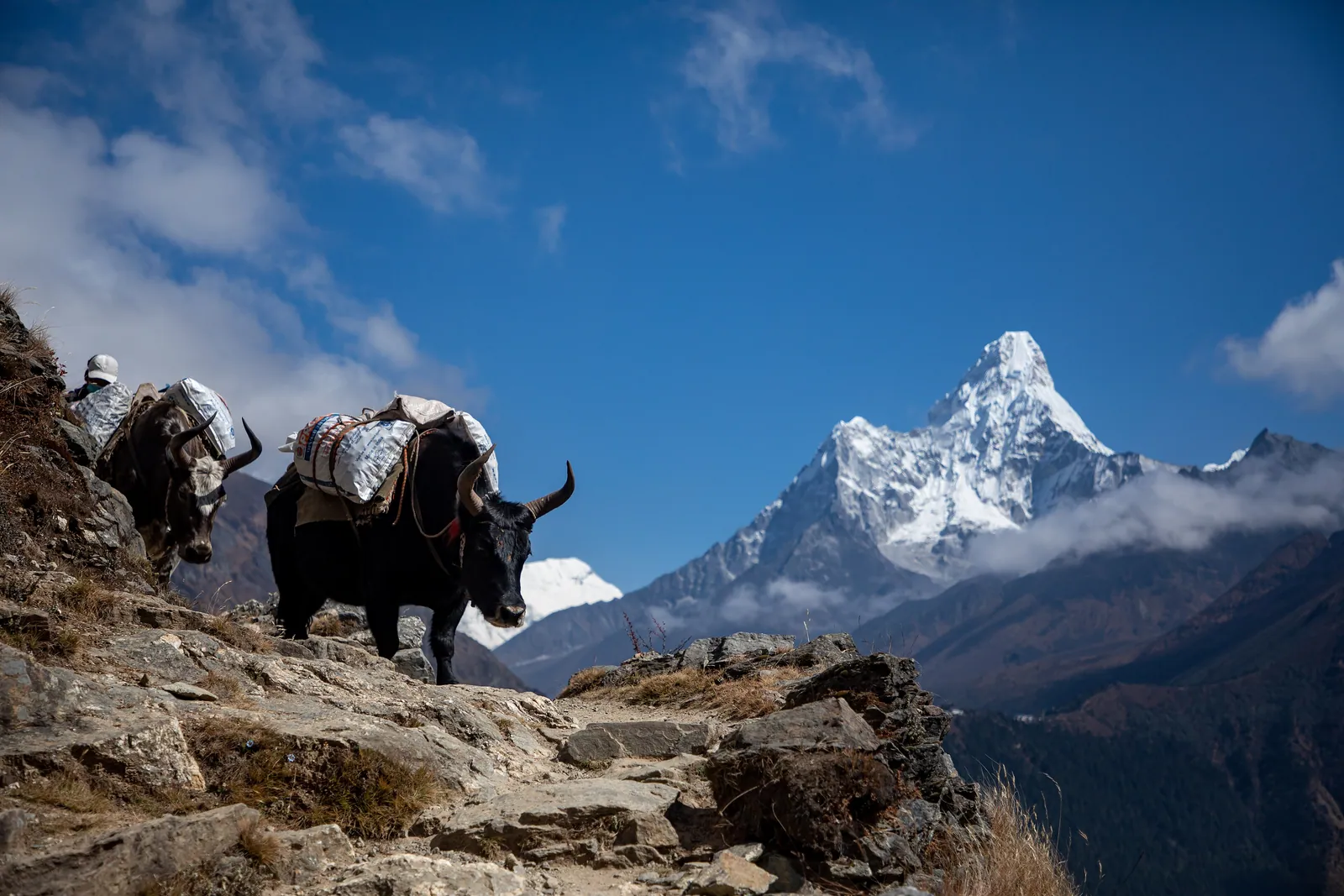
How it travels depends on the region. In the Himalayan teahouse regions, porters carry duffels between lodges and the lodges provide beds and meals. On the Inca alternatives and the Simien traverse, a team of porters or pack animals — mules, and in the high Andes sometimes horses — moves a full camp ahead of the walkers. On the W in Torres del Paine, meals come from the refugios and heavier luggage is handled separately. In every case the walker carries only the day.
Why a light pack matters so much
Carrying weight uphill is hard, and it gets disproportionately harder as the air thins. A fifteen-kilogram pack that is merely tiring at sea level becomes genuinely punishing at 4,000 metres, where every step already costs more oxygen. Stripping the load to a daypack does not just make the walk pleasanter — for many travellers it is the difference between a trek they can complete and one they cannot.
There is a quieter benefit too. A heavy pack pins your attention to the trail and to your own discomfort. A light one frees you to look up — to watch a condor work a thermal, to notice the light change on a face of granite, to talk with the people you are walking with. The landscape is the reason you came; a light pack is what lets you actually receive it.
Packing for a supported trek
Supported trekking changes how you pack. Your main bag should be a soft duffel rather than a wheeled case, because it will be carried, lashed to an animal, or loaded into a small vehicle. There is almost always a weight limit on that bag — commonly in the region of ten to fifteen kilograms — set so the load is fair and safe for the person or animal carrying it.
The skill is dividing your gear correctly. The daypack must hold everything you might need between camps: the day will change from sun to sleet and back, so layers and a shell stay with you, not in the duffel walking ahead. We give every traveller a clear daypack checklist before departure, because the comfort of a trekking day depends heavily on what you kept within reach.
The ethics of being carried for
Supported trekking depends on porters, and good practice matters. Reputable operators cap porter loads, provide proper clothing, footwear and shelter for the crews working at altitude, ensure fair pay, and arrange care if a porter falls ill. The weight limit on your duffel is part of this: it is not bureaucracy but a protection for the people doing the carrying.
We regard the trekking crews as central to the journey, not as background logistics. We work with local porters and guides from the valleys themselves, keep loads within humane limits, and ask travellers to respect the duffel weight allowance precisely so the system stays fair. A trek is only genuinely good if it is good for everyone walking it.
How this shapes a grand journey
Light-pack trekking is what makes serious walking compatible with a long, slow journey. Because the walking days do not demand that you haul a full expedition load, they sit comfortably alongside the cities, the wildlife and the rest days of a grand route rather than dominating the trip with their logistics.
On The Long Way East the Himalayan lodge-to-lodge days are walked with a daypack; on Andes to Antarctica the W and the Inca approaches to Machu Picchu are run the same way. You arrive at each trailhead rested, walk light, and finish each day with energy left for the place you have reached. That is the whole intention: trekking as a pleasure, not an ordeal.
Quick answers
How heavy is the pack I actually carry on a supported trek?
Usually five to eight kilograms — water, layers, a waterproof shell, sun protection, snacks and a camera. Your main bag, the camp and the food are carried separately by porters, pack animals or vehicles. The point of supported trekking is that you never carry the full expedition load, which at altitude is what keeps consecutive walking days enjoyable rather than punishing.
Is there a weight limit on my main bag?
Yes, almost always — commonly somewhere around ten to fifteen kilograms, depending on the route and how the bag is carried. The limit exists to keep loads fair and safe for the porters or pack animals moving your gear. We tell you the exact allowance before departure and recommend a soft duffel, since a wheeled case is awkward to carry or lash to an animal.
Do I still need to be fit if my pack is light?
Yes. A light pack removes one major difficulty but not the others — the consecutive days, the ascent and, on many treks, the altitude all still ask for steady aerobic fitness built over the months beforehand. What a light pack does is bring the trek within reach of a fit, ordinary traveller rather than only an experienced backpacker.
Let the reading become a route.
When an article sparks something, our planners are the next step. Tell us what you are dreaming of.