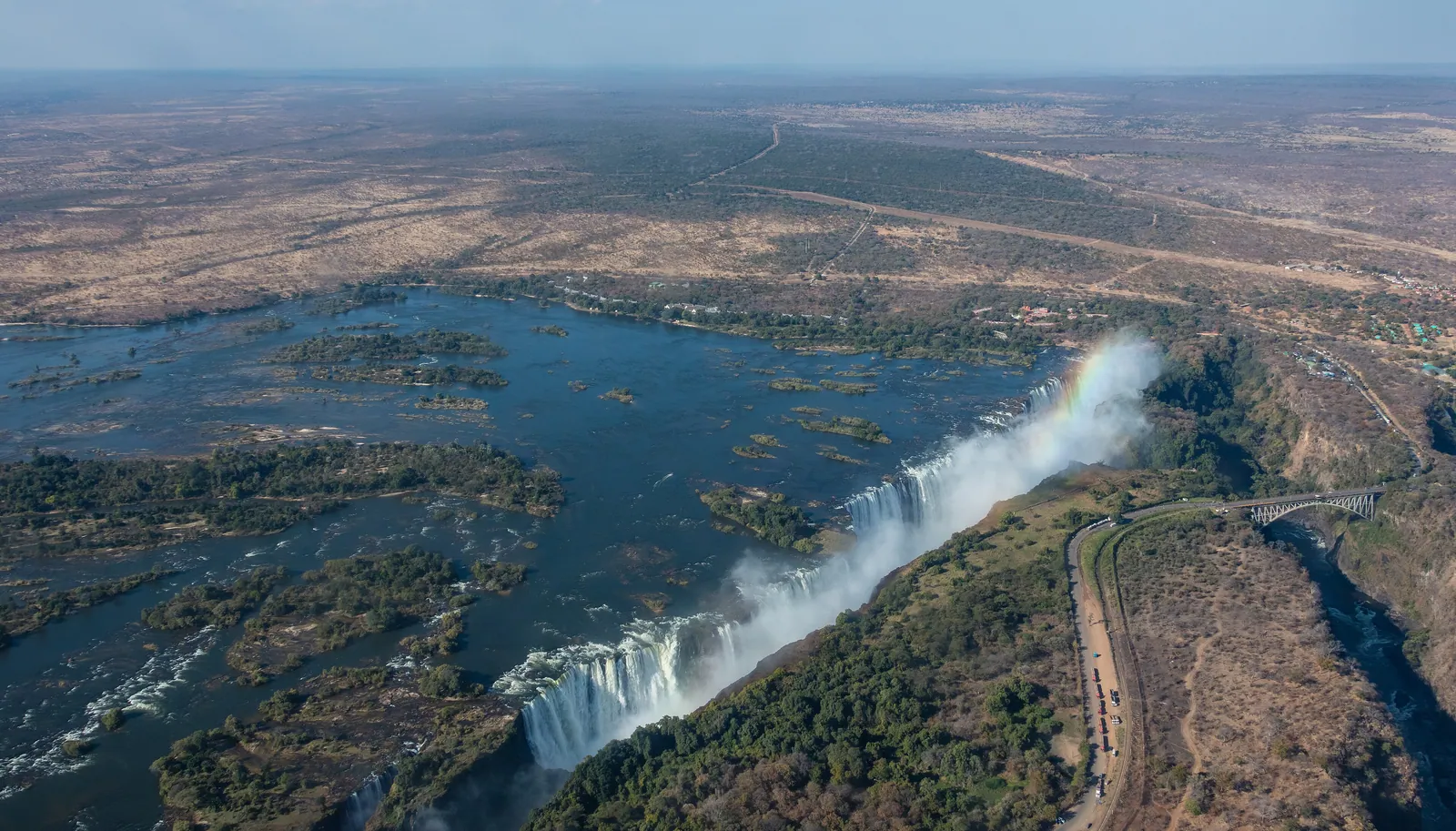
Victoria Falls and the Zambezi: The Smoke That Thunders
Victoria Falls is not the tallest or widest waterfall on Earth, but by the measure that counts — a single uninterrupted sheet of falling water — it is the largest. Here is how it works, season by season.
Victoria Falls is where the Zambezi River, more than 1,700 metres wide, pours over a sheer basalt edge into a narrow chasm. It is often called the largest waterfall in the world, and the claim holds if you define largest as the greatest single curtain of falling water: the combination of width and height produces a sheet bigger than any other. Its local name, Mosi-oa-Tunya, the smoke that thunders, describes the spray and the roar exactly.
The most important thing a traveller can know is that the falls change dramatically with the season. From roughly February to May the Zambezi is in full flood and the falls are at their most powerful — but the spray can be so dense it veils the view. From about August to January the river drops, the curtain thins and parts of the rock face emerge, but visibility is clear and the eastern cataract may slow to a trickle. There is no single best time, only a choice of two very different spectacles.
How the falls were carved
Victoria Falls sits on the border of Zambia and Zimbabwe, and its setting is unusual. The Zambezi flows across a flat plateau of basalt rock that is crossed by a grid of cracks. Over the past hundreds of thousands of years the river has found and eroded these cracks one after another, and each time it cut back along a crack it created a new waterfall and a new gorge.
The result is a zigzag series of deep gorges downstream of the present falls — each one a former position of the waterfall, abandoned as the river carved back to the next crack. The chasm the Zambezi pours into today is simply the most recent in that sequence. The falls are, in effect, a waterfall slowly walking upstream across geological time.
High water and low water
In the high-water months, broadly February through May, the falls are overwhelming. The full width of the Zambezi goes over the edge, the thunder is constant, and spray rises hundreds of metres into the air, drenching the rainforest path and visitors alike. The power is unforgettable — but on peak days the spray can obscure the falls almost entirely, and views are best from a distance or the air.
From around August the river falls. By October and November the eastern sections may run dry, exposing dark basalt, and the curtain narrows to its central channels. What is lost in raw power is gained in clarity: you can see the structure of the falls, the gorge below, and the colours of the rock. Many travellers find this the more photogenic season; others come precisely for the flood.
Two countries, two perspectives
The falls can be viewed from both Zimbabwe and Zambia, and the experiences differ. The Zimbabwean side faces the main curtain and offers the broadest panoramic views along a series of viewpoints through rainforest kept perpetually wet by the spray. The Zambian side brings you closer to the lip of the falls and, in low water, allows access to the Knife Edge Bridge and other vantage points right at the edge.
The bridge between the two countries spans the gorge just below the falls and is itself a landmark, completed in 1905. A waterproof layer and a dry bag for cameras are sensible whichever side you walk; in high water the rainforest path is, quite literally, a downpour.
Beyond the viewpoints
The Zambezi above the falls is wide, calm and lined with wildlife — a sunset cruise here often passes elephant, hippo and a long roll-call of birds, with the river gold in the late light. Below the falls the same river becomes one of the world's great whitewater runs, churning through the gorges the waterfall once occupied.
In low water, when a rock barrier on the lip emerges, some visitors swim in the natural pools at the very brink — an experience that should only be attempted with established local operators and clear conditions. The point is that Victoria Falls is not a single sight but a whole stretch of river, calm above and violent below, with the falls as the hinge between the two.
The falls within a longer journey
Victoria Falls makes a natural high point of any crossing of southern Africa, and it pairs well with the quieter landscapes around it — the Namib's deserts to the west, the game country of the Zambezi valley, the road south to the Cape. It is a place to spend two or three nights, not a half-day stop.
On The Great Rift journey the falls arrive as a deliberate crescendo, set against the slower chapters of desert and coast. Travellers who give it time — a morning at the viewpoints, an afternoon on the river — leave with a sense of the Zambezi as a living system, not just a famous cascade.
Quick answers
Is Victoria Falls the biggest waterfall in the world?
It depends on the measure. Victoria Falls is neither the tallest nor the widest waterfall, but it is considered the largest single sheet of falling water, because its combination of width — over 1,700 metres — and height produces a curtain greater than any other. That is the basis for the claim.
When is the best time to visit Victoria Falls?
There are two distinct seasons. High water, roughly February to May, brings maximum power and spray but can obscure the view. Low water, around August to January, thins the curtain and may dry parts of the rock face, but offers clear visibility and easier photography. Choose according to which spectacle you prefer.
Should you visit the Zimbabwe side or the Zambia side?
Both, if you can. Zimbabwe offers the widest panoramic views of the main curtain; Zambia brings you closer to the edge and, in low water, opens up vantage points right at the lip. Many travellers cross the border bridge to see the falls from both perspectives.
Let the reading become a route.
When an article sparks something, our planners are the next step. Tell us what you are dreaming of.