Wet Season or Dry Season: Choosing Your Salar de Uyuni
The same salt flat offers two completely different journeys depending on when you arrive — a flooded mirror or a cracked white desert. A clear-eyed comparison to help you choose the one you actually want.
There is no single best time to visit the Salar de Uyuni; there are two, and they produce two unrelated landscapes. The wet season, roughly December to March, brings the celebrated mirror — a shallow flood that doubles the sky — but also restricted vehicle access and a real chance of overcast days. The dry season, roughly May to November, gives a firm white crust patterned with polygons, full freedom to drive across the flat, and dependable blue skies, but no reflection at all.
Choosing well means deciding what you came for. If the mirror is the point, accept the wet season’s trade-offs. If you want to reach Incahuasi island, photograph the polygon crust, and rely on clear weather, the dry season is the surer bet. April and November are shoulder months that can deliver either face of the salar — or, occasionally, both.
The wet season: the mirror, with conditions
From around December to March, rain on the altiplano spreads a thin, even film of water over the salt. Because the surface of the salar varies by less than a metre across roughly 10,500 square kilometres, that water does not pool — it forms the seamless reflective sheet the salar is famous for, most reliably from late January to early March.
The cost is access and certainty. Standing water keeps vehicles off large parts of the flat, so Incahuasi island and the deeper interior are often unreachable. Skies are more variable, with genuine cloud and rain, and a sunny mirror day cannot be guaranteed. The wet season rewards travellers who prize one extraordinary effect over a predictable schedule.
The dry season: the white desert, wide open
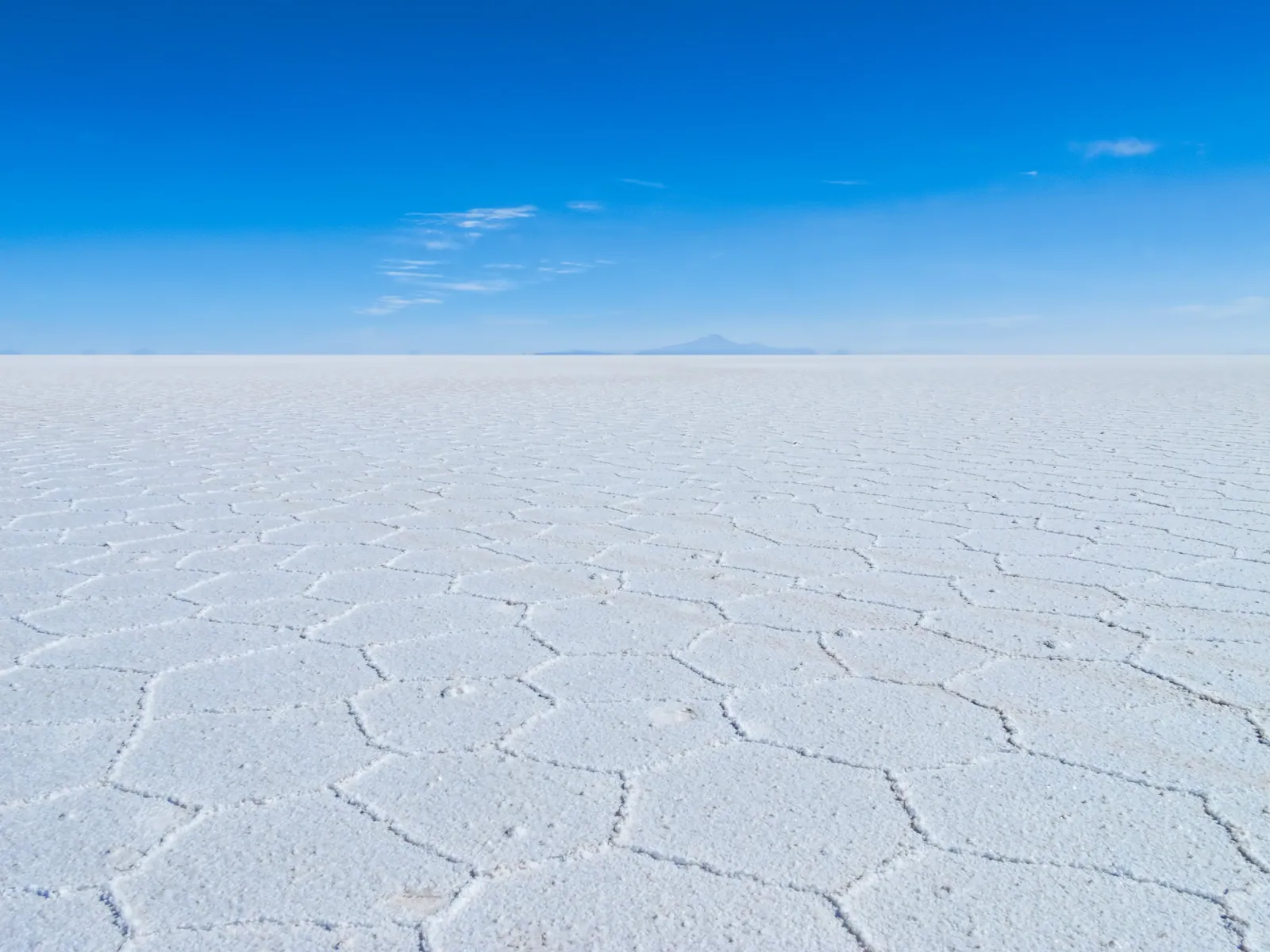
From roughly May to November the water is gone and the salar becomes a hard, blinding-white plain fractured into a honeycomb of polygons — the crust’s natural pattern as the salt dries and contracts. Vehicles range freely across the entire flat, which makes the dry season the time to visit Incahuasi, with its forest of giant Echinopsis cacti rising from a fossil-coral island.
Skies are typically clear and the famous forced-perspective photographs are easiest on the firm, featureless ground. The trade is the cold: altiplano nights in June and July routinely drop well below freezing. There is no mirror — but there is reliability, space and crispness.
Shoulder months and the calendar at a glance
April and November sit between the two regimes and can surprise you. In April the flood may be receding but still present in patches; in November the first rains may have arrived early. Either month can offer a partial mirror alongside drier ground — appealing if you want a taste of both, less so if you need certainty.
As a rough guide: December to March means the mirror with weather risk; late January to early March is the strongest mirror window; May to November means the dry crust, clear skies and full access; June to August are the coldest nights. There is no wrong answer, only the journey that matches your priorities.
Practical packing for either face of the salar
The salar sits at about 3,656 metres, so the sun is intense year-round and reflects fiercely off both salt and water: high-factor sunscreen, proper sunglasses and a brimmed hat matter in every season. Layers are essential because the temperature swing between midday and night is large, and larger still in the dry season.
Wet-season travellers should bring waterproof footwear and a dry bag, as the brine is corrosive to cameras and leather. Dry-season travellers should pack seriously for the cold — a warm hat, gloves and a proper insulated layer for pre-dawn starts and freezing nights.
How we time the salar within a longer journey
On Andes to Antarctica, the Salar de Uyuni is one chapter in a wider crossing of the high country, and its placement is deliberate. Travellers reach the salar already acclimatised from earlier altiplano days, so they can enjoy it rather than endure it.
Because the mirror is governed by weather rather than the calendar, our guides watch conditions across the flat and adapt the day’s route — driving to flooded sectors when the reflection is strong, or out to Incahuasi when the crust is dry. The season you travel sets the stage; local knowledge finds the best of it.
Quick answers
Which is better, the wet or dry season at Uyuni?
Neither is objectively better — they are different experiences. The wet season (about December to March) brings the mirror reflection but with restricted access and variable skies. The dry season (about May to November) offers the polygon-patterned crust, full vehicle access including Incahuasi island, and reliably clear weather, but no reflection.
Can I see the cactus island in the wet season?
Often not. Standing water in the wet season keeps vehicles off large parts of the salar, and Incahuasi sits well into the interior. If reaching the cactus island matters to you, the dry season — roughly May to November — is the dependable choice, when the whole flat is firm and crossable.
How cold does the salar get?
Very cold at night, especially in the dry season. At about 3,656 metres, altiplano nights in June and July regularly fall well below freezing, while daytime sun can feel strong. Pack warm layers, a hat and gloves for any season, and especially for dry-season visits.
Let the reading become a route.
When an article sparks something, our planners are the next step. Tell us what you are dreaming of.