What the Silk Road Actually Was
It was never a single road, and silk was only part of the cargo. Here is what the Silk Road truly was — a two-thousand-year web of overland routes that carried goods, faiths, diseases and ideas between China and the Mediterranean.
The Silk Road was not a road. It was a shifting network of caravan tracks, mountain passes and desert crossings that linked China to Central Asia, Persia, India and the Mediterranean for the better part of two thousand years. No single traveller walked its full length; goods moved in relays, passing through dozens of hands and dozens of cities before reaching the far end.
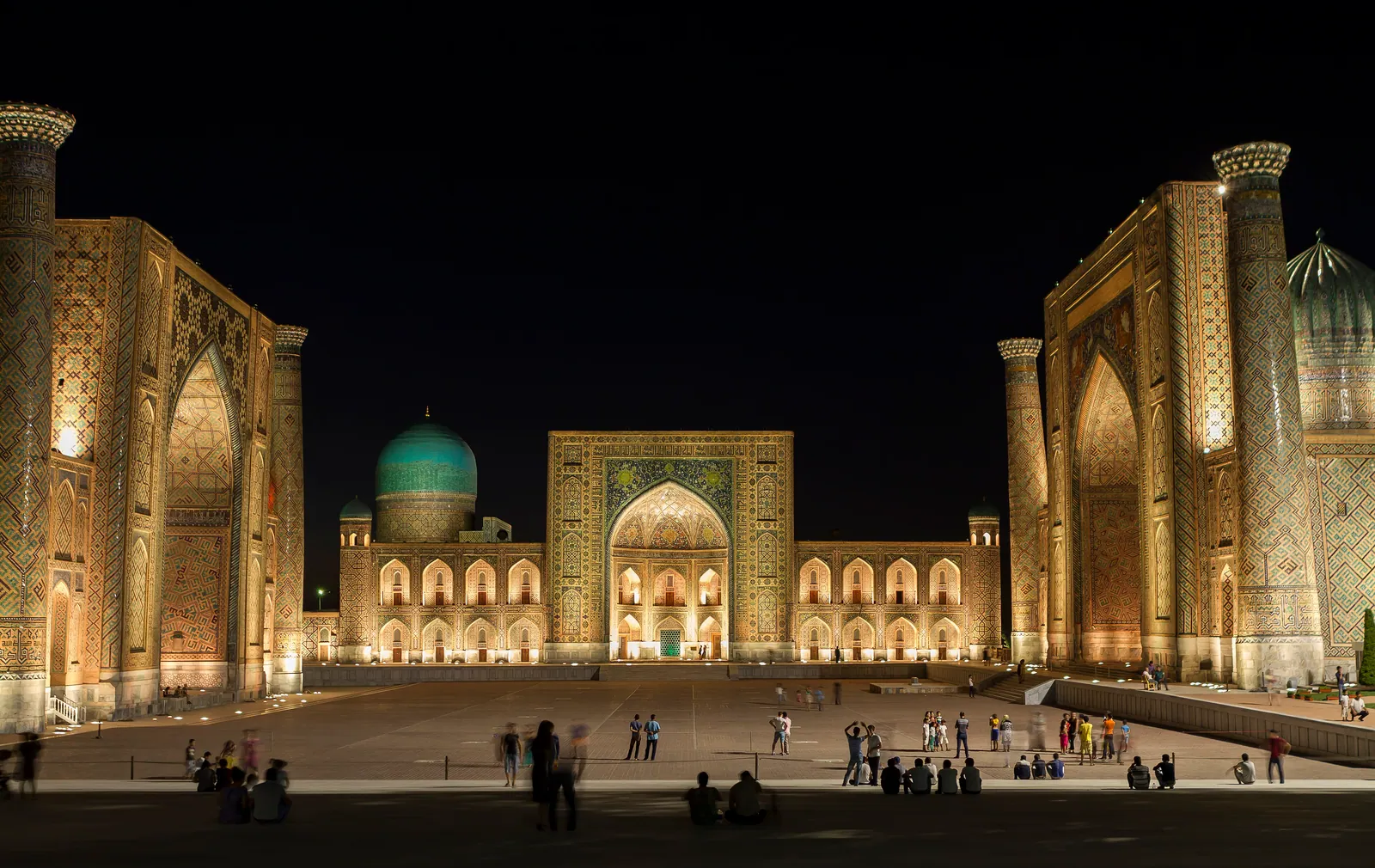
And silk was only one commodity among many. The routes carried paper, spices, glass, horses, gunpowder and precious stones — but their deepest cargo was intangible. Religions, scientific knowledge, artistic styles and, less happily, epidemic diseases all travelled the same dust. Understanding that web is the key to understanding the oasis cities of Uzbekistan, and it is the thread our journey The Silk Road Reborn is built to follow.
A name younger than the route
The term itself is modern. The German geographer Ferdinand von Richthofen coined Seidenstrasse — silk road — in 1877, long after the routes had fallen quiet. The merchants who actually used them had no collective name for the system; they knew only the next stage, the next caravanserai, the next city wall rising out of the haze.
Calling it a single road can mislead. It is more accurate to picture a frayed rope: many strands running roughly east to west, splitting around the Taklamakan Desert into northern and southern branches, threading the passes of the Pamir and Tian Shan, and fanning out west of Samarkand toward Persia, the Levant and the Black Sea. Maritime routes through the Indian Ocean carried much of the same trade by sea.
When the routes opened
Long-distance exchange across Eurasia is older than any empire, but the network we call the Silk Road took recognisable shape around the 2nd century BCE. The Han dynasty envoy Zhang Qian, sent west by Emperor Wu around 138 BCE, returned with detailed reports of the lands beyond China's frontier — including the prized horses of the Ferghana Valley, in present-day Uzbekistan.
From that point trade intensified. The Han pushed military and diplomatic reach into the Tarim Basin; Parthian Persia and, later, the Roman world formed the western markets. Roman writers complained that the empire's silver was draining east to pay for transparent silk, a luxury so unfamiliar that some Romans believed it grew on trees.
What actually moved, and how
Caravans of camels — the two-humped Bactrian, bred for cold and distance — were the workhorses of the overland trade. They crossed the deserts in stages between caravanserais, the fortified roadside inns spaced roughly a day's march apart, where merchants, animals and goods rested under one defended roof.
The cargo was as varied as the geography. Eastward went horses, wool, glass, gold, silver and, crucially, the techniques of new religions. Westward came silk, paper, porcelain, lacquer, rhubarb and tea. Few goods travelled the whole way; most were traded, marked up and re-traded city by city. The oasis towns of Transoxiana — Samarkand and Bukhara above all — grew rich precisely because they sat where the strands converged and the markups compounded.
The cargo that mattered most: ideas
Buddhism travelled the routes from India into China along the Tarim oases, leaving the painted cave-temples of Dunhuang and the colossal Buddhas of Bamiyan as it went. Later, Islam moved the other way, carried east by merchants and scholars after the 8th century until it reshaped Central Asia entirely. Nestorian Christianity, Manichaeism and Zoroastrianism all left their footprints along the way.
Technology followed. Papermaking passed from China westward after Tang prisoners taught the craft in Samarkand around 751 CE, transforming record-keeping across the Islamic world and eventually Europe. Mathematics, astronomy and medicine flowed in every direction. The Silk Road's true legacy is not a commodity but a habit of exchange — and it is that habit our Long Way East journey traces from Spain across the breadth of Asia.
Why the routes faded
No single event closed the Silk Road. The Mongol conquests of the 13th century actually unified much of the route under one administration, and the relative security of the Pax Mongolica let travellers such as Marco Polo and the Moroccan jurist Ibn Battuta cross vast distances. But the fragmentation that followed the Mongol collapse made overland trade riskier and more costly.
The decisive shift came at sea. From the late 15th century, European maritime powers opened ocean routes to Asia that bypassed the land entirely, and bulk goods moved more cheaply by ship than by camel. The oasis cities did not vanish — they simply ceased to be the indispensable middlemen they had been for fifteen centuries. Their monuments, however, remained, which is why a journey through Uzbekistan today still reads like an index of the whole story.
Quick answers
Was the Silk Road really a single road?
No. It was a network of many overland routes, splitting and rejoining across deserts and mountain passes, with maritime branches through the Indian Ocean. No merchant travelled its full length; goods moved in relays from city to city. The single-road image comes from the modern name, coined in 1877, not from how the routes were actually used.
What was traded besides silk?
A great deal. Paper, porcelain, tea, spices, glass, horses, precious metals, gemstones and wool all moved along the routes. Just as importantly, the network carried religions, scientific knowledge, artistic styles, technologies such as papermaking — and epidemic diseases. Silk gave the route its modern name, but it was only one commodity among many.
Can you still travel the Silk Road today?
Yes. The historic oasis cities of Uzbekistan — Samarkand, Bukhara and Khiva — remain among the best-preserved waypoints on the entire network, and modern road and rail make them comfortably accessible. Our journeys The Silk Road Reborn and The Long Way East are built to follow the overland thread between them.
Let the reading become a route.
When an article sparks something, our planners are the next step. Tell us what you are dreaming of.