Why the Atacama Has the Clearest Skies on Earth
The world builds its greatest telescopes in one desert in northern Chile. The reasons are a precise stack of geography, ocean currents and atmospheric physics — and understanding them changes how you look up.
The Atacama has the clearest skies on Earth because four things line up there as they do almost nowhere else: it is extraordinarily dry, it is high, it sits under remarkably stable air, and it is far from any city. Drought removes the water vapour and cloud that dim and blur a sky; altitude lifts you above much of the remaining atmosphere; stable air keeps the stars from twinkling; and emptiness keeps the night genuinely black.
None of this is accident or luck. Each factor has a physical cause — the cold Humboldt Current offshore, the rain shadow of the Andes, a persistent high-pressure system, the sheer scale of an empty desert. This is why the European Southern Observatory, ALMA and a growing cluster of major instruments are all here, and why Beyond the Blue opens its journey to the planet's extremes under exactly this sky.
Dryness — the single biggest factor
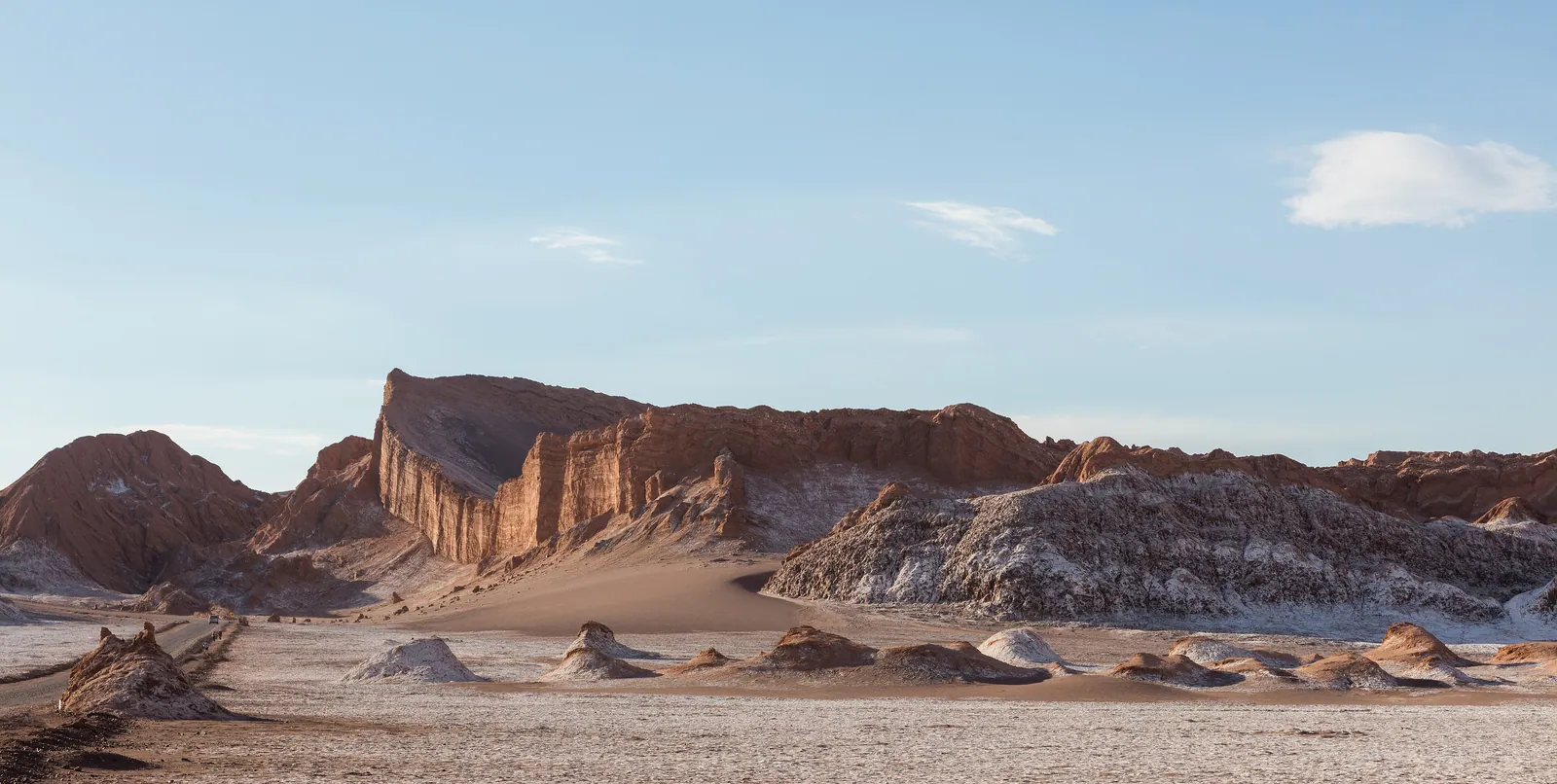
The Atacama is the driest non-polar desert on Earth. Some weather stations in its core have never recorded measurable rainfall, and average humidity is among the lowest of any inhabited place. Water vapour is the enemy of a clear sky: it forms cloud, it scatters and absorbs light, and even invisible humidity blurs and dims the stars. Strip the water out of the air and the sky sharpens dramatically.
Dryness also gives the desert its roughly 330 cloud-free nights a year. For an observatory, clear nights are observing time, and the Atacama simply delivers more of them than almost anywhere else. For a traveller, it means a planned stargazing night is very unlikely to be lost to weather — a rare reliability.
Why the Atacama is so dry — current, rain shadow and ridge
Three mechanisms conspire. Offshore, the cold Humboldt Current chills the air above the Pacific, suppressing the rising motion that builds rain clouds; the moisture that does form tends to stall as coastal fog rather than reaching inland. To the east, the Andes throw a rain shadow across the desert, wringing the moisture from air arriving over the continent before it can descend the western slope.
Above it all sits the subtropical high-pressure belt, a zone of gently sinking air that warms and dries as it descends and discourages cloud from forming at all. A cold ocean on one side, a mountain wall on the other and a drying ridge overhead — the Atacama is dry because geography leaves it no other option.
Altitude — observing from above the haze
San Pedro de Atacama sits at about 2,400 metres, and the desert's observatory sites are far higher: ESO's Paranal at around 2,600 metres, the ALMA array on the Chajnantor plateau above 5,000 metres. Every metre of altitude leaves more of the atmosphere — and more of its dust, vapour and haze — beneath the observer.
Height matters especially for certain kinds of astronomy. ALMA observes at millimetre and submillimetre wavelengths that are strongly absorbed by atmospheric water, so it must sit above as much of that water as possible — hence the punishing elevation of Chajnantor. For the visiting traveller, even San Pedro's modest altitude noticeably darkens and steadies the sky compared with sea level.
Stable air and 'seeing' — why the stars hold still
Astronomers use the word seeing for the steadiness of the atmosphere. When air is turbulent, layers of different temperature mix and shimmer, and a star's pinpoint light is smeared into a dancing blur — the twinkle that looks romantic to the eye but ruins fine detail in a telescope. The Atacama enjoys unusually smooth, laminar airflow, partly because of that stable overhead ridge and the flat approach from the cold ocean.
Good seeing is the difference between a telescope resolving a crisp planetary disc and seeing only a wobbling smudge. It is one of the less obvious reasons the great observatories chose this desert: not just darkness and dry air, but air that holds remarkably still.
Darkness — emptiness and a guarded sky
Clarity is wasted if the sky itself is bright. The Atacama is one of the emptiest inhabited regions on the planet, with hundreds of kilometres of unlit desert between observing sites and any city of size. Chile has also recognised the value of what it has: regulations restrict outdoor lighting in the astronomical regions of the north, helping to keep the night dark by law as well as by geography.
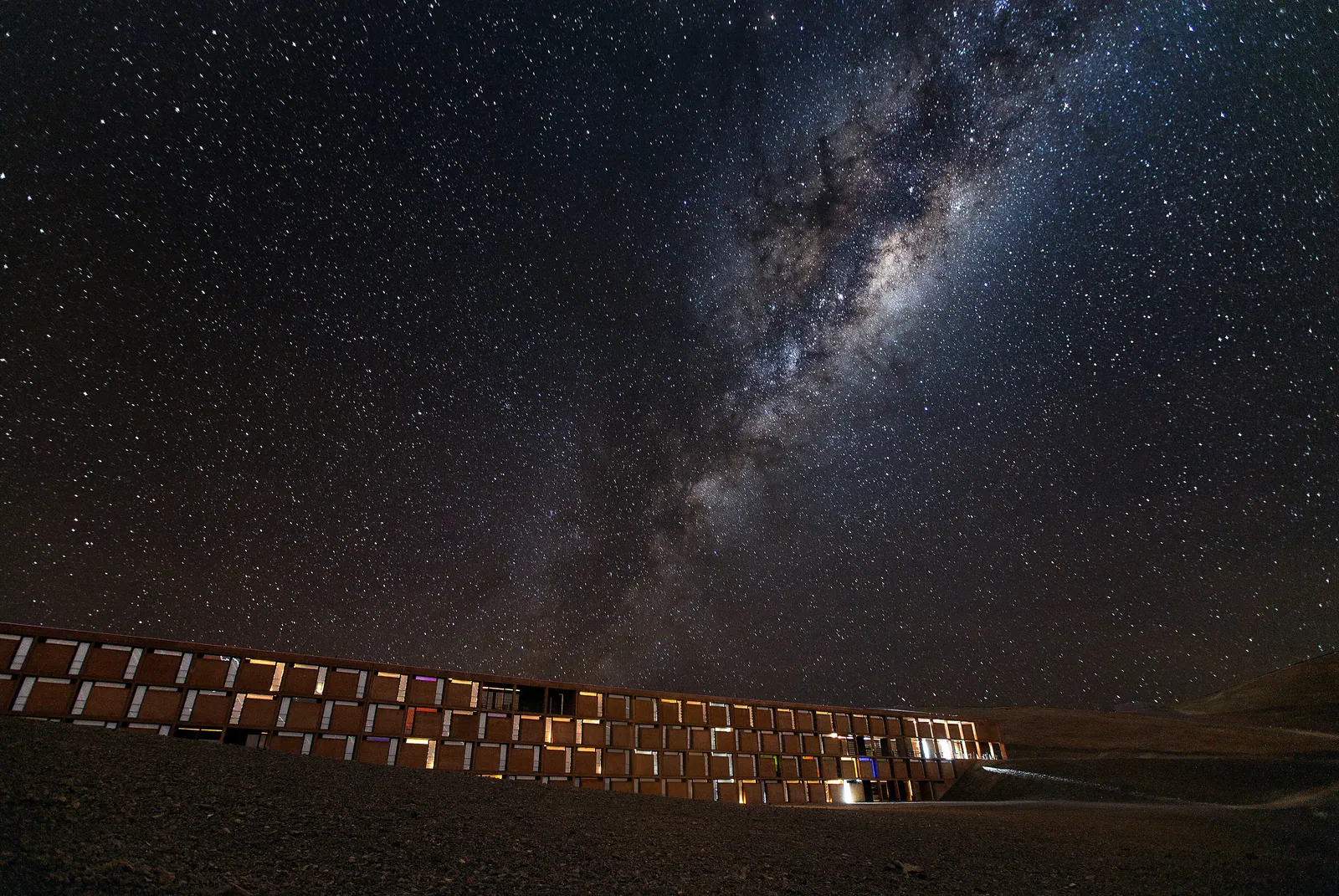
The combined result is a sky that reaches Bortle Class 1 — the darkest grade — where the Milky Way is bright enough to cast a faint shadow and the zodiacal light is plainly visible. It is, in a literal sense, as dark as a sky on Earth can be.
What this means for a traveller
You do not need to be an astronomer to feel the difference. A guided night under the Atacama sky — and many San Pedro lodges, such as Explora, have their own telescopes — is consistently described by travellers as one of the highlights of an entire trip. The desert hands you a sky that most people, living under urban light, have simply never seen.
On Beyond the Blue we place the Atacama first by design. Before the deep ocean, the polar night and the edge of space, six nights in the desert teach you to read the sky — so that everything that follows is seen by an eye that has already learned to look up.
Quick answers
Why are so many observatories built in the Atacama?
Because the desert offers the rare full set of conditions astronomy needs: extremely dry air, high altitude, exceptionally stable 'seeing', many cloud-free nights and very little light pollution. ESO's Paranal and the ALMA array are both here for that reason. Few places on Earth combine all of those factors, and none does so as consistently.
Does the altitude make stargazing in the Atacama difficult?
San Pedro de Atacama sits at about 2,400 metres, which most travellers tolerate well after a gentle first day or two. Stargazing excursions from the town are generally at similar elevations, not at the extreme heights of the professional observatories. Drink plenty of water, ease into the altitude, and dress very warmly — desert nights are cold even when the days are mild.
Can you visit the professional observatories themselves?
Some offer public visits on a limited basis — ESO's Paranal, for example, has historically run weekend tours by advance booking, though these are daytime visits rather than observing sessions. For actual stargazing, travellers use the excellent guided programmes and lodge telescopes around San Pedro de Atacama, which deliver the same extraordinary sky.
Let the reading become a route.
When an article sparks something, our planners are the next step. Tell us what you are dreaming of.