Zanzibar: Stone Town and the Spice Island
Zanzibar is where the Indian Ocean trade routes converged for centuries — Arab, Persian, Indian, Portuguese and Swahili cultures layering one over the next in a labyrinth of carved doors and coral-stone lanes.
Zanzibar is an archipelago off the coast of Tanzania, close enough to the mainland that you can reach it by fast ferry in two hours, yet distinct enough in feel to seem a world apart. Its principal island, Unguja, is shaped by a history of ocean trade that goes back at least a thousand years — Arab navigators riding the monsoon, Persian merchants, Indian traders, Portuguese cannon, Omani sultans and British administrators each leaving a layer in the stone.
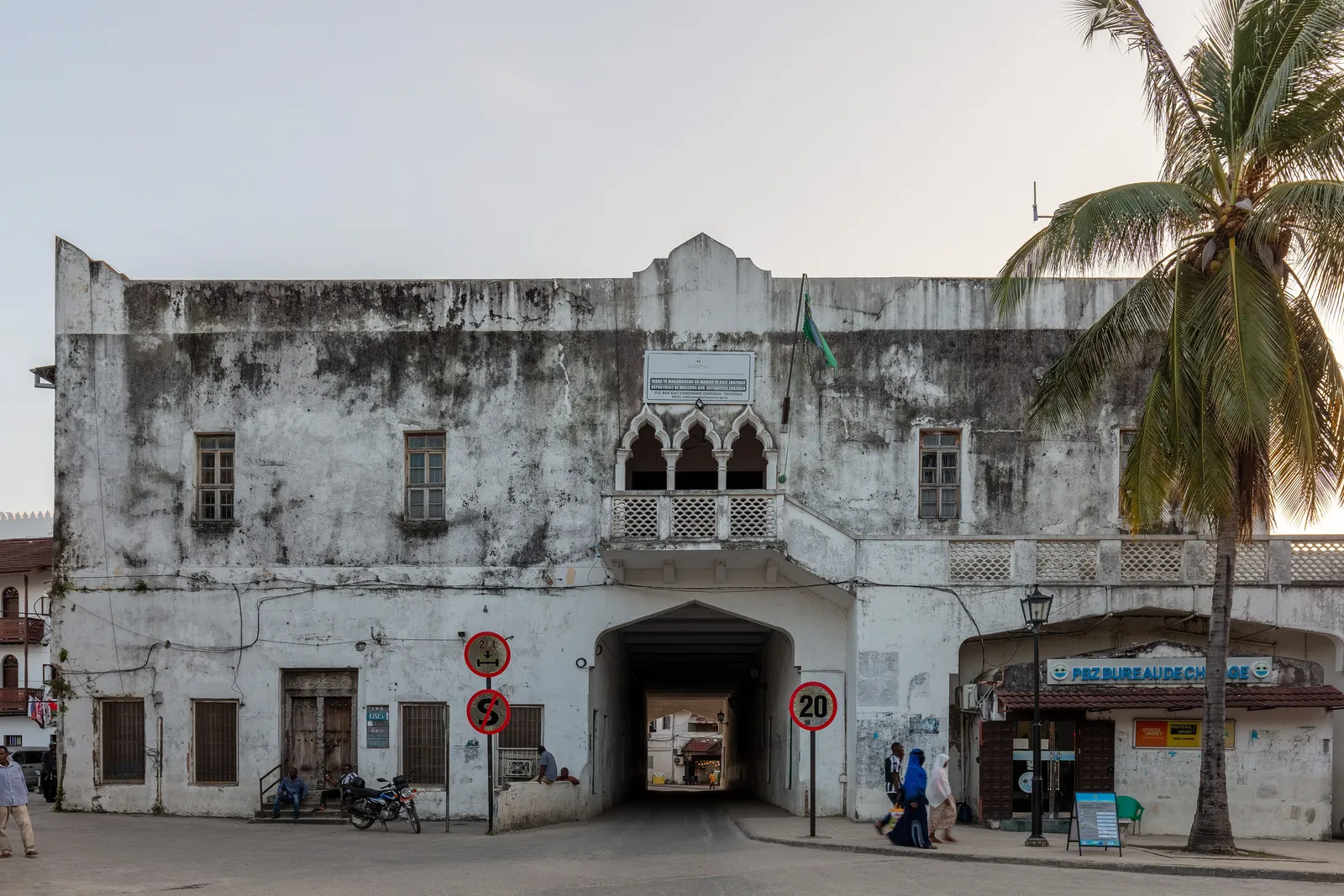
The result is Stone Town, the old city of Zanzibar's western coast: a dense, shadowed labyrinth of coral-stone buildings, hanging balconies and elaborately carved wooden doors, where a mosque, a Hindu temple and an Anglican cathedral stand within minutes of each other. Beyond the town, the island opens into clove and coconut plantations, white-sand beaches and a reef-ringed sea of extraordinary colour. Stone Town was inscribed as a UNESCO World Heritage Site in 2000, and walking it still feels like moving through a living record of the Indian Ocean world.
The carved doors of Stone Town
No feature of Stone Town is more immediately striking than its doors. Hundreds of them survive — heavy, double-leafed, set in carved frames that announce the status and origin of the household behind them. Arab-style doors carry bold geometric carving; Indian-influenced doors, especially those of the merchant class, add lotus bosses and decorative brass studs originally intended as protection against war elephants. Date of carving, quality of timber and complexity of design all signalled wealth.
The doors are not merely decorative. In the Swahili coastal tradition, the door and its frame were the public face of a household, and the investment in carving was a deliberate statement. Walking Stone Town's alleys is to read a hierarchy of ambition in timber: the plainest doors of modest homes, the elaborate frames of merchant houses, and the grandest of all — the double-width, brass-studded door of the former Palace of Wonders on the seafront.
A city of layered faiths
Zanzibar's religious landscape reflects its history directly. The old town's dominant faith is Islam, brought by Arab and Persian merchants centuries ago, and the call to prayer from the Friday Mosque and a dozen others threads through the day. Alongside it, a small but historically significant Hindu community built their temples here when Gujarati merchants became central to the island's commerce in the nineteenth century — a few of those temples still stand.
Most striking of all is the Anglican Cathedral of Christ Church, consecrated in 1873 and built deliberately on the site of the island's former slave market, at the instigation of the missionary David Livingstone. Its altar stands over the old whipping post. A small, sombre museum beneath the cathedral documents the East African slave trade, which at its peak in the nineteenth century passed tens of thousands of people through Zanzibar annually — a history the island neither hides nor forgets.
The spice trade and its legacy
Zanzibar's title of Spice Island is earned. Under Omani rule in the nineteenth century, the island became the world's leading producer of cloves, and clove plantations still cover much of the island's interior. Nutmeg, cinnamon, black pepper, vanilla and cardamom are grown here too — an aromatic inheritance of the same trade networks that once made the Indian Ocean world's fortunes.
Spice tours, visiting working farms in the interior, are one of the most engaging things a traveller can do on the island: not a performance of agriculture but an encounter with the real economy. A good guide will break open a nutmeg to show the mace inside it, crush a leaf of lemon grass, and explain how each plant was introduced and why it took hold. The smells alone — clove-heavy air, vanilla flowers, cinnamon bark — make the humidity of the interior worth bearing.
The ocean that made Zanzibar
Zanzibar's history is inseparable from the Indian Ocean's seasonal winds. The northeast monsoon, blowing from roughly November to March, carried Arab and Indian vessels south to the East African coast; the southwest monsoon, from about May to September, returned them home. This two-way seasonality created a predictable calendar of commerce across the ocean, and Zanzibar sat at its southern margin, accumulating goods, peoples and cultures.
The traditional vessel of this trade is the dhow — a wooden sailing boat with a lateen or settee sail, still built by hand in certain Zanzibar villages. A sunset dhow cruise in the channel between Zanzibar and the mainland, with the sea turning gold and the old town's waterfront lit behind you, is one of those experiences that earns its cliché status entirely. It is genuinely beautiful, and it connects the traveller, however briefly, to ten centuries of ocean movement.
Beaches, reefs and the outer islands
Beyond Stone Town and the plantations, Zanzibar is also a beach destination — one of the finest on the Indian Ocean coast. The east coast, facing the open sea, has the most famous beaches: long, low-tide flats of white sand with clear water and a distant reef breaking the swell. The northeast coast at Nungwi and the southeast at Paje are both well established, each with a distinct character.
The surrounding reef is a reason in itself to pause. Snorkelling and diving reveal a healthy coral system with green and hawksbill turtles, reef sharks and a dense community of fish. Mnemba Atoll, a private conservation area off the northeast coast, is one of the best dive sites in the western Indian Ocean. The outer islands of the Zanzibar Archipelago — Pemba to the north, with even richer reefs, and the smaller islets to the south — reward the traveller willing to go a little further.
How Zanzibar fits a longer journey
Zanzibar pairs naturally with the mainland Tanzania game country — the Serengeti or the Selous — giving a journey the contrast of savannah and ocean, tented camp and coral-stone city, wildlife drama and cultural depth. The ferry from Dar es Salaam is fast and frequent; the flight from Kilimanjaro or Arusha takes under an hour.
Two to three nights is the minimum to do Stone Town justice and reach the east coast beaches; four to five nights allows a half-day spice tour, a dhow excursion and a day's snorkelling at the reef. For travellers crossing the African continent from north to south — from the Nile to the Cape — Zanzibar offers a deliberate pause at the ocean, a place where the continent's trading relationship with the rest of the world becomes visible and tangible.
Quick answers
When is the best time to visit Zanzibar?
The two dry seasons — roughly June to October and December to February — are the most comfortable for beach visits, with lower humidity and reliable sunshine. March to May is the main rainy season and best avoided. The southeast trade winds from June to September can make the east coast rough for swimming, while the calmer west coast and Stone Town are pleasant year-round.
Do I need a visa to enter Zanzibar?
Zanzibar is part of Tanzania, so entry requirements are those of Tanzania: most nationalities require a visa, obtainable on arrival at the airport or online in advance as an e-visa. Check current requirements for your passport before travel. Note that Zanzibar has its own immigration check separate from mainland Tanzania if you arrive from the mainland by ferry.
How long does it take to get to Zanzibar from the mainland?
Fast ferries from Dar es Salaam to Stone Town take roughly two hours in good conditions and run several times daily. Flights from Dar es Salaam take about 20 minutes; from Kilimanjaro or Arusha, around 45 to 60 minutes. The ferry is the more atmospheric option; the flight is faster if time is short.
Is Stone Town safe to walk on your own?
Stone Town is generally safe for independent walking during the day, and most travellers navigate it freely. The old city's alleys are intentionally disorienting — getting briefly lost is almost inevitable and part of the pleasure. As in any tourist city, keep valuables discreet and be alert in quieter lanes after dark. A guide adds historical context that a solo wander cannot replicate.
What is the significance of Zanzibar's slave trade history?
Zanzibar was the hub of the East African slave trade throughout the nineteenth century, with the Omani sultanate and later British-era commerce passing vast numbers of enslaved people through the island's slave market. The market was abolished in 1873. The Anglican Cathedral built on its site and the underground holding cells preserved nearby constitute a sobering and important memorial that most travellers to Stone Town visit.

Let the reading become a route.
When an article sparks something, our planners are the next step. Tell us what you are dreaming of.