48 Hours in Cusco: A Slow Two Days at Altitude
Cusco rewards the unhurried. Here is how to spend a first two days in the old Inca capital — gentle enough to let your body adjust to 3,400 metres, full enough to fall for the city.
Two days is the right amount of time to give Cusco at the start of an Andean journey — not because the city runs out of interest, but because your body needs that pause. At roughly 3,400 metres the air carries about a third less oxygen than at sea level, and the smartest itinerary is one that fills two slow days with low, walkable pleasures while you acclimatise.
The plan below climbs nothing steep and rushes nowhere. It moves between the Plaza de Armas, the artisan lanes of San Blas and the surrounding hills, with long meals and early nights built in. Treat it as a frame rather than a timetable, and let the altitude set the pace.
Day one, morning: settle into the centre
Arrive, drop your bags and do almost nothing — this is the single most useful hour of the trip. When you are ready, walk the few level blocks to the Plaza de Armas, the arcaded heart of the city, and simply sit. Order a coca tea, the mild Andean infusion offered everywhere, and watch the square wake up.
When you feel steady, step into the Cathedral, begun in 1559 on the foundations of an Inca palace. Look for its much-loved colonial Last Supper, in which the dish at the centre of the table is a guinea pig — the painting is a small lesson in how thoroughly the Andes absorbed and reshaped what Spain brought. Keep the morning short. The city is not going anywhere.
Day one, afternoon: Qorikancha and a long lunch
Walk gently downhill to Qorikancha, once the empire’s holiest sanctuary and, according to the Spanish chroniclers, sheathed in sheets of gold. The conquistadors stripped it and raised the Santo Domingo convent on its walls, but the Inca masonry survived beneath, and the building you see today is the two civilisations locked together in a single structure — a theme you will meet again and again in Cusco.
Then give the afternoon to a proper Cusqueñan lunch. The regional table runs to alpaca, trout from highland rivers, corn and a bewildering variety of native potatoes. Eat slowly, drink plenty of water, and resist alcohol on this first day. A short rest afterwards is not laziness; it is acclimatisation doing its quiet work.
Day two, morning: the lanes of San Blas
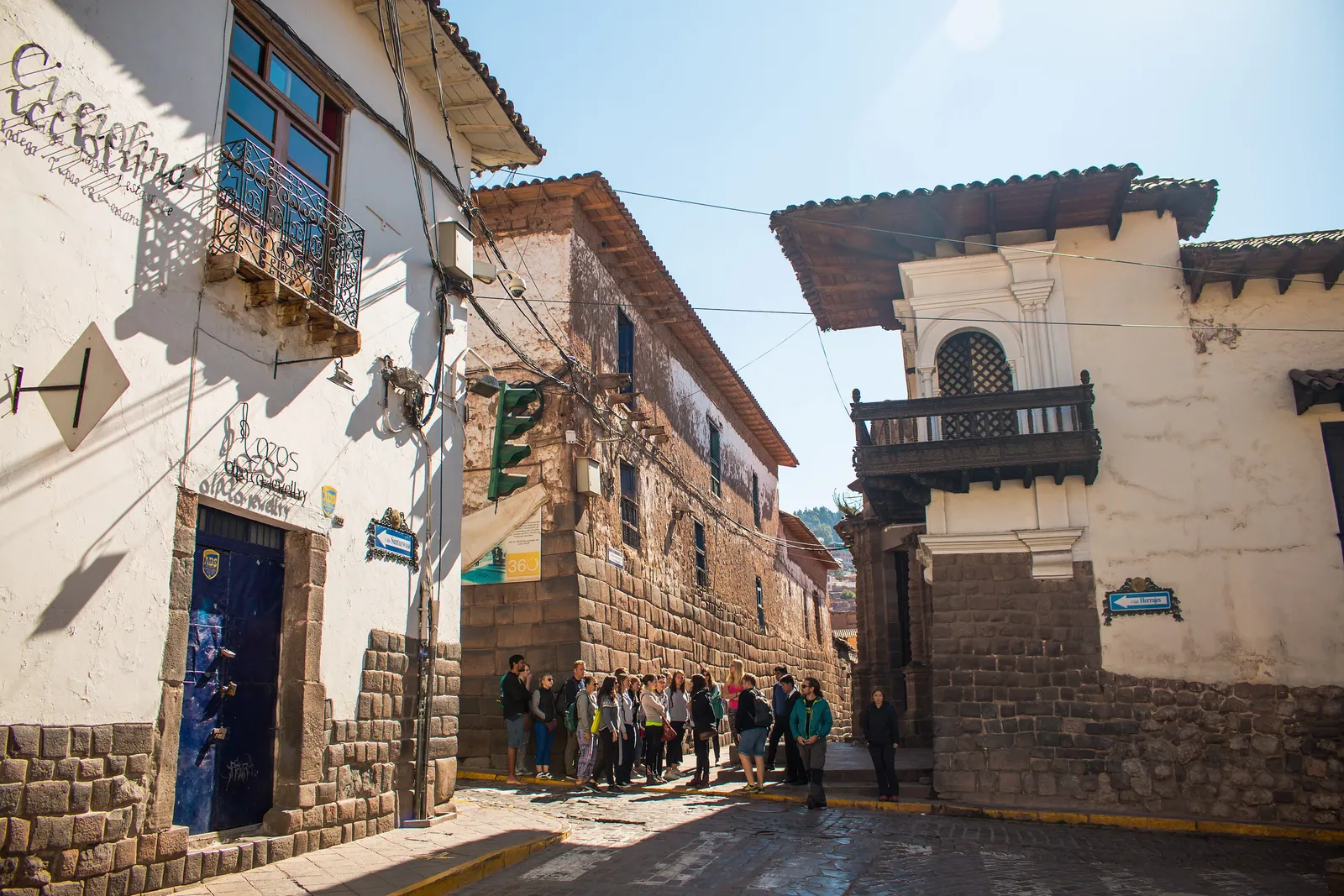
Spend the second morning climbing — slowly, with frequent stops — into San Blas, the artisans’ quarter on the slope above the centre. The lanes are steep and cobbled, the walls whitewashed, and the workshops here have belonged to families of carvers, weavers and silversmiths for generations.
On the way, find Hatun Rumiyoc, the lane that holds Cusco’s most famous single stone: a block cut with twelve angles so that it locks flawlessly into every neighbour. It is worth pausing over, because it explains the whole city. The Inca did not use mortar; they shaped each stone to its specific place, and the result has outlasted five centuries of earthquakes that toppled the Spanish arches above.
Day two, afternoon: Sacsayhuamán above the city
By the second afternoon most travellers feel noticeably better, and a short drive up to Sacsayhuamán is a fitting close. This vast ceremonial complex on the hill above Cusco is built from limestone blocks of almost unbelievable size — some weigh well over a hundred tonnes — fitted together without a trace of mortar.
Stand on the ramparts as the light goes long and gold over the valley, and the scale of the Inca achievement settles in. If your journey continues, this is also the moment the geography clarifies: north and west lies the Sacred Valley, and beyond it Machu Picchu. Cusco is the threshold.
How this fits a longer journey
On the Andes to Antarctica journey, these two Cusco days are deliberately placed first and kept gentle, because the itinerary then drops to the lower, kinder air of the Sacred Valley before any demanding day. Machu Picchu itself sits at 2,430 metres — lower than Cusco — so a traveller who has given the city its two slow days arrives at the citadel already well adjusted.
If you have a third day, do not add altitude or exertion; add depth. Return to a museum, revisit the Plaza at a different hour, or take a half-day into the valley. Cusco is a city that improves the second time you look at anything.
Quick answers
Is two days enough for Cusco?
Two days is a sound minimum for the city itself and doubles as essential acclimatisation time. It covers the Plaza de Armas, the Cathedral, Qorikancha, San Blas and Sacsayhuamán at an altitude-friendly pace. If you are also visiting the Sacred Valley and Machu Picchu, plan three to four days based in or around Cusco in total.
Should I visit Cusco or the Sacred Valley first?
Both work, but many travellers find it kinder to spend their first nights lower in the Sacred Valley, where the air is easier, then come up to Cusco. Where an itinerary begins in Cusco, the key is to keep the first two days gentle — no steep climbs, no alcohol, plenty of water — and to descend into the valley soon after.
Let the reading become a route.
When an article sparks something, our planners are the next step. Tell us what you are dreaming of.