A Walk Through the Old Town of Bukhara
Bukhara is the most complete medieval city in Central Asia — a living old town of mosques, trading domes and a thousand-year-old minaret. Here is a walking route through it, monument by monument, in the order they make sense.
Where Samarkand dazzles with set-piece monuments, Bukhara works as a whole. Its old town is a dense, walkable knot of mosques, madrasas, covered bazaars and merchant houses — most of it built between the 9th and 17th centuries, much of it still in everyday use. UNESCO inscribed the historic centre in 1993 precisely because so little of it has been swept away.
This is a city best understood on foot, in roughly the sequence below. The distances are short, the lanes are shaded, and the route runs from the oldest surviving structure to the lively pool at the town's social heart. It is the way we walk Bukhara on The Silk Road Reborn, and it turns a list of names into a single coherent afternoon.
Start at the Samanid Mausoleum
Begin in the park on the western edge of the old town, at the Samanid Mausoleum. Built around 900 CE for the Samanid dynasty that ruled Bukhara at its first great height, it is the oldest standing monument in the city and one of the oldest pieces of Islamic architecture in all of Central Asia.
It is a small, perfect cube of baked brick, and its genius is entirely in that brick. The builders laid it in shifting patterns so that the walls seem to weave and the light changes across them through the day. There is no tilework here at all — this is pre-tile architecture, and seeing it first makes everything blue that follows easier to date.
The Poi-Kalyan ensemble
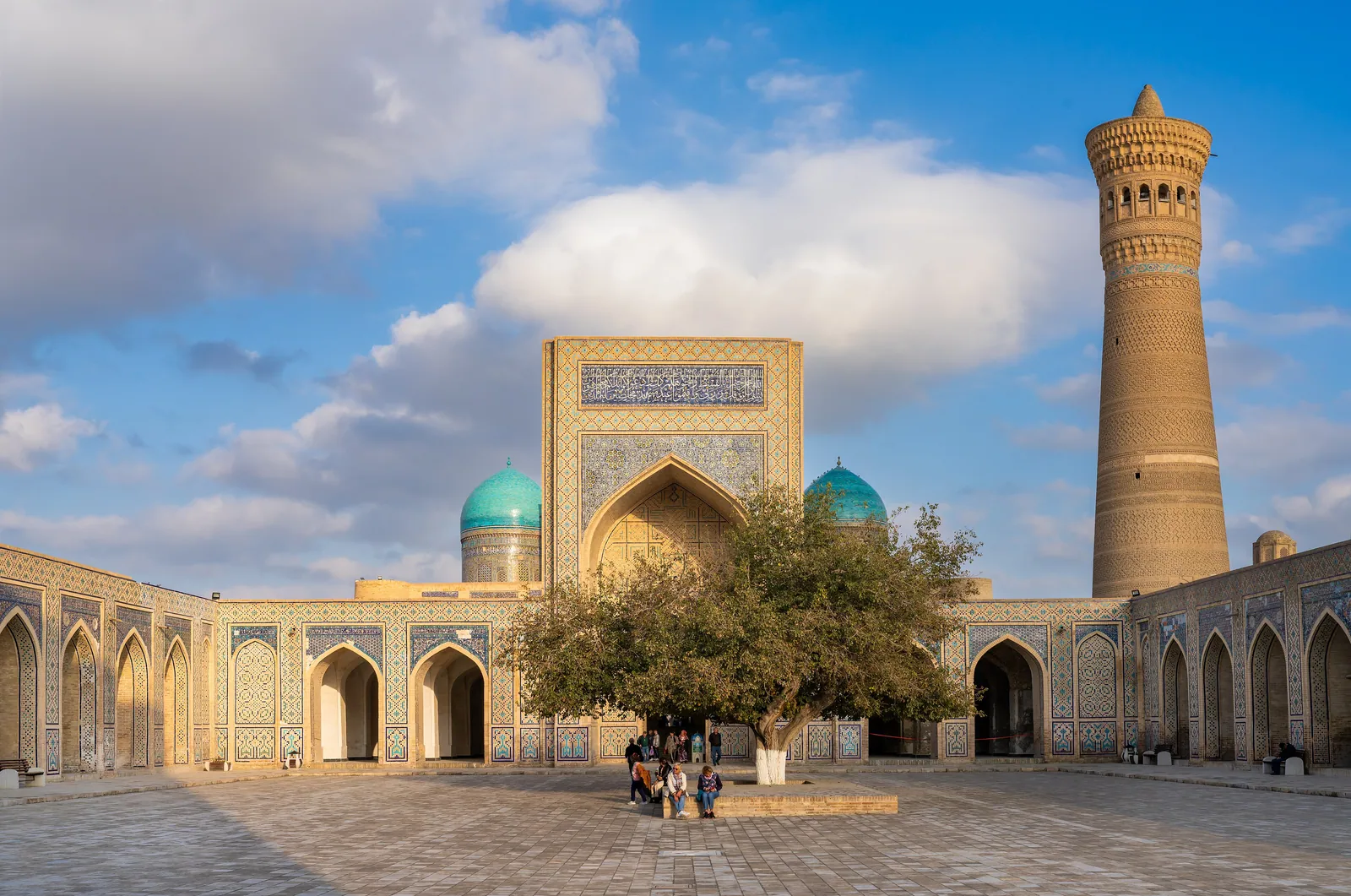
Walk east into the old town to the Poi-Kalyan complex, the monumental core of Bukhara. Its centrepiece is the Kalyan Minaret, completed in 1127 — a 47-metre brick tower banded with fourteen distinct ornamental friezes. It is said that Genghis Khan, sacking Bukhara in 1220, ordered it spared, and it has guided travellers toward the city ever since.
Facing each other across the minaret's base are the Kalyan Mosque, a vast congregational mosque rebuilt in the 16th century around a courtyard that holds thousands, and the Mir-i-Arab Madrasa, a working religious college with one of the finest tiled facades in the city. Mir-i-Arab is still in use, so its courtyard is usually closed to visitors — but the exterior alone justifies the stop.
The Ark and the Bolo Haouz
A short walk west brings you to the Ark of Bukhara, the great earthen fortress that was the seat of the city's rulers for more than a thousand years. Its sloping walls enclose what was effectively a royal town — palace, mint, prison, mosque — and the emirs of Bukhara governed from inside it until the Soviet takeover in 1920.
Directly opposite the Ark stands the Bolo Haouz Mosque, the official mosque of the emirs, built in 1712. Its glory is its wooden iwan: a porch of twenty slender painted columns whose reflection in the pool before it earned the building its nickname, the mosque of forty pillars. The contrast — heavy fortress, delicate porch — is the point of standing here.
The trading domes and covered bazaars
Heading back into the old town, the route passes through Bukhara's surviving trading domes — the Taki-Zargaron, Taki-Telpak-Furushon and Taki-Sarrafon. These are 16th-century covered crossroads, domed brick structures raised over street junctions so that commerce could continue in shade and shelter.
Each was historically tied to a trade: zargaron means jewellers, telpak-furushon means cap-sellers, sarrafon means moneychangers. They still function as markets today, selling carpets, miniatures, scissors and silk, and walking through them is the closest a visitor comes to the working texture of the Silk Road city. Between the domes stands the Magoki-Attori Mosque, sunk well below modern street level — a reminder of how much the city has risen over the centuries.
End at the Lyab-i-Hauz
Finish at the Lyab-i-Hauz, a stone pool dug in 1620 and shaded by ancient mulberry trees. It is ringed by three buildings — the Kukeldash Madrasa, the largest in the city, and the Nadir Divan-Begi madrasa and khanaka facing each other — and it is the social heart of old Bukhara, lined with teahouses and chaikhanas.
The Nadir Divan-Begi facade is worth a long look: like the Sher-Dor in Samarkand, it carries figurative imagery — two phoenixes flying toward a sun with a human face — a rare flourish on a religious building. Sit at the pool with green tea as the day cools; this is where Bukhara still gathers, and where a walk through the old town is meant to end.
Quick answers
How long does it take to walk Bukhara's old town?
The historic centre is compact and the monuments are close together, so the core walking route can be covered in a single unhurried day, perhaps three to four hours of walking with stops. Most travellers prefer two days — one for the monuments and one for the bazaars and a slower pace. Distances are short and the lanes are shaded.
What is the oldest building in Bukhara?
The Samanid Mausoleum, built around 900 CE for the Samanid dynasty, is the oldest standing monument in the city and among the oldest Islamic buildings in Central Asia. It is built entirely of patterned baked brick, with no tilework, which makes it a useful starting point for understanding how the city's architecture developed.
Is Bukhara's old town a museum or a living city?
It is very much a living city. While some monuments are now museums, many mosques and madrasas remain in religious or commercial use, the trading domes still function as markets, and the Lyab-i-Hauz is a working social square. UNESCO inscribed the historic centre in 1993 partly because it survives as an inhabited medieval town, not a preserved ruin.
Let the reading become a route.
When an article sparks something, our planners are the next step. Tell us what you are dreaming of.