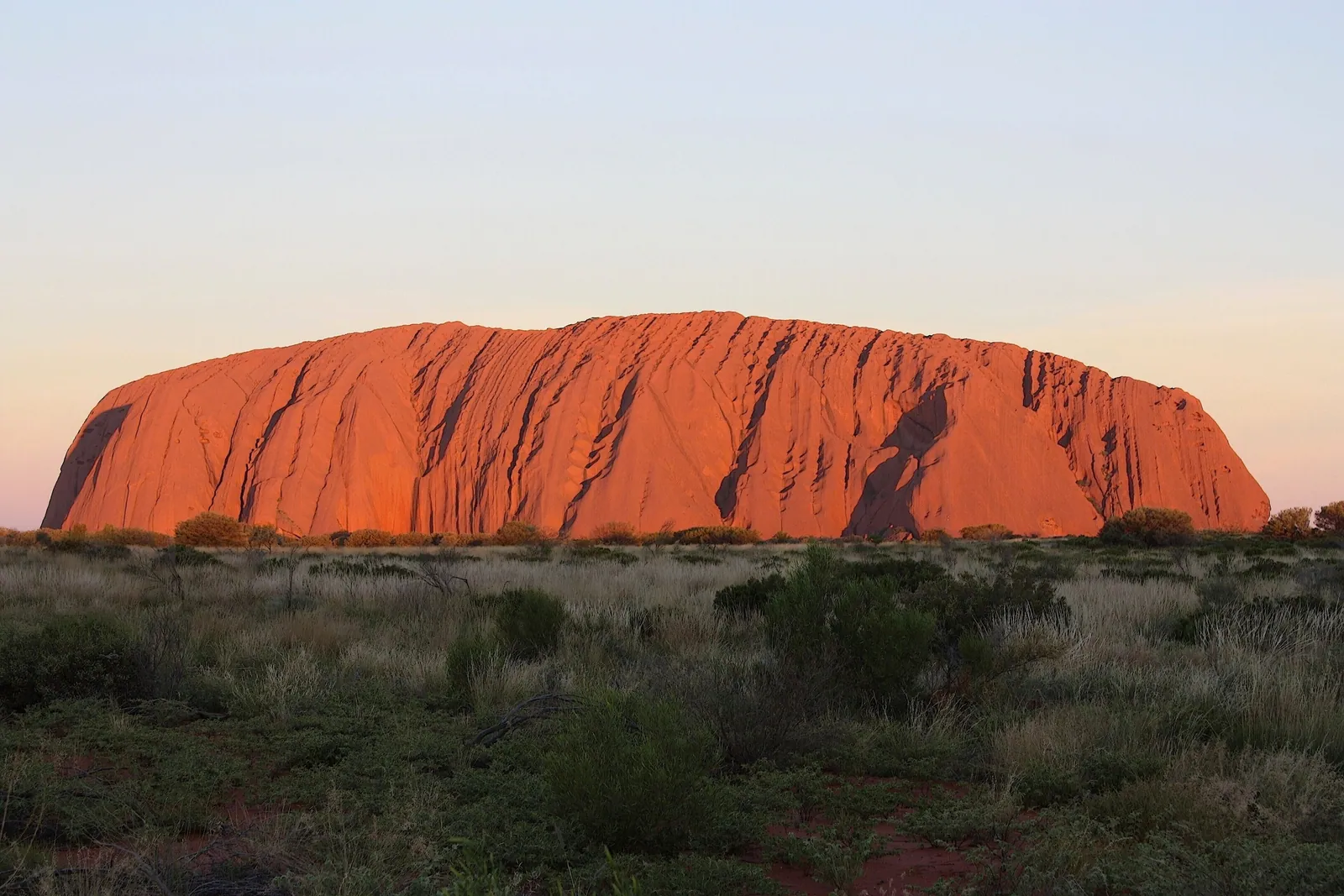
Tjukurpa: The Anangu and the Living Meaning of Uluru
Uluru is not a monument but a living cultural landscape, cared for by the Anangu for tens of thousands of years. Here is how to understand their custodianship — and how to be a respectful guest.
To the Anangu, the Aboriginal people of Australia's Western Desert, Uluru is not scenery. It is a place dense with meaning — a record of ancestral events, a source of law, and a responsibility held and passed down for an extraordinarily long time. Aboriginal people have lived in central Australia for tens of thousands of years, and the Anangu describe an unbroken connection to this country that long predates any written history.
For a visitor, the single most useful idea is that Uluru is a cultural landscape, jointly managed and Aboriginal-owned, where some knowledge is shared freely and some is not shared at all. Travelling here well means following the guidance of the traditional owners — about where to walk, what to photograph, and how to listen — and understanding that this guidance is an invitation into a worldview, not a list of restrictions.
Tjukurpa: law, story and land as one
At the centre of Anangu life is Tjukurpa, a word sometimes loosely translated as 'Dreaming' or 'creation time' but better understood as a complete framework: it is at once the account of how the world and its features came to be, the moral and legal code that governs behaviour, and the body of knowledge about land, plants, animals and kin. Tjukurpa is not located in a distant past — it is present, ongoing and binding.
Many of Uluru's physical features — its caves, fissures, ribs and waterholes — are understood as the marks left by ancestral beings whose actions are recounted in Tjukurpa. To know the rock is to know these accounts, and to be entrusted with them carries obligations. This is why some places at Uluru are sensitive: the knowledge attached to them belongs to particular people and is not for general telling.
Knowledge that is shared, and knowledge that is not
Anangu culture distinguishes carefully between public knowledge, which can be shared with visitors and children, and restricted knowledge, which is held only by certain men or certain women and is passed on at the proper time. This is not secrecy for its own sake; it is how a complex body of law and responsibility is kept accurate and in the right hands across generations.
For travellers this has a practical meaning. At several points around the base of Uluru, signs ask visitors not to photograph specific sites, because images of them could circulate to people who, under Anangu law, should not see them. Respecting these requests is straightforward and important. It costs a visitor nothing and honours a system of knowledge far older than the camera.
Handback and joint management
In 1985, in a milestone known as the 'handback', the Australian government returned the title of Uluru-Kata Tjuta to its Anangu traditional owners. The land was then leased back to the national parks agency, and the park has since been run under a model of joint management, with a board of management on which Anangu hold a majority.
This arrangement means decisions about the park — how it is presented, which areas are open, how cultural sites are protected — are made with Anangu authority. The permanent closure of the Uluru climb in 2019 was the clearest expression of this: a long-stated wish of the traditional owners, finally enacted. Park entry fees are shared with the Anangu, so visiting the park in the proper way also supports its owners directly.
Learning from the traditional owners
The best way to understand Uluru is to learn from Anangu themselves. The Cultural Centre within the national park, designed in consultation with traditional owners, introduces Tjukurpa, language and the joint-management story, and is the right first stop on any visit. Ranger-guided and Anangu-led walks, such as the Mala Walk, share the public layers of meaning attached to particular places.
Anangu-owned and Anangu-guided tour operators also offer experiences led by community members, from bush-food walks to art and dot-painting workshops, where the knowledge shared is offered directly by its holders. On The Pacific Arc journey we prioritise these traveller experiences led by the traditional owners, because the meaning of Uluru is best conveyed by the people who carry it.
Being a good guest
Respectful conduct at Uluru is mostly common courtesy informed by a little knowledge. Stay on marked tracks; do not climb the rock; observe the no-photography signs at sensitive sites; do not remove rocks or sand, which the park asks visitors not to do. Greet people warmly and without intrusion, and understand that not every question will, or should, be answered.
It is also worth knowing that 'Uluru' is the proper Anangu name and the one the traditional owners ask visitors to use. The older colonial name, Ayers Rock, is now formally secondary. Small things — the name you use, the signs you heed, the guides you choose — together amount to travelling here as a guest rather than a spectator.
Quick answers
What is Tjukurpa?
Tjukurpa is the foundation of Anangu life and culture. It encompasses the account of how the world was created, the law and moral code that governs behaviour and relationships, and the practical knowledge of land, plants and animals. It is often translated as 'the Dreaming', but it is understood as present and ongoing rather than as a distant past.
Why are some parts of Uluru not allowed to be photographed?
Certain sites around Uluru are associated with knowledge that, under Anangu law, is restricted to particular people. Photographs of these places could be seen by people who should not see them. Signs around the base mark these sites and ask visitors not to photograph them. Honouring these requests is a simple and meaningful courtesy.
Who owns and manages Uluru today?
Uluru-Kata Tjuta is owned by its Anangu traditional owners, to whom title was returned in the 1985 'handback'. The land is leased to Australia's national parks agency and run under joint management, with an Anangu-majority board of management. Park entry fees are shared with the traditional owners.
Let the reading become a route.
When an article sparks something, our planners are the next step. Tell us what you are dreaming of.