Aswan, Philae and Abu Simbel: Egypt's Southern Frontier
Where Egypt once ended and Nubia began, the Nile narrows at Aswan past granite islands and rescued temples. A guide to the gentlest of Egypt's great cities and the colossi that were lifted from a rising lake.
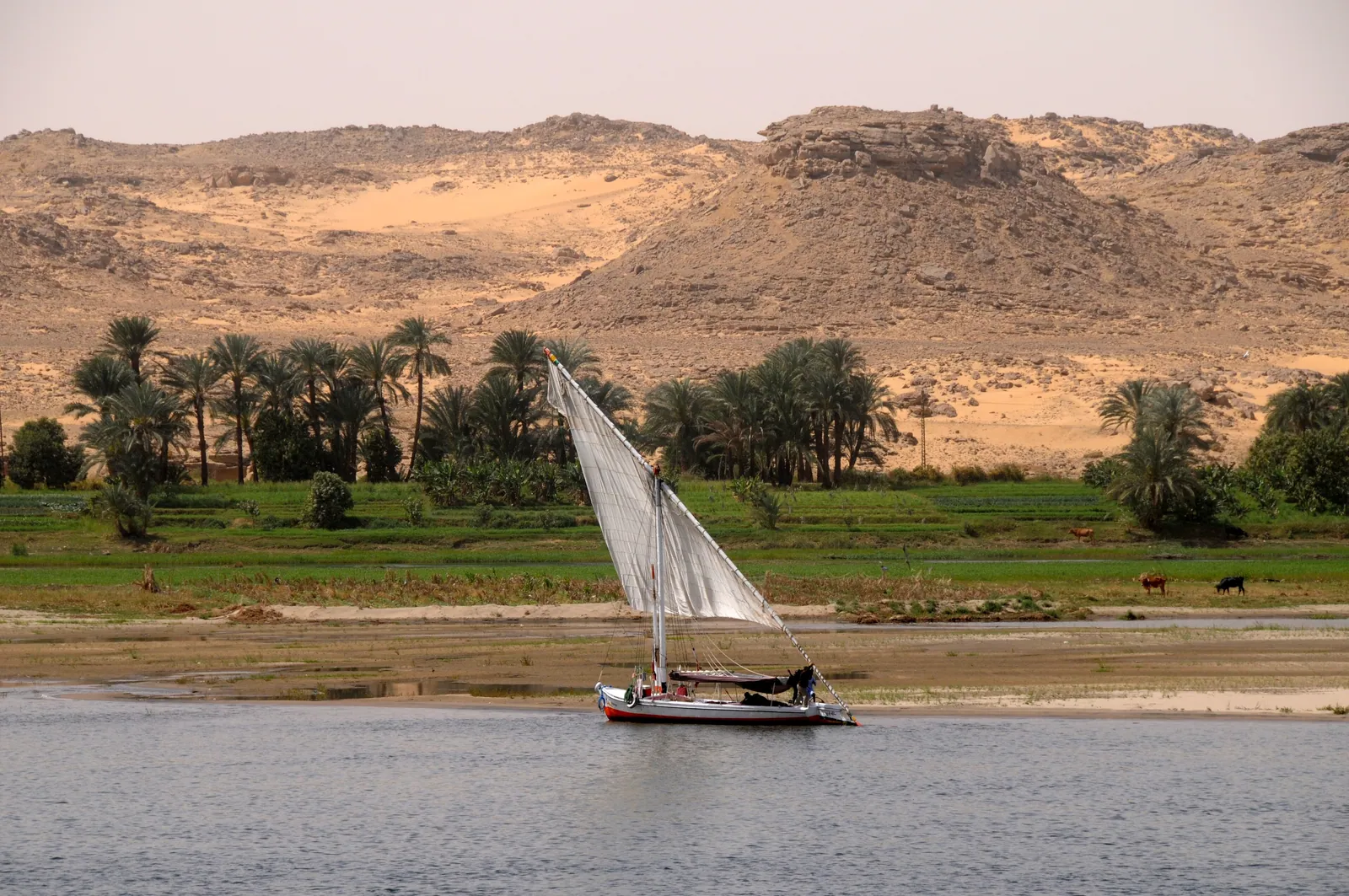
Aswan is Egypt's southernmost city, the point where the Nile breaks over its First Cataract and where, for most of pharaonic history, Egypt proper ended and the land of Nubia began. It is the calmest and most beautiful of the river cities — granite boulders splitting the current, white-sailed feluccas, and a slower temper than Cairo or even Luxor.
Two of its monuments owe their survival to one of the great rescue operations in history. When the Aswan High Dam created Lake Nasser in the 1960s, the temples of Philae and Abu Simbel faced drowning. An international effort, coordinated by UNESCO, cut them into blocks and rebuilt them on higher ground — which is why both can still be visited today, and why they sit slightly differently from where the pharaohs first placed them.
Aswan and the edge of ancient Egypt
The First Cataract — a stretch of rapids and granite islands — was a natural frontier, and Aswan grew up as the garrison, quarry and trading town that controlled it. Goods from the African interior, gold, ivory and ebony among them, passed north through here, and the town's ancient name, Swenett, gave us the word 'syenite' for its distinctive granite.
That granite is everywhere in Egyptian monuments, and Aswan's Unfinished Obelisk still lies in its quarry — a single shaft that would have stood some 42 metres tall had a crack not stopped the work, abandoned mid-cut and hugely instructive about how obelisks were made. Today Aswan is a place to slow down: a felucca among the islands at sunset is one of the quiet pleasures of any Nile journey.
The Temple of Philae
The Temple of Philae was the great sanctuary of the goddess Isis, built mainly in the Ptolemaic and Roman periods on an island just upstream of Aswan. It was one of the last functioning temples of the old religion, with worship continuing here into the sixth century CE, long after the rest of Egypt had turned to Christianity.
The first Aswan dam left Philae half-submerged for much of the year for decades; the High Dam threatened to drown it entirely. In the rescue of the 1970s the whole temple was dismantled and re-erected on the neighbouring higher island of Agilkia, landscaped to resemble the original. It is reached by a short motorboat ride, which only adds to the sense of arriving at a sacred island.
Abu Simbel
Some 280 kilometres south of Aswan, near the Sudanese border, stand the two rock-cut temples of Abu Simbel, carved into a cliff for Ramesses II in the 13th century BCE. The Great Temple is fronted by four colossal seated statues of the king, each about 20 metres high; the smaller temple beside it honours his queen, Nefertari, and the goddess Hathor.
The temples were aligned so that twice a year the rising sun reaches deep into the Great Temple to light the statues of the gods in its innermost sanctuary — an event still observed each February and October. When Lake Nasser rose, the entire complex was cut into more than a thousand blocks and lifted some 65 metres up the cliff, reassembled inside an artificial mountain. The solar alignment was preserved, off by only about a day.
The High Dam and Lake Nasser
The Aswan High Dam, completed in 1970, ended the Nile's annual flood, generating hydroelectric power and storing water for year-round irrigation. Behind it spread Lake Nasser, one of the largest reservoirs on Earth, reaching far into Sudan.
The dam reshaped Egypt for better and worse: reliable water and power, but also the loss of the silt that once fertilised the fields, and the flooding of Nubian homelands, whose communities were resettled. The temple rescues at Philae and Abu Simbel were the response to one part of that cost, and they remain a landmark in the idea that world heritage belongs to everyone.
Aswan on a Nile journey
Aswan is the southern end of the dahabiya stretch on The Great Rift, where the river leg between Luxor and Aswan comes to rest. After the temple-dense days downriver, Aswan's slower pace is a deliberate pause — a felucca among the islands, the Nubian villages of the west bank, the quiet of the river above the cataract.
From Aswan, Abu Simbel is visited as a dedicated excursion before the journey turns away from the river and flies south over the Sahara into the Ethiopian highlands. It is the last and southernmost of Egypt's great monuments on the route — a fitting place to leave the pharaohs behind and let the continent change.
Quick answers
Why were the temples of Abu Simbel and Philae moved?
Both were threatened by the rising waters of Lake Nasser after the Aswan High Dam was built in the 1960s. In an international campaign coordinated by UNESCO, each temple was cut into blocks and reassembled on higher ground — Abu Simbel about 65 metres up its cliff, and Philae on the nearby higher island of Agilkia.
How do you get from Aswan to Abu Simbel?
Abu Simbel lies about 280 kilometres south of Aswan, near the Sudanese border. It is reached by road across the desert, usually as an early-morning trip, or by a short domestic flight. Either way it is a dedicated excursion rather than a casual side-stop, and an early start beats both heat and crowds.
What is the sun alignment at Abu Simbel?
The Great Temple of Abu Simbel was built so that twice a year — around 22 February and 22 October — the rising sun shines through the entrance and along the axis to illuminate the statues of the gods in the innermost sanctuary. When the temple was relocated, the alignment was carefully preserved, shifting by only about a day.
Let the reading become a route.
When an article sparks something, our planners are the next step. Tell us what you are dreaming of.