Beating the Crowds at Kyoto's Famous Sites
Kyoto's most photographed places can be overwhelming by mid-morning — and almost serene two hours earlier. A practical strategy for the famous sites: when to go, what to skip, and how to find the quiet city behind the postcards.
The single most effective tactic for enjoying Kyoto’s famous sites is also the simplest: go early. The bamboo grove in Arashiyama, the orange torii tunnels of Fushimi Inari, the hillside stage of Kiyomizu-dera — all are transformed by a 7am arrival, near-silent and luminous, and all can be shoulder-to-shoulder by ten. The crowd is real, but it is also remarkably predictable, and predictability can be planned around.
Beyond timing, the other half of the strategy is choice: knowing which celebrated sites genuinely reward the effort, which to see briefly, and which lesser-known temples and gardens offer the same beauty without the press. This article sets out a working plan for the famous places, and points toward the quieter Kyoto that most visitors never reach.
The first two hours of the day are everything
Kyoto’s crowds follow a daily curve. Tour groups and day-trippers from Osaka arrive in force from mid-morning; the famous sites peak from roughly 10am to mid-afternoon, then ease somewhat toward closing. The window before about 9am is consistently the quietest, and the very first hour after sunrise is the prize.
Several headline sites are open with no gate and no ticket, which makes them perfect for a dawn visit: the Arashiyama bamboo grove and the Fushimi Inari shrine can both be walked at any hour. Arrive at the bamboo path by 7am and you may hear the stalks creaking overhead in near silence — the experience the postcards promise but mid-morning cannot deliver. For ticketed temples such as Kiyomizu-dera, being at the gate as it opens has nearly the same effect.
Use the late afternoon and the evening too
The end of the day is the second-best window. After about 4pm the tour buses begin to leave, and many sites in their last open hour are markedly calmer. Light at that hour is also kinder for photographs than the flat glare of midday.
Kyoto’s seasonal evening illuminations are an underused tool here. In both the cherry-blossom and autumn seasons, numerous temples — Kiyomizu-dera and Eikan-dō among them — open after dark with their gardens and trees lit, drawing visitors into hours outside the daytime crush. An illuminated temple is a genuinely different experience, and it spreads the crowd across more of the day rather than concentrating it.
Fushimi Inari: climb past the crowd
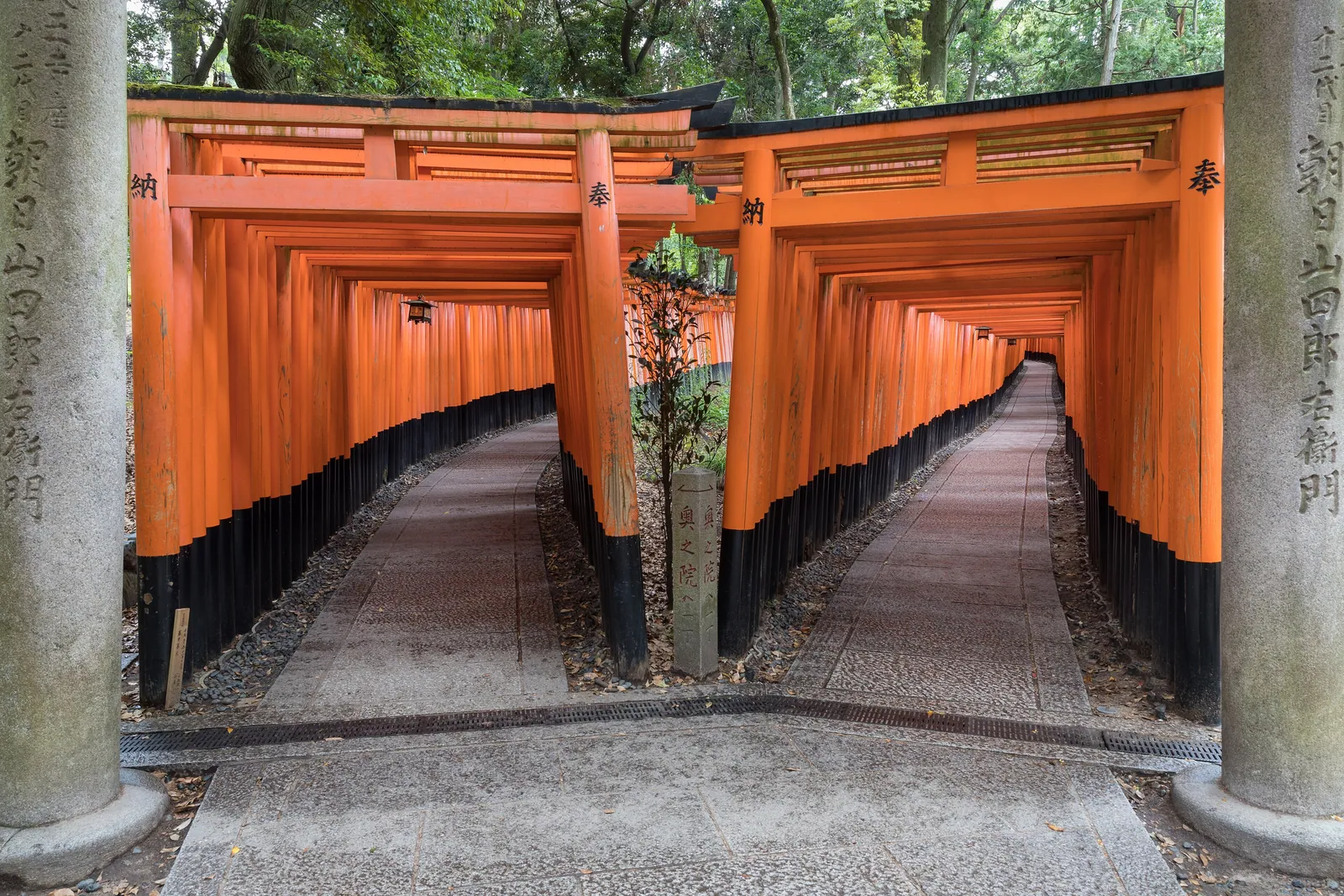
Fushimi Inari Taisha, the great shrine south of central Kyoto with its thousands of vermilion torii gates, deserves a particular note because it has its own escape valve. The crowds are densest at the base of the mountain and along the first stretch of gates. But the shrine is in fact a trail that climbs the wooded slope of Mount Inari, a loop of two to three hours to the summit and back.
Walk twenty or thirty minutes uphill and the crowd thins dramatically; the upper paths can be close to solitary even when the entrance is heaving. The gates continue almost the whole way. Combine an early start with a willingness to climb, and one of Kyoto’s busiest sites becomes one of its most peaceful — a quiet forest walk through endless orange.
Trade the famous for the equally beautiful
Some of Kyoto’s relief lies in substitution. For every thronged site there is a quieter one of comparable beauty. Rather than only Kinkaku-ji, the celebrated Golden Pavilion, give time to the understated Ginkaku-ji and the Zen sub-temples of the Daitoku-ji precinct. Instead of competing for the most famous rock garden, seek out the gardens of Tōfuku-ji in the south-east.
The northern Ōhara valley, with temples set among moss and maple, and the lesser-walked temples of the north-west, trade crowds for calm entirely. A single half-day spent away from the headline core, in one of these quieter quarters, often becomes the most memorable part of a Kyoto week — precisely because it is the part spent in something like the city’s natural stillness.
Other practical levers
A few further habits help. Travel midweek where you can; Saturdays and Japanese public holidays are noticeably busier. Be aware of the peak seasons — the cherry-blossom weeks of late March and early April and the autumn colour of November are the most crowded of the year, and a visit in green-maple May or crisp winter sidesteps the worst of it. Move around by Kyoto’s buses and trains, since central traffic and parking are slow.
On The Long Way East, the Kyoto and Arashiyama chapter is built around exactly this thinking — early starts at the bamboo grove and the famous temples, unhurried middays, quieter corners chosen deliberately over the most photographed ones, and the time to walk the back lanes between sites. Beating the crowds in Kyoto is less a trick than a rhythm, and the rhythm is the slow traveller’s natural one.
Quick answers
What time should I arrive at Kyoto's famous sites?
As early as you can — ideally by 7am at the open-access sites such as the Arashiyama bamboo grove and Fushimi Inari, and at the gate as it opens for ticketed temples like Kiyomizu-dera. The first hour after sunrise is consistently the quietest. Crowds build sharply from mid-morning and peak between roughly 10am and mid-afternoon.
How do I avoid the crowds at Fushimi Inari?
Arrive early, and then climb. The crowds concentrate at the base of the mountain and the first stretch of torii gates. The shrine is actually a two-to-three-hour loop trail up Mount Inari, and twenty to thirty minutes uphill the path thins dramatically — often near-solitary — while the gates continue almost the whole way.
Which seasons are most crowded in Kyoto?
The cherry-blossom weeks of late March to mid-April and the autumn foliage of November are the busiest of the year, with the famous sites at their fullest and accommodation booked far ahead. Travelling in the fresh-green months of late spring or in crisp, clear winter avoids the heaviest crowds while Kyoto remains beautiful.
Let the reading become a route.
When an article sparks something, our planners are the next step. Tell us what you are dreaming of.