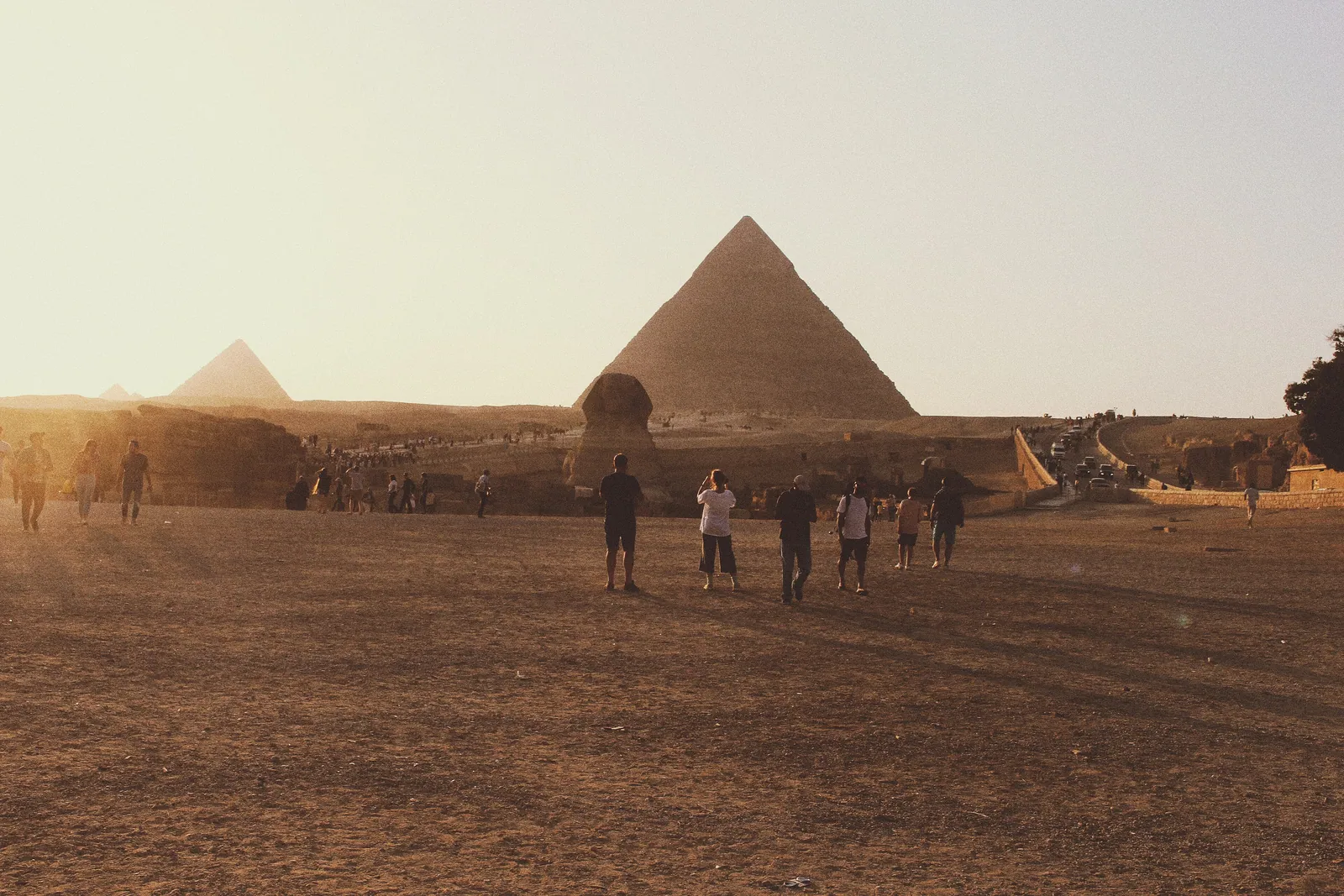
Cairo, Old and New
Pharaonic, Coptic, Islamic and modern — Cairo holds four cities in one. A guide to making sense of the largest metropolis in Africa and the Arab world, layer by layer.
Cairo can overwhelm a first-time visitor: more than twenty million people, ceaseless traffic, and a span of history that runs from the pharaohs to a brand-new capital rising in the desert. The key to enjoying it is to stop treating it as one place. Cairo is at least four cities, founded in different centuries, and each rewards a different kind of attention.
There is pharaonic Cairo, anchored by Giza and the great museums; there is old Coptic Cairo, the early Christian quarter; there is medieval Islamic Cairo, a UNESCO-listed maze of mosques and markets; and there is the modern city of grand avenues, the Nile corniche and, now, a new administrative capital. Visit each on its own terms and the chaos resolves into one of the richest urban experiences on Earth.
Pharaonic Cairo and the great museums
The pharaohs did not build Cairo — the city is much later — but their capital of Memphis lay just to the south, and the Giza plateau sits on the city's western edge. For most travellers, pharaonic Cairo means the pyramids and, above all, the museums.
The Grand Egyptian Museum, on the edge of the Giza plateau, is the new flagship: an enormous purpose-built museum gathering the country's treasures, including the complete Tutankhamun collection displayed together for the first time. The older Egyptian Museum on Tahrir Square, opened in 1902, keeps its own dense, atmospheric charm. Together they hold the densest concentration of ancient Egyptian art anywhere in the world.
Coptic Cairo
In the south of the city, within the walls of the old Roman fortress of Babylon, lies Coptic Cairo — the heart of Egypt's ancient Christian community. The Copts are the direct descendants of the Egyptians who adopted Christianity in the first centuries CE, and their church has worshipped here continuously since.
The quarter is compact and quiet. The Hanging Church, suspended above a Roman gate, and the old churches of Saints Sergius and Bacchus and Saint Barbara stand within a short walk of one another, alongside the Ben Ezra Synagogue and the Coptic Museum. It is a reminder that Egypt's story did not end with the pharaohs — and that the country has been home to several faiths at once for a very long time.
Islamic Cairo
Medieval Cairo — Islamic Cairo — is the city's most atmospheric quarter and a UNESCO World Heritage Site in its own right. Founded after the Arab conquest and grandly expanded under the Fatimid, Ayyubid and Mamluk dynasties, it holds one of the world's greatest concentrations of medieval Islamic architecture.
The landmarks are many: the vast 9th-century mosque of Ibn Tulun, the medieval gates of Bab Zuwayla, the Sultan Hassan and Al-Rifa'i mosques facing each other beneath the Citadel, and the great hilltop Citadel of Saladin itself. Threading them is the bazaar of Khan el-Khalili, a market quarter trading since the 14th century. This is Cairo to be walked slowly, on foot and unhurried.
The modern city and the new capital
Nineteenth-century rulers, above all Khedive Ismail, laid out a modern Cairo of broad boulevards and European-style squares west of the medieval core, and the Nile corniche remains the city's great public promenade. Downtown's faded Belle Epoque architecture is a distinct pleasure of its own.
Cairo is also still being built. A short distance east, in the desert, Egypt has been constructing an entirely new administrative capital to house the government and ease pressure on the old city. Whatever its long-term fate, it is a fitting twist for a place that has been founding new cities beside old ones for more than a thousand years.
Cairo as the start of a journey
Cairo opens The Great Rift, the eighty-day journey down the length of Africa, and the first chapter gives the city a full week — enough to move between the Giza plateau, the museums, and the medieval quarters at a humane pace rather than in a single overwhelming day.
We build in time for the parts travellers most often miss: an unhurried morning in Islamic Cairo, the early Christian churches of the Coptic quarter, a walk along the corniche at dusk. Cairo deserves to be understood as a layered living city, not merely as the gateway to the pyramids — and a week is what that understanding takes.
Quick answers
How many days do you need in Cairo?
Three full days is a sensible minimum: one for the Giza plateau and the Grand Egyptian Museum, one for Islamic Cairo and the Citadel, and one for Coptic Cairo and the older Egyptian Museum. A longer stay rewards the city well, as Cairo's layers — pharaonic, Coptic, Islamic and modern — each take time to absorb.
What is the difference between the Grand Egyptian Museum and the Egyptian Museum?
The Grand Egyptian Museum is a large modern museum on the Giza plateau, built to display Egypt's treasures including the complete Tutankhamun collection. The Egyptian Museum on Tahrir Square is the historic museum opened in 1902, smaller and denser in character. Many travellers visit both; they complement rather than duplicate one another.
Is Islamic Cairo worth visiting?
Very much so. Islamic Cairo is a UNESCO World Heritage Site holding one of the world's richest collections of medieval Islamic architecture — mosques, gates, the Citadel of Saladin and the historic Khan el-Khalili bazaar. It is best explored slowly and on foot, and is one of the highlights of any visit to the city.
Let the reading become a route.
When an article sparks something, our planners are the next step. Tell us what you are dreaming of.