Cusco, the Layered City: Reading Five Centuries in the Streets
When Spain conquered Cusco in 1533 it did not erase the Inca capital — it built on top of it. The result is a single city of two civilisations, and reading its layers is the key to the place.
Cusco is unusual among the world’s great historic cities because it was not replaced but overwritten. The Inca built it as the sacred and political heart of their empire; when the Spanish took the city in 1533, they raised their churches and mansions directly onto the Inca foundations rather than clearing them away.
What survives is a single urban fabric of two civilisations — colonial arcades resting on Inca walls — and it is precisely this layering that earned Cusco its UNESCO World Heritage listing in 1983. This is a guide to reading those layers, street by street, so that the city becomes legible rather than simply picturesque.
The Inca city beneath the plan
The Inca conceived Cusco as the centre of Tawantinsuyu, their four-part empire, and tradition holds that the city was laid out in the form of a puma, with the fortress of Sacsayhuamán as its head. Its streets radiated toward the four great roads that bound the empire together.
The modern street grid of the old centre still substantially follows the Inca plan, and the lower courses of many walls are Inca work. To read Cusco, begin at ground level: the dark, perfectly fitted stone at the base of a building is almost always the older layer, with the Spanish construction stacked above it.
Qorikancha: the clearest layer of all
No single building tells the story better than Qorikancha. As the empire’s holiest temple, dedicated to the sun, it was — according to the chroniclers — clad in gold and lined with the finest coursed masonry the Inca ever produced. After the conquest the Spanish stripped its wealth and built the convent of Santo Domingo directly on its walls.
Both are still there. The convent stands on, and partly within, the curved Inca temple wall, and you can walk from colonial cloister to Inca chamber in a few steps. Earthquakes have repeatedly damaged the Spanish structure while the Inca masonry beneath has held — a physical demonstration of which layer was built to last.
The Plaza de Armas and the colonial overlay
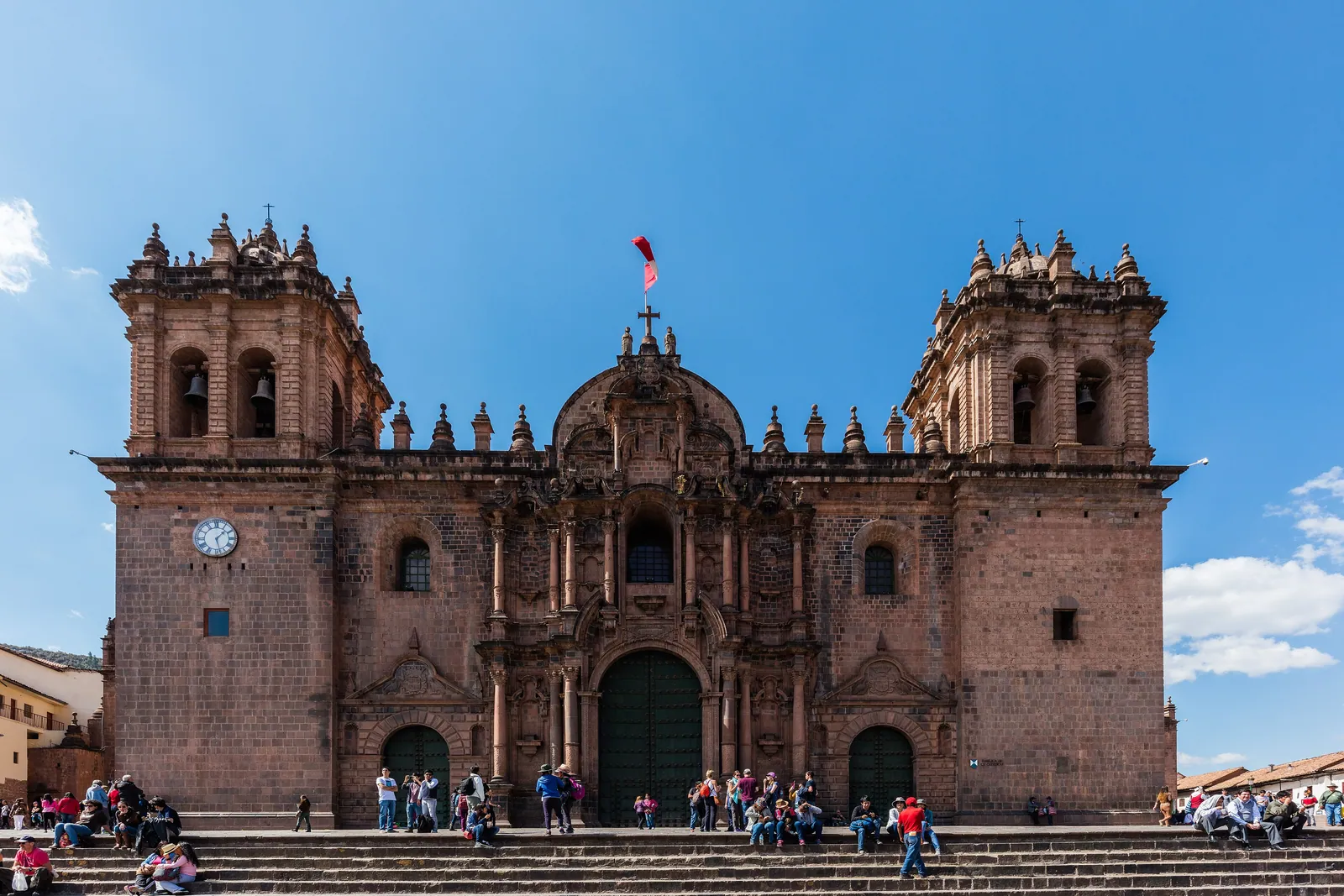
The Plaza de Armas was already a great ceremonial square in Inca times, though smaller, and the Spanish reshaped it into the arcaded plaza seen today. Its Cathedral, begun in 1559, rises on the site of an Inca palace, and inside hangs the much-discussed colonial Last Supper in which the central dish is a guinea pig.
That painting is the layered city in miniature. Cusqueñan artists of the colonial Cusco School learned European technique but filled it with Andean content — local foods, local faces, local landscape — so that even the imported art became something of the Andes. The plaza rewards a slow eye: Spanish form, Andean substance, almost everywhere you look.
San Blas and the streets that show their age
Climb into San Blas, the artisans’ quarter on the slope above the centre, and the layering becomes intimate. Whitewashed colonial houses sit on Inca terraces and walls; lanes such as Hatun Rumiyoc carry famous Inca stonework, including the celebrated twelve-angled stone, with colonial mansions resting directly on top.
Look for the trapezoidal doorways and niches that mark Inca work, and notice how often a humble courtyard wall turns out to be five centuries older than the house around it. Cusco hides very little once you know the signs; the city is, in effect, its own museum, open in the street.
Why the layered city matters to a journey
Cusco’s doubled history is not an academic footnote — it is the lens for the whole region. The same layering of Inca foundation and later overlay reappears across the Sacred Valley, at Pisac and Ollantaytambo, and it deepens the encounter with Machu Picchu, the rare major Inca site the Spanish never reached and so never built upon.
On the Andes to Antarctica journey, the days in Cusco are placed first partly for acclimatisation and partly because the city teaches you how to see. A traveller who has learned to read Cusco’s layers arrives in the Sacred Valley, and at Machu Picchu, already fluent in the landscape’s history.
Quick answers
Why is Cusco called a layered city?
When the Spanish conquered Cusco in 1533, they built their churches and mansions directly on top of the existing Inca city rather than demolishing it. The result is a single urban fabric in which colonial buildings rest on Inca foundations and walls. This blend of two civilisations is what UNESCO recognised when it listed the city in 1983.
Where can you best see the Inca and Spanish layers together?
Qorikancha is the clearest example: the colonial convent of Santo Domingo stands on and within the Inca sun temple’s walls. The Plaza de Armas and Cathedral, built on an Inca palace site, and the lanes of San Blas, where colonial houses sit on Inca stonework such as the twelve-angled stone, also show the layering plainly.
What is the Cusco School of painting?
The Cusco School was a colonial-era artistic tradition in which Andean painters were trained in European religious styles but infused the work with local content — Andean foods, faces, dress and landscape. The Cathedral’s Last Supper, in which the central dish is a guinea pig, is its best-known example and a vivid emblem of the layered city.
Let the reading become a route.
When an article sparks something, our planners are the next step. Tell us what you are dreaming of.