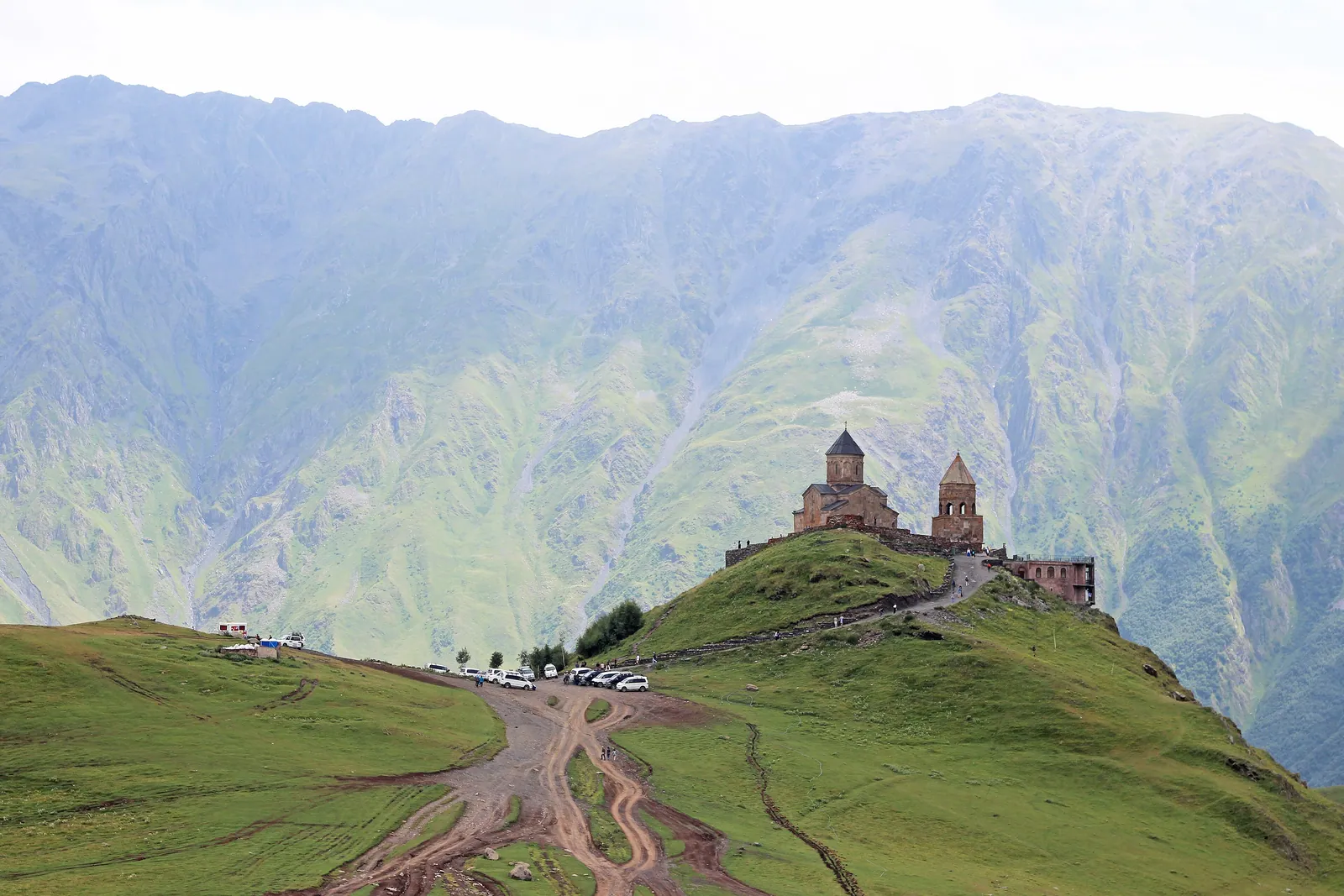
Georgia, the Cradle of Wine
Wine has been made in Georgia for some eight thousand years — longer than anywhere else on Earth. Here is the story of the qvevri, the country's living wine culture, and why the journey east passes through it.
Georgia, the small country wedged between the Caucasus mountains and the Black Sea, has the best claim of anywhere to be the birthplace of wine. Archaeologists have found residue of grape wine in clay vessels here dating back roughly eight thousand years, to the Neolithic — the earliest evidence of winemaking known.
What makes this more than a record-book footnote is that the tradition never stopped. Georgians still make wine the ancient way, in buried clay vessels called qvevri, and wine remains woven through the country's food, faith, language and feasting. To travel in Georgia is to travel through a living wine culture, not a museum of one.
Eight thousand years in the making
The evidence comes from sites in southeastern Georgia, where pottery jars dated to around 6000 BC carry the chemical fingerprints of grape wine. That pushes the origins of winemaking back several centuries earlier than previous claims elsewhere, and places the cradle firmly in the South Caucasus.
Georgia also holds an astonishing genetic library of the grape itself: well over five hundred indigenous varieties, many grown nowhere else. Names like Saperavi, a deep red, and Rkatsiteli, a versatile white, are the everyday workhorses, but the diversity in old village vineyards is far greater — a reservoir of vines accumulated over millennia of continuous cultivation.
The qvevri: winemaking in the earth
The heart of Georgian tradition is the qvevri, a large egg-shaped vessel of clay, lined with beeswax and buried up to its neck in the ground. Grapes — often crushed with skins, stalks and pips — are sealed inside, where they ferment and then age, the surrounding earth holding the qvevri at a naturally steady cool temperature.
The result, particularly for white grapes left in long contact with their skins, is the deep golden, tannic wine the world now calls amber or orange wine — a style Georgia has been making continuously for thousands of years. The ancient qvevri method is recognised by UNESCO on its list of Intangible Cultural Heritage, an acknowledgement that this is a craft, and a culture, worth safeguarding.
Kakheti, the country's wine heartland
Most of Georgia's wine comes from Kakheti, the warm, fertile region in the east, its vineyards spread along river valleys beneath the wall of the Greater Caucasus. The walled town of Sighnaghi looks out over the Alazani Valley, and the surrounding villages are dense with cellars, both large modern wineries and small family operations still working a few qvevri in the yard.
Visiting here, you quickly learn that wine in Georgia is rarely a commercial product first. Many households make their own, the harvest — the rtveli — is a communal event, and a guest is very likely to be led down to the cellar and offered a glass drawn straight from the clay. Hospitality and wine are, in practice, the same subject.
Wine, faith and the feast
Wine runs deep in Georgian Christianity, one of the oldest national churches in the world. Tradition holds that Saint Nino, who brought Christianity to Georgia in the fourth century, carried a cross bound with her own hair — and, in many depictions, a cross of grapevine wood, its arms gently drooping. The vine and the faith have grown together ever since.
Wine is also inseparable from the supra, the Georgian feast, where it is drunk in formal toasts led by a designated toastmaster, the tamada. Toasts here are not casual — they move through set themes of homeland, family, peace and the memory of the departed — and a toast is honoured by emptying the glass. Wine, in Georgia, is the medium of community.
Georgian wine on The Silk Road Reborn
Georgia sits squarely on the historic web of Silk Road routes that crossed the Caucasus, and on The Silk Road Reborn the country is where the journey pauses to taste, quite literally, the depth of its history. A visit to Kakheti — a cellar, a qvevri, a glass of amber wine offered by the family that made it — is one of the most grounding stops on the route.
It is also a lesson in what slow travel is for. A bottle of Georgian wine can be bought anywhere; what cannot be exported is the cellar, the toast, the eight-thousand-year continuity standing behind a single ordinary glass. Tasting it where it is made is the point.
Quick answers
Is Georgia really the birthplace of wine?
It has the strongest evidence. Clay vessels excavated at Neolithic sites in southeastern Georgia carry residue of grape wine dated to roughly 6000 BC — about eight thousand years ago — which is the earliest confirmed winemaking found anywhere. Neighbouring countries in the South Caucasus have ancient wine traditions too, but Georgia's claim is currently the best supported and, importantly, unbroken to the present day.
What is qvevri wine, and what does it taste like?
Qvevri wine is made in large egg-shaped clay vessels buried in the ground, the traditional Georgian method recognised by UNESCO as Intangible Cultural Heritage. White grapes fermented on their skins this way produce deep-golden amber (or orange) wine — more tannic and structured than a conventional white, with notes of dried fruit, nuts and tea. Reds such as Saperavi made in qvevri are full and earthy.
Where do you go to taste wine in Georgia?
Kakheti, in the east, is the main wine region and the most rewarding to visit, with the hilltop town of Sighnaghi as a popular base and countless cellars in the surrounding villages. Many are small family operations where you taste wine drawn straight from the qvevri. Tbilisi, the capital, also has excellent wine bars showcasing producers from across the country.

Let the reading become a route.
When an article sparks something, our planners are the next step. Tell us what you are dreaming of.