The Great Walk on Each of the Six Grand Journeys
Every one of our journeys has a walk at its heart — the trail that lets you meet its landscape on foot. Here is the signature walk of each route, what it asks, and the season that brings out its best.
Each of the six Viajes Globales journeys is built around landscapes you can only truly know by walking into them. The vehicles, the lodges and the cities carry the journey between regions; the walking is where you slow to the speed of the country itself. Every route therefore has a signature walk — sometimes a multi-day trek, sometimes a string of unforgettable day hikes.
This is a guide to those six walks, one per journey. None is technical mountaineering. Each is chosen because it belongs to its landscape, sits at a sensible point in the itinerary so you arrive rested and acclimatised, and rewards a fit, ordinary traveller. Use it to picture the walk that would mean the most to you.
Andes to Antarctica — the W Trek, Patagonia
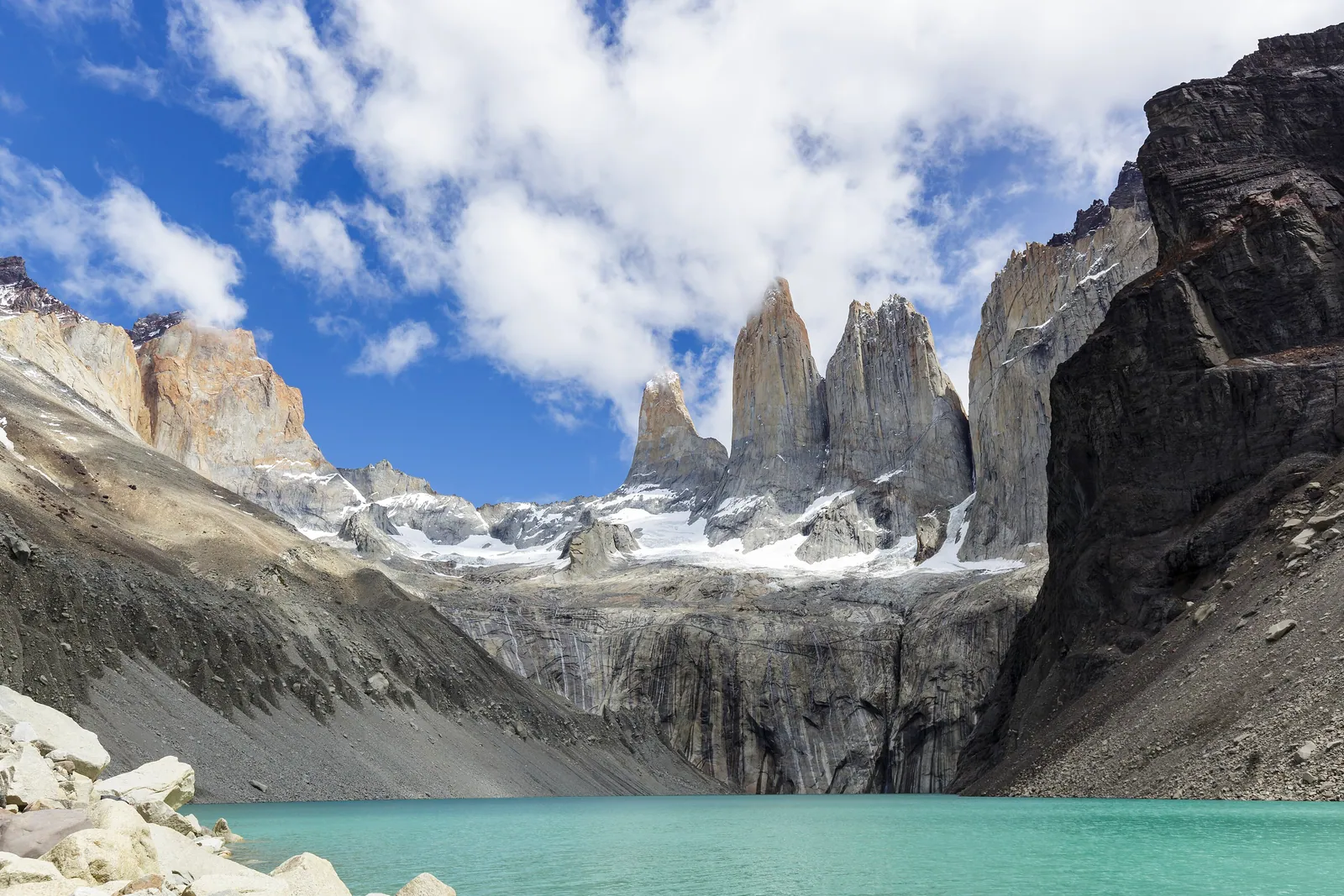
The walking heart of Andes to Antarctica is the W Trek in Chile's Torres del Paine, a four- or five-day route of roughly 70 to 100 kilometres through three valleys: to the granite towers at dawn, up the avalanche-loud French Valley, and out to the icebergs of Grey Glacier. It is walked refugio to refugio with a light daypack.
The journey also offers day walks from El Chalten in Argentina — Laguna de los Tres beneath Fitz Roy, Laguna Torre — and a walking approach to Machu Picchu by the Inca alternatives. The Patagonian season is the southern summer, November to March, with strong wind a near-constant companion.
The Long Way East — lodge-to-lodge in the Himalaya
On The Long Way East the signature walk is a lodge-to-lodge trek in the Nepal Himalaya, sleeping each night in a family-run village inn with a warm dining room and a hot meal. Daily distances are modest — in the high mountains it is the ascent, not the kilometres, that counts — and the itinerary caps each day's climb with rest days built in.
The walking days are deliberately gentle and woven between the cities and monasteries of the route, so you reach the high valleys already rested and partly acclimatised. The seasons are pre-monsoon spring, March to May, and post-monsoon autumn, late September to November, the latter prized for stable, clear skies.
The Great Rift — the Simien escarpment, Ethiopia
The Great Rift's defining walk runs along the escarpment of Ethiopia's Simien Mountains, a UNESCO range of grass plateaus that fall away in thousand-metre cliffs. A traverse of three to six days, walked at 3,000 to 4,000 metres or higher, passes troops of gelada — the cliff-dwelling primates found nowhere else on Earth — grazing unbothered at the trail's edge.
The walking is non-technical, though the altitude is real and asks for gradual ascent. Fit walkers can add Ras Dashen, Ethiopia's highest summit at 4,543 metres. The dry season, October to March, brings the clearest air and the firmest footing.
The Silk Road Reborn — the valleys of the Tien Shan
The Silk Road Reborn crosses Central Asia, and its walking belongs to the Tien Shan — the celestial mountains whose snow once watered the caravan oases. Day walks and short treks lead through alpine valleys, past summer pastures still grazed by herders, and beside high lakes such as Kyrgyzstan's Song-Kol, where shepherds raise yurts through the warm months.
This is gentler, pastoral walking rather than committing high-altitude trekking, and it is at its best in the short mountain summer, roughly June to September, when the passes are open, the pastures green and the herders' camps in use. It pairs the great Silk Road cities with the mountain country between them.
The Pacific Arc and Beyond the Blue — coast, forest and fjord
The Pacific Arc follows the volcanic rim of the ocean, and its walks are day hikes through that geology — cloud forest, lava field and crater rim, with the trails of New Zealand's Fiordland among the finest, threading temperate rainforest beneath waterfalls toward Milford Sound. The southern hemisphere summer, roughly November to March, is the walking season.
Beyond the Blue is a journey of islands and oceans, and its walking is coastal and volcanic: headland paths, reef walks at low tide, and the climb to a high lookout for the long view over water. Both journeys favour shorter walks that return to comfortable bases, which suits travellers who want wild country without committing every night to the trail.
Quick answers
Which journey has the most demanding walking?
The Long Way East, because its Himalayan lodge-to-lodge trekking combines real altitude with consecutive walking days, and Andes to Antarctica, with the multi-day W Trek. The Great Rift's Simien traverse is also at altitude but generally shorter. The Silk Road Reborn, the Pacific Arc and Beyond the Blue lean toward day walks, which are less committing though still rewarding.
Can I join a journey if I do not want to do the big walk?
Yes. Our journeys are arranged so the walking is offered rather than imposed. On multi-day treks the itinerary is built so you can rejoin the group lower down or by another route if a particular stretch is not for you. Journeys based on day hikes naturally let you choose your effort each morning. The walking is part of the journey, never a barrier to it.
Are these walks at the right time for the best conditions?
Yes — each journey is timed to its walk's best season. Patagonia runs in the southern summer, the Himalaya in spring or autumn, the Simien in the dry season from October, the Tien Shan in the short mountain summer, and the Pacific walks in the southern summer. Travelling with the season, not against it, is central to how we plan.
Let the reading become a route.
When an article sparks something, our planners are the next step. Tell us what you are dreaming of.