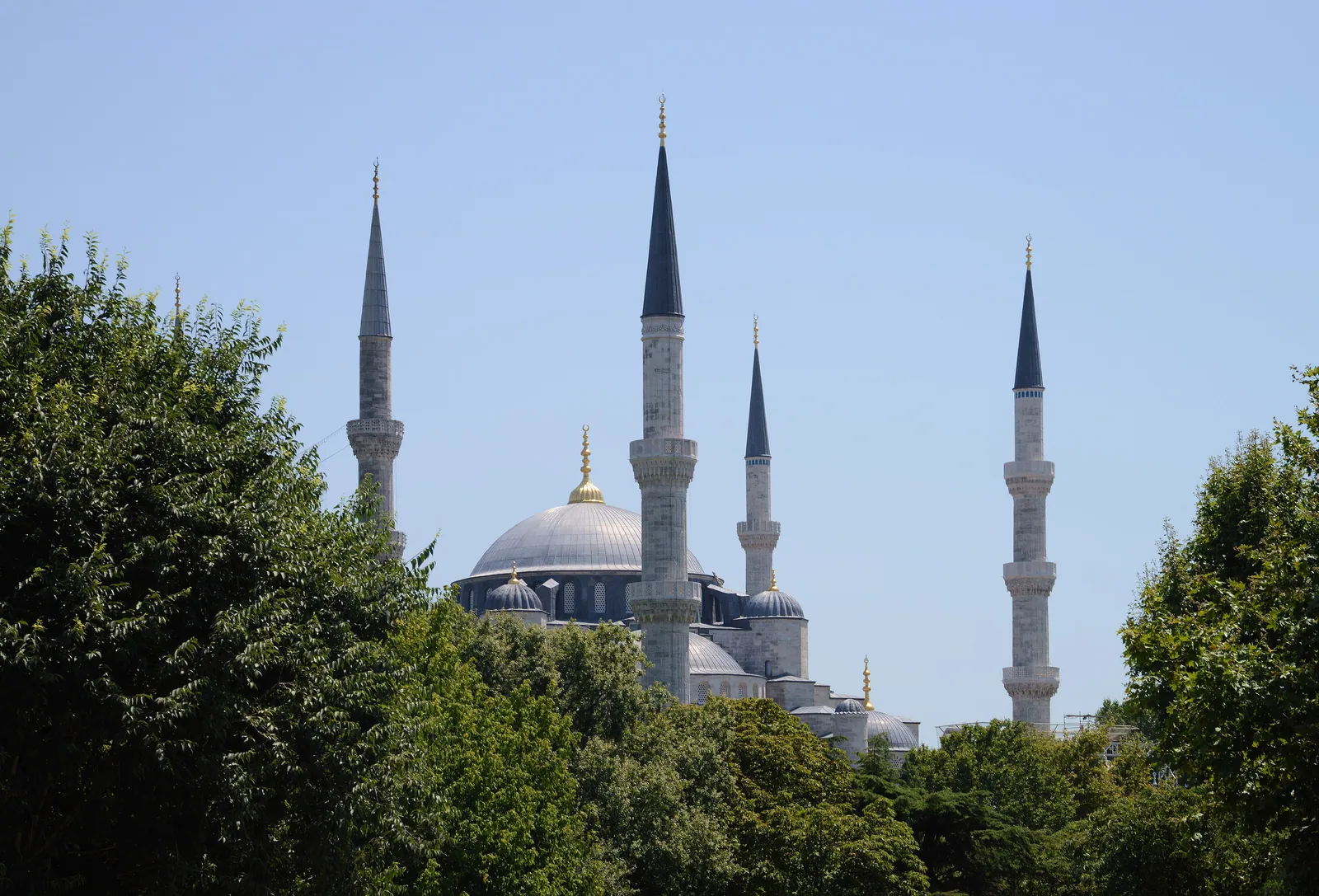
Hagia Sophia and the Layered Faiths of Istanbul
For nearly fifteen centuries one building has stood at the centre of Istanbul, serving in turn as cathedral, mosque, museum and mosque again. Hagia Sophia is the city's whole history compressed into a single dome.
Hagia Sophia, on the historic peninsula of Istanbul, is among the most important buildings ever raised — and the clearest single key to the city. Completed in 537 as the great cathedral of the Byzantine Empire, it later became an Ottoman mosque, then a museum, and since 2020 has functioned as a mosque once more.
That sequence is not a series of accidents; it is the history of the city itself, written into one structure. To stand under the dome of Hagia Sophia is to stand inside the meeting point of the Christian and Islamic worlds, of Europe and Asia, of empire after empire — which is why no visit to Istanbul is complete without it.
The dome that changed architecture
Hagia Sophia was built in just five years for the Byzantine emperor Justinian, and completed in 537. Its central dome — more than thirty metres across and floating some fifty-five metres above the floor — was an engineering leap of extraordinary daring, achieved by setting the round dome over a square space using curved triangular sections called pendentives.
The effect on anyone who enters is the same now as it was for medieval visitors: the dome seems to rest on light, pierced as it is by a ring of windows at its base. For close to a thousand years Hagia Sophia was the largest cathedral in the world, and it reshaped what builders believed a dome could do — its influence runs through Ottoman mosque architecture and far beyond.
Cathedral, mosque, museum, mosque
For nearly a millennium Hagia Sophia was the principal church of Eastern Christianity and the setting for Byzantine imperial ceremony. When Constantinople fell to the Ottomans in 1453, Sultan Mehmed II converted it into a mosque, adding the four slender minarets that now frame it, a mihrab and minbar, and great round calligraphic panels.
In 1934, the secular Turkish Republic under Atatürk turned the building into a museum, a status it held for some eighty-six years. In 2020 it was reconverted to a working mosque. Each of these changes left its mark, and the building you visit today carries all of them at once — a layered monument rather than a frozen one.
Reading the walls: mosaics and calligraphy
The interior is where the layers become visible. High on the walls and in the galleries survive Byzantine gold-ground mosaics — among them a serene Christ, the Virgin and Child in the apse, and emperors and empresses in formal procession. Many were plastered over after the conversion to a mosque, and later uncovered; their partial survival is itself part of the story.
Alongside them hang the enormous Ottoman roundels, their flowing Arabic calligraphy naming God, the Prophet and the early caliphs, and the mihrab marks the direction of Mecca. Christian and Islamic art share the same vast space, and learning to read both is the real work of a visit. A knowledgeable guide is invaluable here.
Visiting a working mosque
Because Hagia Sophia is again an active mosque, a visit asks for the same respect due at any place of worship. Dress modestly — shoulders and knees covered — and women are asked to cover their hair; scarves are usually available at the entrance if you arrive without one. You remove your shoes before stepping onto the carpeted prayer area.
The building closes to sightseeing during the five daily prayer times, so it is worth checking the timings and arriving outside them. Visited thoughtfully and at the right hour, it remains entirely open to travellers of every background — a place of prayer that is also one of the world's great shared monuments.
A neighbourhood of layered faith
Hagia Sophia does not stand alone. Directly across the square is the early-seventeenth-century Sultan Ahmed Mosque, the Blue Mosque, deliberately built to answer it; a short walk away the Byzantine Basilica Cistern still holds its forest of submerged columns, and the Topkapı Palace spreads over the point of the peninsula. The whole district is a UNESCO World Heritage Site.
On The Silk Road Reborn, Istanbul is the western threshold of the journey, and Hagia Sophia is where its central theme — the constant meeting and overlaying of civilisations along the old routes east — is most concentrated. One dome, four roles, fifteen centuries: the building is the journey's argument made visible in stone.
Quick answers
Can tourists still visit Hagia Sophia?
Yes. Although Hagia Sophia returned to use as a working mosque in 2020, it remains open to visitors of all backgrounds outside of prayer times. You should dress modestly, remove your shoes before entering the carpeted area, and women are asked to cover their hair — scarves are generally available at the door. Check the prayer schedule, as sightseeing access pauses during the five daily prayers.
Why is Hagia Sophia so historically important?
Completed in 537, it was the largest cathedral in the world for nearly a thousand years, and its vast dome was a revolutionary feat of engineering that influenced architecture for centuries, including Ottoman mosque design. It also served successively as a Byzantine cathedral, an Ottoman mosque, a museum and a mosque again — making it a unique physical record of Istanbul's layered Christian and Islamic history.
Can you still see the Christian mosaics inside?
Yes, a number of the Byzantine gold mosaics survive and remain visible, including figures of Christ, the Virgin and Child, and Byzantine emperors. Many were covered with plaster after the building became a mosque and later uncovered. Today they share the interior with monumental Ottoman calligraphic roundels — the coexistence of the two is one of the main reasons to visit.
Let the reading become a route.
When an article sparks something, our planners are the next step. Tell us what you are dreaming of.