Incahuasi: The Cactus Island in a Sea of Salt
In the middle of the Salar de Uyuni stands a rocky island crowded with giant cacti and built from ancient coral. The story of Incahuasi — once a real shoreline, now a viewpoint over a vanished lake.
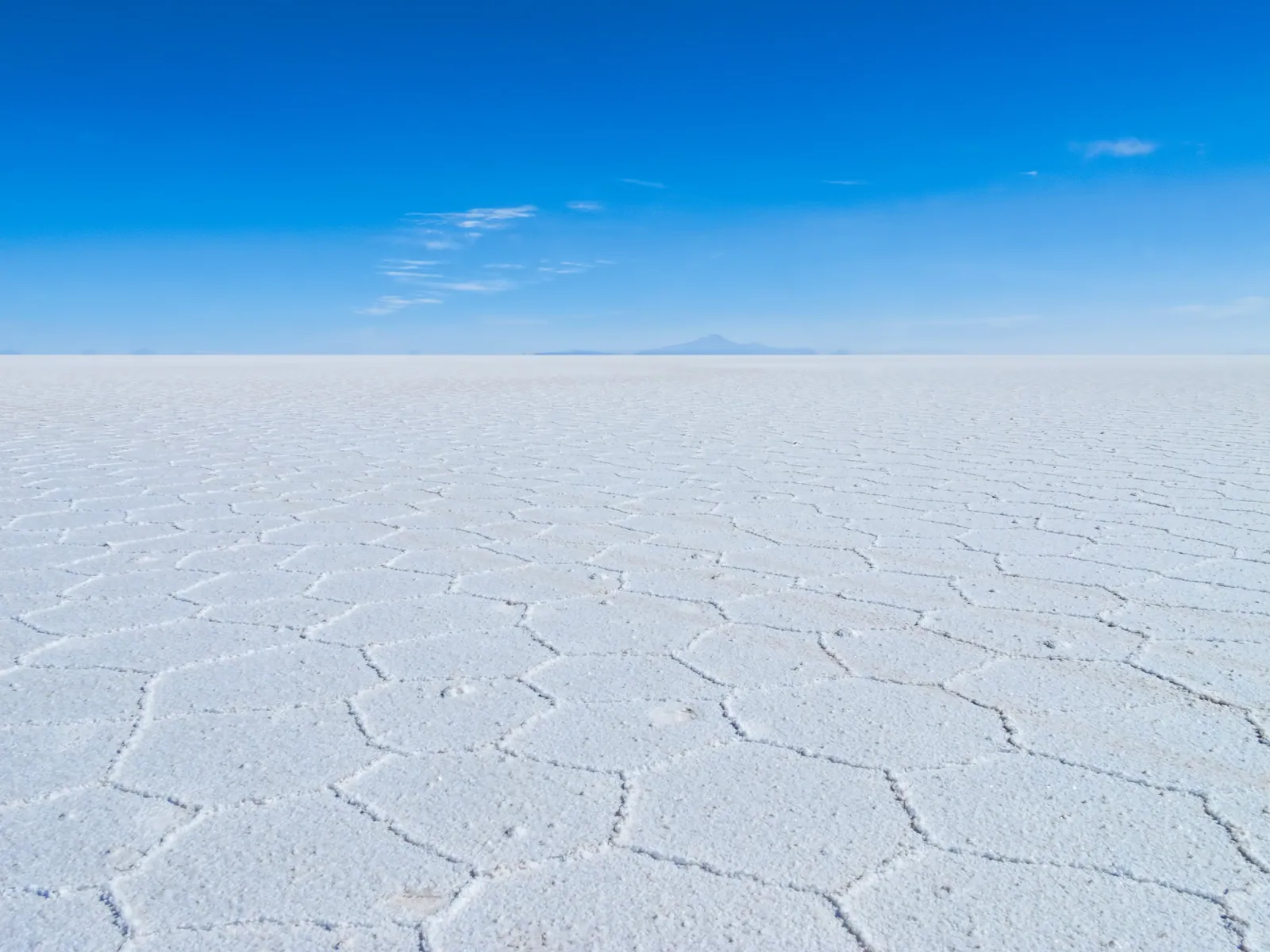
Roughly in the centre of the Salar de Uyuni, an hour or so by vehicle from the salt flat’s edge, a rocky outcrop breaks the white horizon. This is Incahuasi — sometimes called Isla del Pescado for its fish-like profile — a hill bristling with hundreds of giant cacti and ringed by walking trails. From its summit the salar opens in every direction, a blinding plain that meets the sky without a seam.
Incahuasi is the eroded remnant of an ancient volcano, and its surface is encrusted with fossilised coral and algal structures. That detail is the key to the place: this hill was once an island in a real lake. The cacti are Echinopsis atacamensis, a slow-growing species that can exceed ten metres in height, meaning the tallest among them are many centuries old.
An island that was once truly an island
The Salar de Uyuni is the dried bed of vast prehistoric lakes that covered much of the southern altiplano during the Pleistocene, the largest of them known as Lake Tauca. When those lakes filled the basin, outcrops like Incahuasi genuinely were islands, with water lapping their shores.
As the climate dried and the lakes evaporated, they left behind the immense salt crust we see today, and the former islands became hills marooned in white. The fossil coral and stromatolite formations covering Incahuasi are the petrified record of that underwater past — a coral reef stranded at 3,650 metres in the middle of a desert.
A forest of ancient cacti
Incahuasi is famous for its dense stand of Echinopsis atacamensis (also known as Trichocereus), a columnar cactus adapted to extreme aridity, intense sun and freezing nights. The species grows extremely slowly — on the order of a centimetre or so a year — so the giants that tower above the trails, several metres tall, have stood there for centuries.
The contrast is the draw: spiny green columns rising from a coral-crusted hill, set against an endless white plain. A short loop trail climbs through the cacti to viewpoints over the salar, and the walk is the reason most travellers stop here — though at this altitude even a gentle ascent is felt.
Visiting the island, and when you can
Reaching Incahuasi means driving across the open salar, which is straightforward when the flat is dry — roughly May to November — and the island is a standard stop on dry-season crossings. In the wet season, standing water often makes the interior of the salar impassable to vehicles, and the island can be cut off for weeks at a time.
There is a modest entrance fee, a short network of marked paths, and very little else: no town, minimal facilities. The trails are easy to follow but steepen near the top, and the salt glare is relentless, so sunglasses, sunscreen and a hat are essential. Most visits last an hour or two — long enough to climb, take in the view and walk the loop.
The light, the scale and the silence
Incahuasi is at its best in the soft light of early morning or late afternoon, when the low sun rakes across the cacti and the salt shifts from white to gold. Midday is harsh and flattening, though the panorama remains extraordinary. A clear night here, under one of the darkest skies on the continent, is something many travellers remember above all else.
What stays with people is the sense of scale. Standing among centuries-old cacti on a fossil reef, surrounded by a salt sea to every horizon, the ordinary measures of landscape stop applying. It is one of the few places where geological time feels almost visible.
Incahuasi on the Andes to Antarctica route
On the Andes to Antarctica journey, a stop at Incahuasi anchors the salt-flat day, giving travellers a high point — literally — from which to grasp the immensity of the salar before continuing south toward the coloured lagoons and the Atacama.
Because access depends on the salar being dry, our guides plan the day around current conditions, knowing the wider altiplano route still rewards travellers handsomely even when the island itself is unreachable. By the time anyone climbs Incahuasi’s trails, earlier days at altitude have done their work, and the ascent is a pleasure rather than a struggle.
Quick answers
Why are there cacti in the middle of a salt flat?
Incahuasi is a rocky hill — the eroded remnant of an ancient volcano — not salt, so plants can root there. Its giant Echinopsis cacti are adapted to extreme aridity and temperature swings. The hill was an island in prehistoric lakes that once filled the basin; when they dried, it was left surrounded by salt crust.
How old are the cacti on Incahuasi?
Many are centuries old. The species, Echinopsis atacamensis, grows only about a centimetre or so per year, so the largest specimens — several metres tall — have been growing for hundreds of years. Their slow growth is an adaptation to the harsh, dry, high-altitude environment.
Can you visit Incahuasi year-round?
Not reliably. In the dry season (roughly May to November) vehicles cross the firm salt easily and the island is a standard stop. In the wet season, standing water frequently floods the interior of the salar and can leave Incahuasi inaccessible for extended periods.
Let the reading become a route.
When an article sparks something, our planners are the next step. Tell us what you are dreaming of.