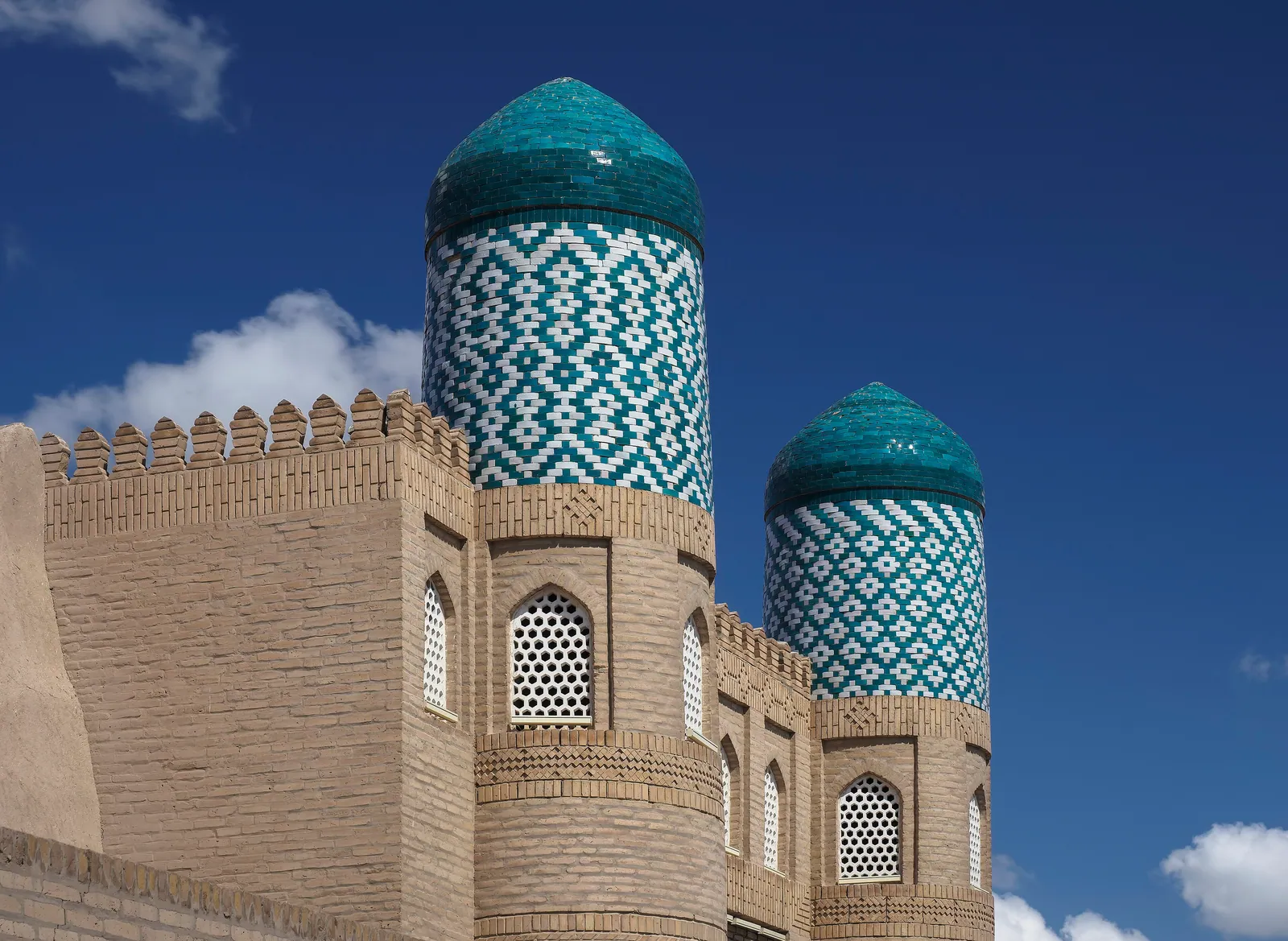
Khiva: The Walled City of the Desert
Inside its mud-brick walls, Khiva is the most concentrated old town on the Silk Road — a complete medieval city you can cross in twenty minutes. Here is what the walled Itchan Kala holds, and how it came to be so intact.
Khiva is the westernmost of Uzbekistan's three great Silk Road cities, and the most extreme. Its old town, the Itchan Kala, is entirely enclosed by mud-brick walls roughly ten metres high, and inside them stands a near-complete medieval city — minarets, madrasas, a royal palace, mosques and merchant houses, packed so tightly you can walk from gate to gate in twenty minutes.
It was the first site in Uzbekistan inscribed by UNESCO, listed in 1990. Khiva owes its remarkable preservation partly to remoteness — it sits on the edge of the Kyzylkum desert, far from the main routes — and partly to a deliberate 20th-century decision to protect the whole walled core as a single monument. It is the climax of our Silk Road Reborn journey, the point where the route reaches the desert and the city closes around you.
An oasis on the edge of the desert
Khiva grew on the Khorezm oasis, watered by the lower Amu Darya river before the river loses itself toward the shrinking Aral Sea. The oasis has been settled for well over two thousand years, and local tradition holds that the city sprang up around a well dug by a son of Noah — a legend that says less about history than about how old Khiva feels.
From the 16th century Khiva was the capital of the Khanate of Khiva, one of three Central Asian khanates alongside Bukhara and Kokand. It was a real Silk Road waypoint, but also, less proudly, a notorious slave market until the Russian conquest of 1873. Much of the architecture visible today dates from that final flourishing of the khanate in the 18th and 19th centuries.
The Itchan Kala and its walls
The Itchan Kala — the inner town — is the part travellers come for. Its walls, rebuilt many times and last substantially in the 18th century, run for some two kilometres and are pierced by four gates, one at each point of the compass. The main entrance is the western Ata Darvoza gate.
Inside, the scale is intimate. The lanes are narrow, the buildings low and earth-coloured, and the famous tiled minarets rise above them as landmarks. Because the walls hold the city to its medieval footprint, Khiva reads as a single designed object in a way that few old towns do. It is small enough to learn in an afternoon and rich enough to reward several.
The Kalta Minor and the Islam Khoja minaret
Khiva's signature is a minaret that was never finished. The Kalta Minor — the short minaret — was begun in 1851 by Muhammad Amin Khan, who reportedly intended a tower so tall he could see Bukhara from its top. He died in 1855 and the work stopped. What remains is a wide, stubby drum, but it is unique in Central Asia: glazed entirely in bands of turquoise, blue and green tile from base to truncated top.
Its counterpoint is the Islam Khoja minaret, the tallest in Khiva at around 57 metres, completed in 1910. Slender where the Kalta Minor is squat, tapering and banded with delicate tilework, it can be climbed by a tight internal stair for the best view over the walled city's roofscape.
Palaces, mosques and the wooden columns
Two royal residences anchor the Itchan Kala. The Kunya Ark is the older fortress-palace of the Khivan rulers, with a tiled throne room and a bastion offering a fine elevated view. The Tash Khauli palace, built in the 1830s, is the more elaborate — a maze of more than 150 rooms and several courtyards, the harem courtyard lined with richly painted tile and timber.
Khiva's quietest masterpiece is the Juma Mosque, the Friday mosque. It is a single low hall whose roof is held up by 213 wooden columns, no two carved alike — some over a thousand years old, salvaged from earlier buildings. Light falls through a few openings in the roof onto the forest of pillars below. After the glare of the lanes, it is the coolest and stillest room in the city.
Khiva as a place to stay, not just visit
Khiva is often described as an open-air museum, and the walled core is indeed managed as a heritage reserve. But people still live and trade inside the Itchan Kala, and several historic madrasas have been converted into small hotels, so it is genuinely possible to sleep within the walls.
That changes the city. The day-trip crowds arrive late and leave early; spend a night and you have the early morning and the blue evening hour largely to yourself, the minarets catching low light and the lanes nearly empty. On The Silk Road Reborn we plan an overnight inside the walls for exactly that reason — Khiva is at its best when the gates have quietened and the desert silence returns.
Quick answers
What is the Itchan Kala?
The Itchan Kala is the walled inner town of Khiva — a near-complete medieval city enclosed by mud-brick walls about ten metres high and two kilometres long, with four gates. It contains minarets, madrasas, mosques and two royal palaces. It was the first site in Uzbekistan inscribed on the UNESCO World Heritage List, in 1990.
Why is the Kalta Minor minaret so short and wide?
The Kalta Minor was never finished. Begun in 1851 by Muhammad Amin Khan, who is said to have wanted a tower tall enough to see Bukhara, construction stopped when he died in 1855. What remains is a broad, truncated drum — but it is unique for being glazed entirely in turquoise and blue tile from base to top.
Can you stay overnight inside Khiva's walls?
Yes. Several historic madrasas within the Itchan Kala have been converted into small hotels, so it is possible to sleep inside the walled city. Doing so is worthwhile: the day-trip crowds leave by evening, giving you the quiet early morning and dusk, when Khiva is at its most atmospheric.
Let the reading become a route.
When an article sparks something, our planners are the next step. Tell us what you are dreaming of.