Moroccan Food and the Tagine: Slow Cooking in a Conical Pot
The tagine is both a dish and the clay pot it is named for — a piece of desert engineering that turns tough cuts and humble vegetables tender and fragrant. It is the doorway into the Moroccan table.
Say tagine and you mean two things at once: the shallow earthenware pot with its tall conical lid, and the slow-simmered stew cooked inside it. Travellers crossing Morocco on The Pacific Arc meet it everywhere, from a roadside grill in the Atlas to a courtyard riad in Marrakech, and it is the single best entry point into one of the Mediterranean world's great cuisines.
Moroccan food, at its core, is the cooking of patience and balance. It combines Amazigh (Berber) mountain traditions, Arab spice, Andalusian refinement and Saharan trade, and it leans on a handful of moves — slow heat, layered spice, the marriage of savoury and sweet — that the tagine pot performs better than almost any other vessel.
How the pot actually works
The tagine pot is a piece of low-technology brilliance. Food is layered in the wide, shallow base; the tall conical lid sits over it and traps the rising steam. As the steam meets the cooler peak of the cone it condenses and trickles back down onto the food. The result is a closed, self-basting cycle that cooks gently and loses very little moisture.
This matters in a place where water and fuel were historically precious. A tagine can be set over a low charcoal fire or a scattering of embers and left almost alone, slowly turning a cheap, tough cut or a pile of root vegetables tender and deeply flavoured. The conical lid is not decoration — it is the engine of the dish.
What goes into a tagine
A classic tagine builds in layers: a little oil, then onion and the protein or main vegetable, then spices, then ingredients that release liquid as they cook, so the stew makes much of its own sauce. The spicing is warm rather than fiery — cumin, ginger, turmeric, cinnamon, sweet paprika, saffron, black pepper — and often a spice blend known as ras el hanout, meaning roughly the top of the shop, the merchant's finest mixture.
The most loved tagines pair savoury with sweet and sour. Lamb with prunes and almonds, gently sweet and scented with cinnamon, is a celebration dish. Chicken with preserved lemon and green olives is the bright, salty counterpart — and preserved lemons, whole lemons cured in salt until soft, are a defining Moroccan ingredient. Vegetable tagines, with carrot, potato, courgette and chickpeas, are everywhere and entirely satisfying. Most tagines are eaten with bread, khobz, used to scoop, rather than with cutlery.
Beyond the tagine: couscous, harira and the wider table
The tagine has famous companions. Couscous — steamed semolina, traditionally prepared over a simmering pot of meat and vegetables — is the great dish of Friday, the Muslim day of communal prayer, and a proper couscous is a labour of repeated steaming. Harira, a hearty tomato, lentil and chickpea soup, is the soup that breaks the fast each evening during Ramadan.
Then there are the dishes that show Morocco's range. Pastilla is an extraordinary savoury-sweet pie, traditionally of pigeon or chicken, wrapped in thin warqa pastry and dusted with cinnamon and sugar. Mechoui is whole lamb slow-roasted until it falls apart. Grilled brochettes and kefta, spiced minced-meat skewers, are the everyday street food. And the day is held together by mint tea — green tea brewed strong with fresh mint and a generous amount of sugar, poured from a height to crown the glass with foam, and offered as the universal gesture of welcome.
The market, the bread oven and the communal meal
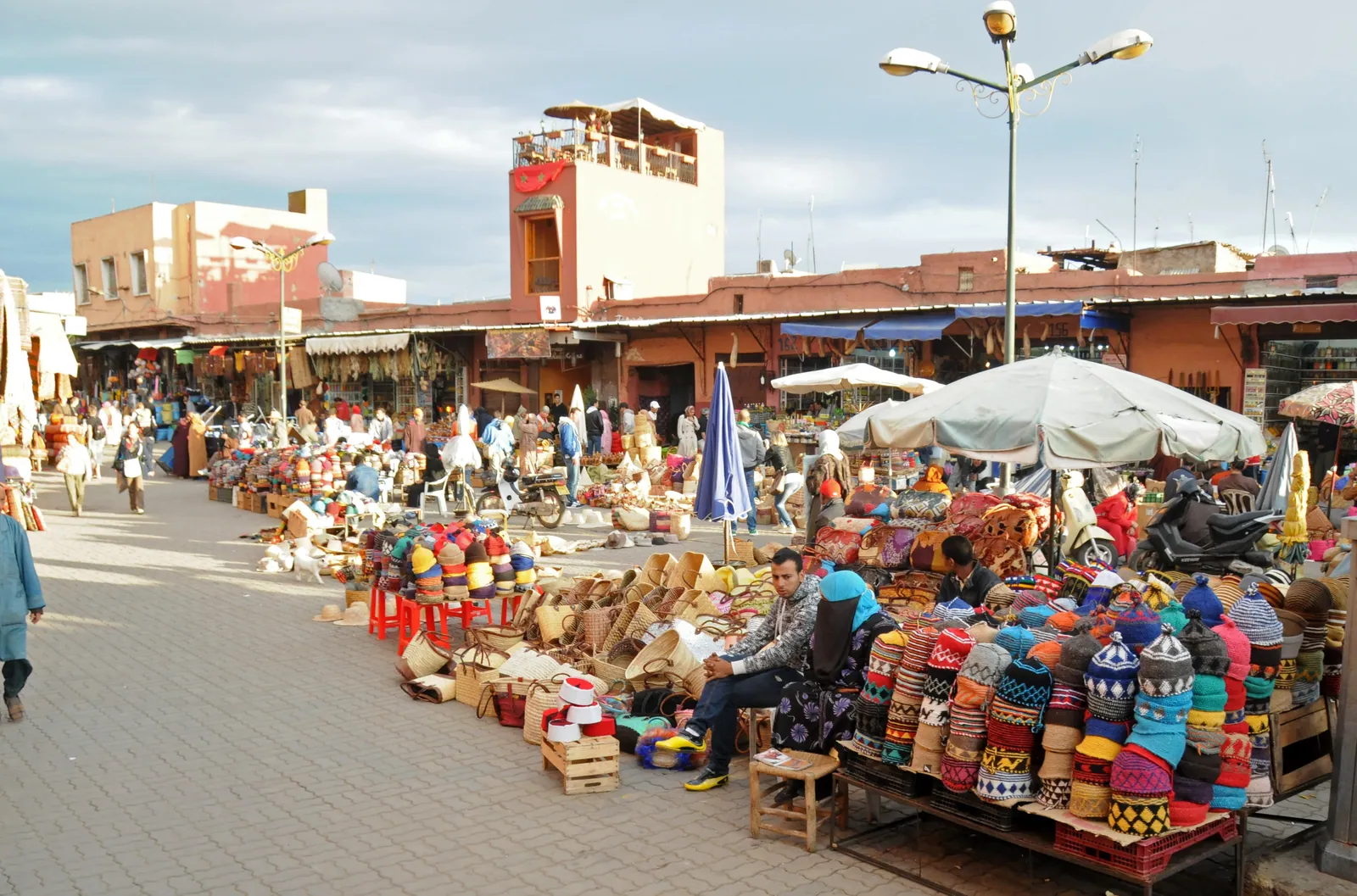
Moroccan food is inseparable from the souk, the market. The spice stalls of Marrakech, with their cones of cumin and paprika and baskets of preserved lemons and olives, are not staged for visitors — they are how households shop. Many neighbourhoods still share a communal wood-fired oven, the ferran, where families bring their own shaped dough and trays to be baked, and a hammam next door heated by the same fire.
The meal itself is communal. A tagine arrives in its pot at the centre of the table and is eaten from the edge inward, each person working the section in front of them, scooping with bread held in the right hand. Sharing one dish is not a constraint but the point: Moroccan hospitality is built around the single pot and the open door.
Eating Morocco well
To eat Morocco properly, slow down to the food's own pace. Seek out a tagine that has genuinely been cooked slowly — at a good address it will have simmered for hours, the lamb yielding, the sauce reduced and glossy. Try a Friday couscous if your travels allow. Visit a spice souk with someone who can explain it, and accept the mint tea every time it is offered; refusing it politely is harder than simply enjoying it.
A note for the curious: a true tagine, slow-cooked, is a different thing from a hurried hotel version. The journeys that cross Morocco are built to put travellers at the unhurried table — a courtyard dinner in Marrakech, a mountain lunch in the Atlas — where the pot has been allowed the time it needs.
Quick answers
Is a tagine the pot or the dish?
Both. Tagine is the name of the shallow earthenware pot with the tall conical lid, and also of the slow-cooked stew prepared in it. The conical lid traps and condenses steam so the food cooks gently in its own moisture, which is why the dish and the vessel share a name.
Are there good options for vegetarians in Moroccan cuisine?
Yes. Vegetable tagines — built around carrot, potato, courgette, pumpkin and chickpeas — are common and genuinely good, and salads of cooked vegetables are a Moroccan strength. Take one care: meat-based dishes and stocks are widespread, and a vegetable couscous may be steamed over a meat broth, so it is worth confirming when you order.
What is ras el hanout?
Ras el hanout is a Moroccan spice blend whose name means roughly the top of the shop — the best mixture a spice merchant offers. There is no fixed recipe; a blend may contain a dozen or more spices, typically including cumin, ginger, cinnamon, cardamom, pepper and dried flowers. It is used to season tagines, couscous and grilled meats.

Let the reading become a route.
When an article sparks something, our planners are the next step. Tell us what you are dreaming of.