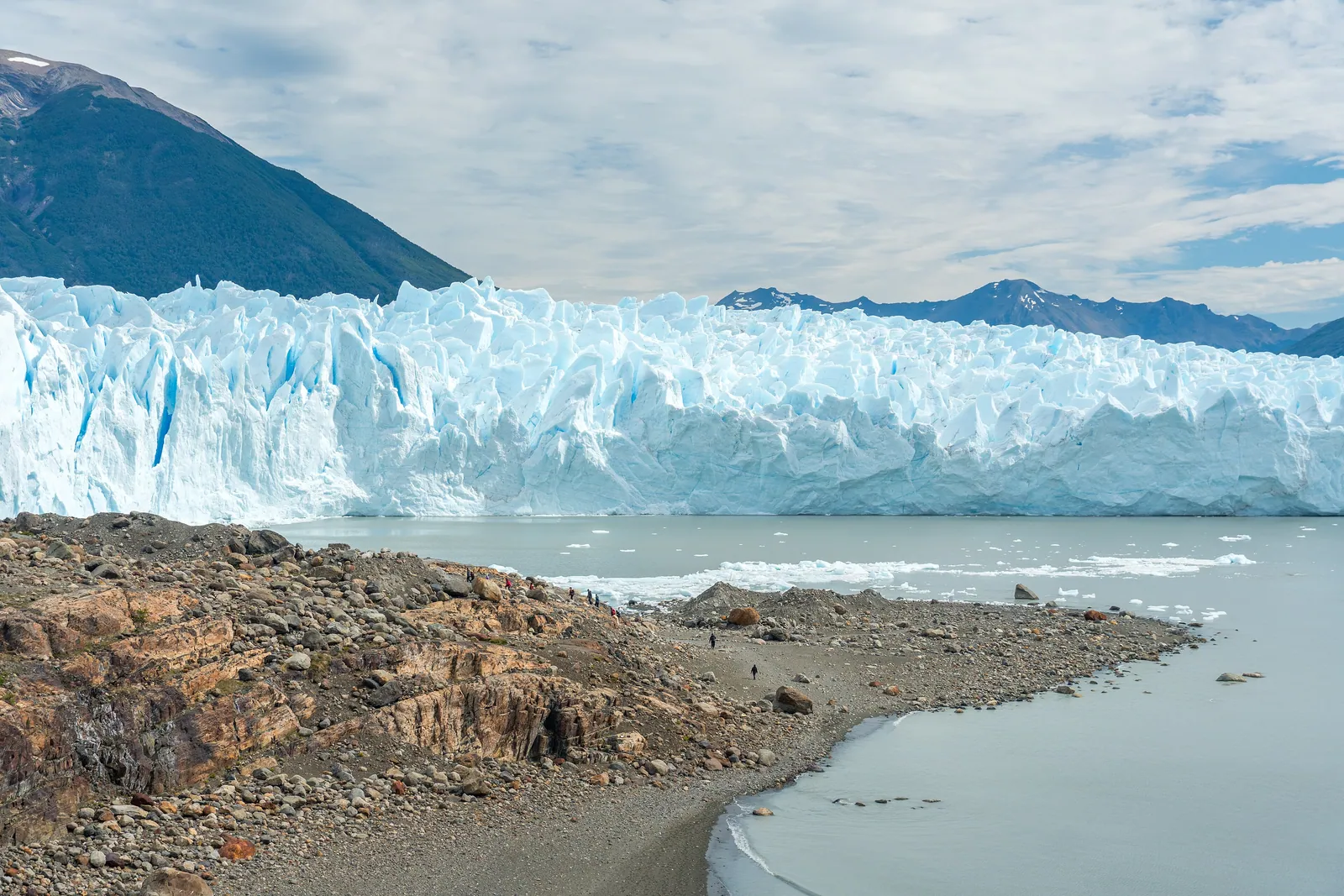
Perito Moreno: The Glacier That Advances
Most of the world's glaciers are retreating. Perito Moreno, in Argentine Patagonia, is famously not — and every few years it builds an ice dam across a lake until the water breaks through in a spectacle decades in the making.
Perito Moreno is a glacier in Los Glaciares National Park, in the Santa Cruz province of Argentine Patagonia, and it is the most visited ice in South America. It descends from the Southern Patagonian Ice Field to the turquoise water of Lago Argentino, presenting a front roughly five kilometres wide and around 60 metres high above the lake — a wall of ice you can stand level with from a network of steel walkways.
Its fame rests on two things. First, while glaciers worldwide are shrinking, Perito Moreno has long been close to balance, neither markedly advancing nor retreating over the long term — a rare stability that makes it a touchstone for visitors and scientists alike. Second, it performs. The glacier calves almost constantly, and every few years it stages a rupture event of such drama that it draws crowds from across the world. It is the natural showpiece of the Patagonian leg of our Andes to Antarctica journey.
Where it sits and how to see it
Perito Moreno lies about 80 kilometres by road from El Calafate, the lakeside town that serves as the gateway to Los Glaciares. The drive runs along the shore of Lago Argentino and into the national park, ending at the Península de Magallanes opposite the glacier face.
From the peninsula, a system of metal boardwalks and viewing platforms steps down the hillside, letting you watch the ice from several heights and angles, often from only a few hundred metres away. Boat trips run on the lake for a view from the water, and the ice itself can be walked on with licensed operators offering crampon excursions, from a short minitrekking outing to a longer traverse.
Why this glacier holds its ground
A glacier advances or retreats depending on the balance between snow accumulating high in its catchment and ice lost by melting and calving lower down. Perito Moreno draws on a large, high, snowy basin within the Southern Patagonian Ice Field, and for decades the supply from above has roughly matched the loss below, so its front has stayed remarkably steady while neighbouring glaciers thin and recede.
It is important not to romanticise this. A stable glacier in a warming world is unusual rather than reassuring, and scientists treat Perito Moreno as a special case shaped by its particular geometry, not as evidence that all is well. Long-term monitoring continues, and recent observations suggest even this glacier is not entirely immune to change.
The rupture: an ice dam and its collapse
The glacier's signature event begins when its advancing snout pushes against the Magallanes peninsula and seals off the southern arm of Lago Argentino, the Brazo Rico, from the main lake. With the outflow blocked, water trapped behind the ice dam rises — historically by tens of metres — until the pressure forces a channel through the base of the glacier.
Once water finds a way under the ice, it carves a tunnel that widens fast, and the spectacle accelerates over hours or days. The roof of the tunnel grows into an ice bridge spanning the channel, and eventually that bridge collapses into the lake in a thunderous fall of ice. The cycle is irregular — sometimes years apart — and the timing cannot be reliably predicted, which is part of the legend.
Calving: the everyday spectacle
You do not need a rupture year to be rewarded. Perito Moreno calves continuously: slabs and towers of ice break from the face and crash into Lago Argentino throughout the day, each fall preceded by a crack like a rifle shot that rolls across the water before the ice even moves.
Patience is the only skill required. Settle on a platform, give the face your attention, and the glacier will perform — a column of ancient blue ice toppling into green water, sending up a plume and a slow wave. The blue tint, incidentally, is real physics: glacial ice is so dense and bubble-free that it absorbs the longer red wavelengths of light and scatters back the blue.
Visiting well
Perito Moreno can be visited year-round; the boardwalks stay open through the seasons. Summer brings the longest days and the most calving activity as warmer temperatures loosen the ice, while winter offers a quieter, frosted, snow-rimmed glacier with far fewer visitors. Patagonian weather is changeable in every season, so layered, windproof clothing is wise whenever you come.
Allow a full, unhurried day. The glacier rewards lingering far more than a quick photo stop, and the light shifts the ice from white to grey to a deep electric blue as the hours pass. On our journeys the day at Perito Moreno is paired with time in El Calafate and the wider Los Glaciares park, so the glacier is met as the centrepiece of a region rather than a roadside attraction.
Quick answers
Is the Perito Moreno glacier really not retreating?
For decades Perito Moreno has stayed close to balance — its front neither markedly advancing nor retreating over the long term — which is unusual in a warming world where most glaciers are shrinking. This stability comes from its particular high, snowy catchment and geometry. It is treated by scientists as a special case, not as a sign that glaciers generally are stable, and monitoring continues.
Can I predict when the next rupture will happen?
No. The ice-dam rupture, in which the glacier seals off an arm of Lago Argentino and water eventually breaks through to collapse an ice bridge, happens on an irregular cycle that has ranged from a year or two to many years apart. Its timing cannot be reliably forecast. The everyday calving of ice from the face, however, happens continuously and is reward enough on any visit.
Can you walk on the Perito Moreno glacier?
Yes, with licensed operators. Crampon excursions on the ice range from a short minitrekking outing of an hour or two to a longer traverse of several hours, all led by guides who fit the equipment and choose a safe route. These trips have age and fitness requirements. You can also view the glacier from the boardwalks or from boats on Lago Argentino.
Let the reading become a route.
When an article sparks something, our planners are the next step. Tell us what you are dreaming of.