Rainbow Mountain and the Wilds Beyond Machu Picchu
Machu Picchu is the centrepiece, but the region around it holds the striped slopes of Vinicunca and the remote Vilcabamba range — the last refuge of the Inca. A guide to the high country beyond the citadel.
Machu Picchu rightly draws every traveller to the southern Peruvian Andes, but it sits within a far larger landscape worth knowing. Two places in particular reward those who look past the citadel: Vinicunca, the so-called Rainbow Mountain, and the Vilcabamba range, the rugged country where the Inca made their final stand.
Both are demanding in their own way — Vinicunca for its sheer altitude, Vilcabamba for its remoteness. Neither is a casual add-on. But each deepens the picture of a region whose history and geology run far beyond a single ridge of ruins.
Vinicunca: the Rainbow Mountain
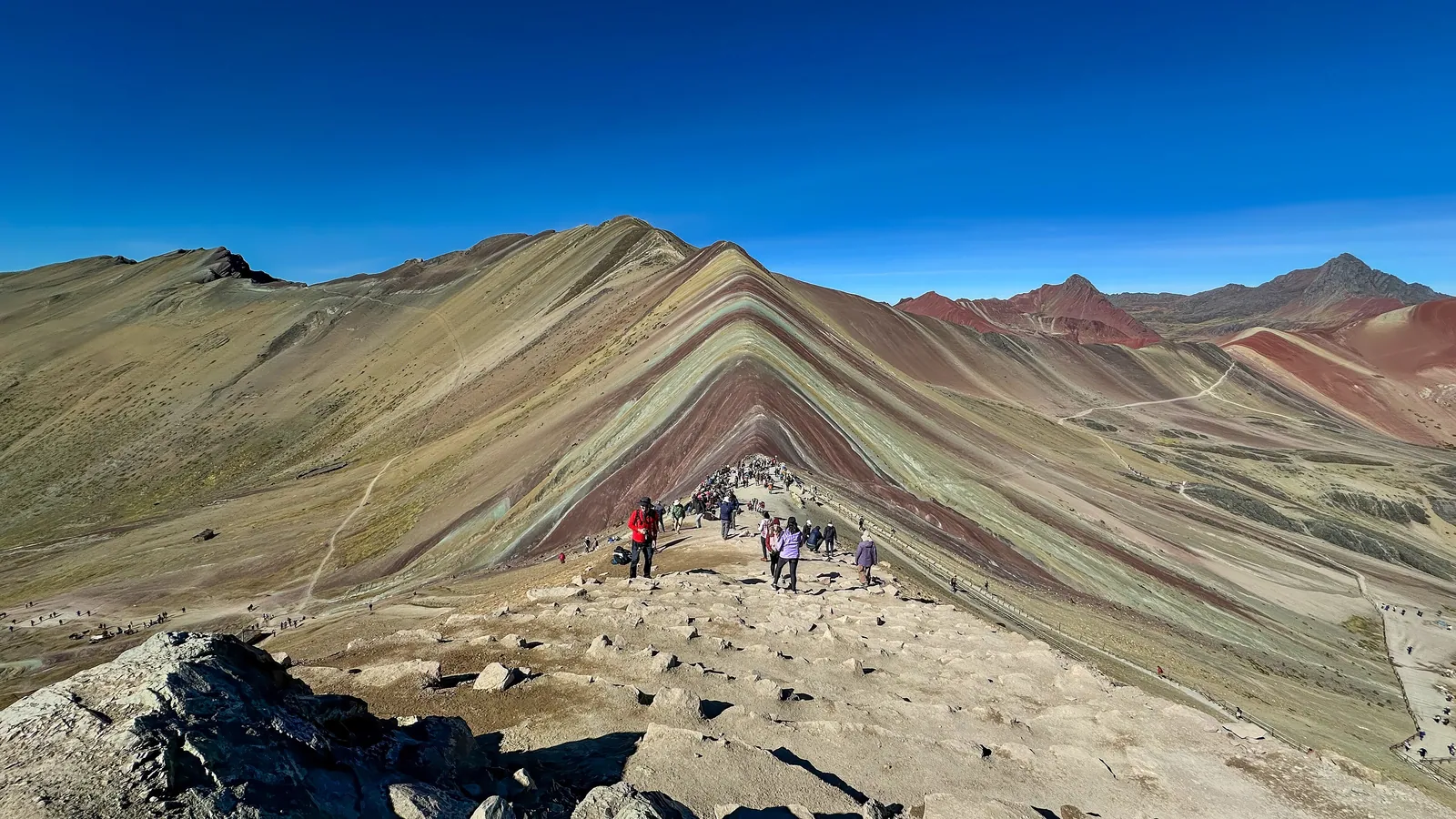
Vinicunca, southeast of Cusco, has become one of Peru's most photographed sights — a ridge whose slopes are banded in stripes of rust red, gold, turquoise and lavender. The colours are geology, not trick of light: layers of mineral-rich sedimentary rock, their iron and other minerals weathered into different hues, exposed and tilted over geological time.
Its fame is recent. For most of modern history the stripes lay under snow and ice; only as that cover retreated did the mountain emerge as the spectacle now visited in large numbers. That story is itself a sobering marker of a changing Andean climate.
What a visit to Vinicunca demands
Rainbow Mountain is high — the viewpoint stands well above 5,000 metres, higher than any point on the Classic Inca Trail or either Machu Picchu peak. The walk to it is not technically hard, but the altitude makes it genuinely strenuous, and it is no place for an unacclimatised visitor fresh off a plane.
Proper acclimatisation in Cusco and the Sacred Valley beforehand is essential, and an early start helps, since afternoon weather can close in. The colours show best under dry, clear skies, which makes the May-to-September dry season the dependable window; snow can blanket the stripes at other times.
The Vilcabamba range and the last Inca capital
West of Machu Picchu rises the Vilcabamba, a rugged range crowned by the great glaciated peak of Salkantay. It is wilder and far less visited than the Sacred Valley — and it carries a particular weight of history.
After the Spanish conquest, the Inca did not vanish. They withdrew into this remote country and established a refuge state at Vilcabamba, which held out until 1572. The associated site of Espíritu Pampa, deep in the forest, is identified with that last capital — the place where Inca sovereignty finally ended. Choquequirao, the great ridge-top complex above the Apurímac, belongs to this same rugged hinterland.
Trekking the deeper country
The Vilcabamba is trekking country for those who want solitude. Routes through it are long, remote and demanding, crossing high passes beneath Salkantay and dropping into deep river canyons. The Salkantay trek skirts its edge; longer expeditions reach toward Choquequirao and the Vilcabamba historical sites themselves.
These are not casual outings. They reward experienced, well-acclimatised walkers willing to trade comfort and crowds for genuine wilderness and a landscape thick with Inca history — the country the empire chose precisely because it was hard to reach.
Where this fits on a grand journey
On Andes to Antarctica the days in and around Cusco are paced to build altitude steadily, which is exactly what makes a side trip to a place like Vinicunca feasible rather than punishing. A 5,000-metre walk is a different proposition once your body has adjusted over preceding days.
Whether a journey reaches toward Rainbow Mountain or into the Vilcabamba depends on appetite, time and fitness. But knowing this wider country exists changes how you see Machu Picchu — not as an isolated wonder, but as one jewel in a vast and storied range that stretches, in our journeys, all the way south toward Patagonia and the ice.
Quick answers
Why is Rainbow Mountain so colourful?
The stripes of Vinicunca are geological. The mountain is built of layers of sedimentary rock rich in different minerals — iron oxides and others — which have weathered into distinct red, gold, green and lilac bands. Tilting and erosion over geological time exposed these coloured layers on the slope.
How high is Rainbow Mountain, and is it hard to reach?
The Vinicunca viewpoint sits above 5,000 metres, higher than the Inca Trail or the Machu Picchu peaks. The walk is not technically difficult but is strenuous because of the altitude, so prior acclimatisation in Cusco and the Sacred Valley is essential before attempting it.
What was Vilcabamba?
Vilcabamba was the remote refuge state of the Inca after the Spanish conquest. Withdrawing into the rugged range west of Machu Picchu, the Inca held out there until 1572. The forest site of Espíritu Pampa is identified with this last Inca capital, the place where Inca sovereignty finally came to an end.
Let the reading become a route.
When an article sparks something, our planners are the next step. Tell us what you are dreaming of.