
Reading the Southern Night Sky
The Southern Hemisphere holds the richest sky on the planet — the bright galactic centre, two companion galaxies and a constellation that genuinely works as a compass. A traveller's guide to finding your way around it.
The southern sky is not simply the northern sky upside down — it is a different and, by most measures, a better sky. It faces the luminous heart of our own galaxy, so the Milky Way runs brighter and broader overhead. It contains the Magellanic Clouds, two small galaxies visible to the naked eye and found nowhere in the northern sky. And it offers the Southern Cross, a small constellation that can be used to find true south.
You do not need a telescope or prior knowledge to read it. With a few landmarks — the Cross, the two bright Pointer stars beside it, the long sweep of the Milky Way and the two faint smudges of the Clouds — you can orient yourself under any southern sky within a few minutes. This is a working field guide to those landmarks, the kind of looking-up our travellers learn on the first nights of Beyond the Blue.
Crux — the Southern Cross and how to find south
The Southern Cross, or Crux, is the smallest of the 88 constellations but among the most useful. It is a compact cross of four bright stars, with a fifth fainter one, and it appears on the flags of several southern nations for good reason. Nearby lie two brilliant stars, Alpha and Beta Centauri, known as the Pointers — Alpha Centauri being the closest star system to our own Sun.
To find true south, extend the long axis of the Cross — from the top star through the bottom — about four and a half times its own length. Then drop straight down from that point to the horizon: that direction is very close to true south. Unlike the north, the southern sky has no bright pole star, so this simple projection is the traveller's substitute for one.
The Magellanic Clouds — two galaxies you can see by eye
Set well away from the Milky Way's band are two soft, detached patches of light: the Large and Small Magellanic Clouds. They look at first like stray pieces of the Milky Way, or like thin cloud that refuses to move. They are in fact two dwarf galaxies, companions to our own, the Large Cloud lying roughly 160,000 light-years away.
They are visible to the naked eye only from a genuinely dark site, and they are one of the clearest rewards of travelling to a Bortle 1 sky such as the Atacama or the Namib. Binoculars resolve glowing knots within them — including the Tarantula Nebula, a star-forming region so large that, were it as close to us as the Orion Nebula, it would cast shadows.
The galactic centre — the Milky Way's bright heart
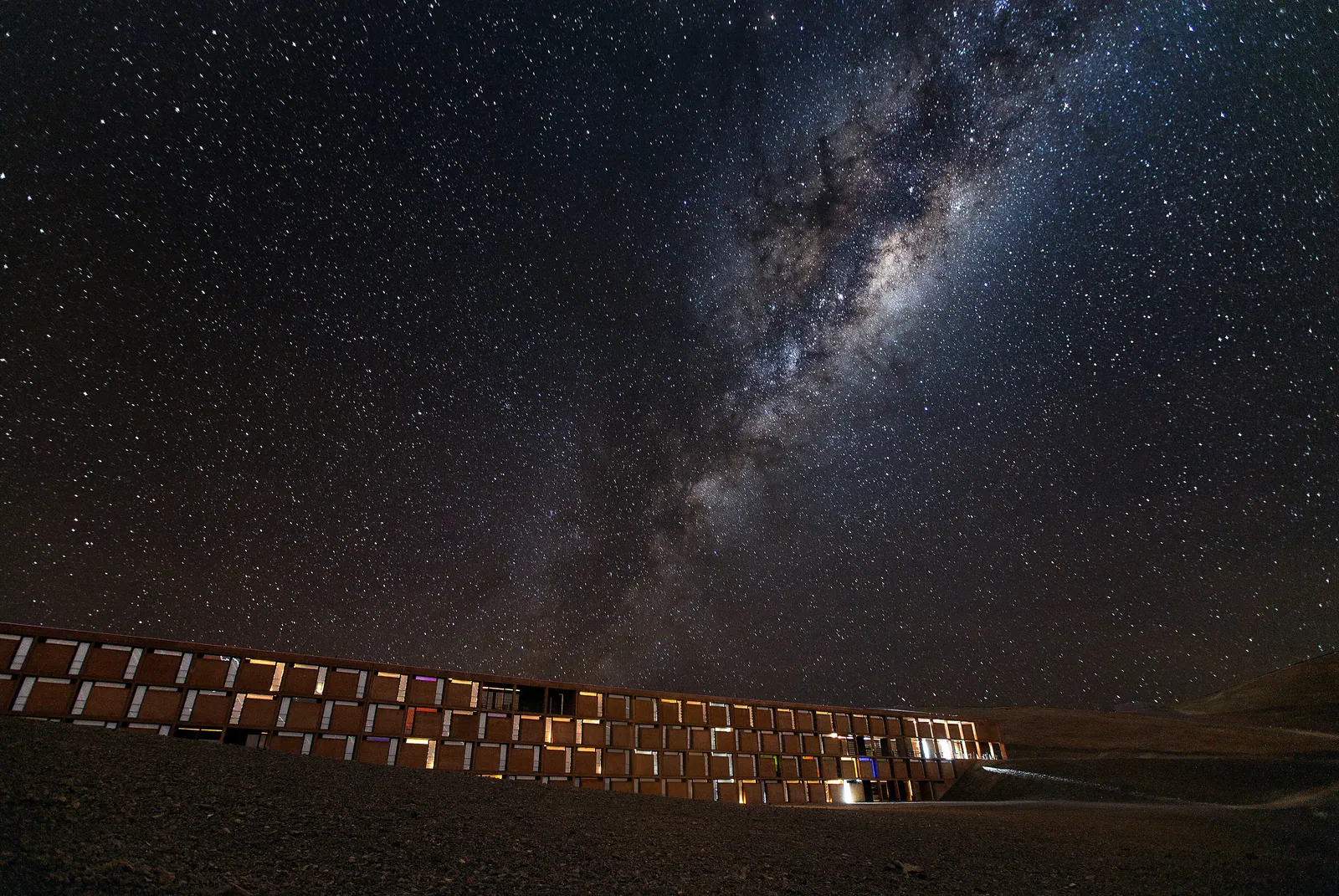
Look toward the constellations Sagittarius and Scorpius and you are looking straight into the centre of the Milky Way. From the Southern Hemisphere this region passes high overhead, rather than skimming the horizon as it does up north, so the galaxy's brightest, most textured stretch is displayed at its best.
On a dark, moonless night the core is unmistakable — a dense, mottled cloud of starlight split by dark dust lanes, the so-called Dark Rift. The southern winter, roughly May to September, is the season the core rides highest after dark, and it is the prime time of year to see the Milky Way at full strength from a southern site.
Bright stars and seasonal signposts
A few brilliant stars anchor the southern sky. Canopus, the second-brightest star in the whole night sky, is a reliable southern marker. Achernar sits at the end of the long river-constellation Eridanus. And the unmistakable hourglass of Orion — shared with the north but seen 'upside down' from the south — dominates the southern summer along with Sirius, the brightest star of all.
The sky also turns with the seasons. The Southern Cross and the galactic core are creatures of the southern winter evenings; Orion, Sirius and Canopus own the summer. Knowing which signposts belong to your season saves a great deal of confusion when you first step outside and look up.
How to actually learn the sky on a journey
Start with the naked eye and let your vision adapt — full dark adaptation takes around twenty to thirty minutes, and a single glance at a white phone screen undoes it. Use a red light, which preserves night vision, and a planisphere or a red-mode sky app to confirm what you are seeing. Begin with the easy landmarks: find the Cross, find the Pointers, trace the Milky Way, then hunt the Clouds.
On Beyond the Blue, the Atacama chapter is built precisely for this. Six opening nights under Bortle 1 skies, with guides and telescopes, are enough for most travellers to go from a sky of random dots to a sky they can read — a skill that then travels with them through every later stage of the journey.
Quick answers
Is there a southern pole star?
Not a useful one. There is a faint star, Sigma Octantis, near the south celestial pole, but it is too dim to see easily and useless for navigation. Instead, southern observers find true south by extending the long axis of the Southern Cross about four and a half times and dropping that point to the horizon. The Cross is, in effect, the southern sky's compass.
What are the two faint clouds near the Milky Way?
They are the Large and Small Magellanic Clouds — two dwarf galaxies that orbit our own. They look like detached fragments of the Milky Way but are entirely separate galaxies, the Large Cloud lying roughly 160,000 light-years away. They are visible to the naked eye only from a dark site, which makes them a real prize of travelling to genuinely unpolluted skies.
When is the best time of year to see the Milky Way from the Southern Hemisphere?
The southern winter, roughly May to September, is best, because that is when the galaxy's bright centre — toward Sagittarius and Scorpius — rides high in the evening sky. The core is visible at other times too, but lower and for less of the night. As always, aim for the nights around new Moon and a clear, dark location.
Let the reading become a route.
When an article sparks something, our planners are the next step. Tell us what you are dreaming of.