The Sacred Valley, Town by Town
Most travellers see the Sacred Valley in a single hurried day. Slow down, and the Urubamba reveals a chain of distinct towns — each with its own Inca past, market, microclimate and reason to linger.
The Sacred Valley is the fertile corridor of the Urubamba River, running roughly northwest from near Cusco toward Ollantaytambo and the descent to Machu Picchu. Its great advantage is altitude: at around 2,800 to 3,000 metres it sits several hundred metres below Cusco, the air is gentler, and the Inca prized its warmth and soil enough to terrace its slopes intensively.
Seen properly, the valley is not one stop but a sequence. Pisac, Chinchero, Maras, Moray, Urubamba and Ollantaytambo each hold something the others do not. This is a guide to that sequence — what to slow down for in each, and why the valley rewards two days where most itineraries grant one.
Pisac: terraces, market and a hilltop citadel
Pisac is the valley’s eastern gateway and a fine first stop. Above the town, a steep ridge carries one of the most complete Inca sites outside Machu Picchu: a complex of ceremonial buildings, agricultural terraces that curve with the mountain, and, cut into the cliff opposite, hundreds of looted tombs — the largest known Inca cemetery.
Down in the town, the Pisac market is among the best known in the Andes. It is busiest and most touristic on Sunday, when it spreads across several squares; visit on a quieter weekday morning and you will find the same textiles, ceramics and produce with room to look properly.
Chinchero: the weavers’ town
Chinchero sits high on the windswept plain at roughly 3,760 metres — higher than Cusco, so it is best visited after you have acclimatised. It is one of the centres of Andean weaving, where cooperatives still card, spin, dye with plants and minerals, and weave on backstrap looms exactly as their ancestors did.
The town also carries its layered history plainly. A handsome adobe colonial church, built around 1607, sits directly on the terraced foundations of an Inca royal estate, and the surrounding fields are still farmed in long Inca terraces. Chinchero’s Sunday market is smaller and more local in feel than Pisac’s.
Moray and Maras: an agricultural laboratory and a salt mountain
Two of the valley’s strangest sites sit close together on the high ground above Urubamba. Moray is a set of vast concentric agricultural terraces sunk into natural depressions in the earth; the temperature varies measurably from the top ring to the bottom, and many archaeologists believe the Inca used it to test crops across different microclimates.
A short distance away, the Salineras de Maras are several thousand shallow salt pans stepped down a hillside, fed by a naturally salty spring and worked by local families since long before the Inca. The pools shift colour as they evaporate, and the salt is still harvested and sold today. Together the two sites show the practical, experimental cast of Andean life.
Ollantaytambo: a living Inca town and the rail gateway
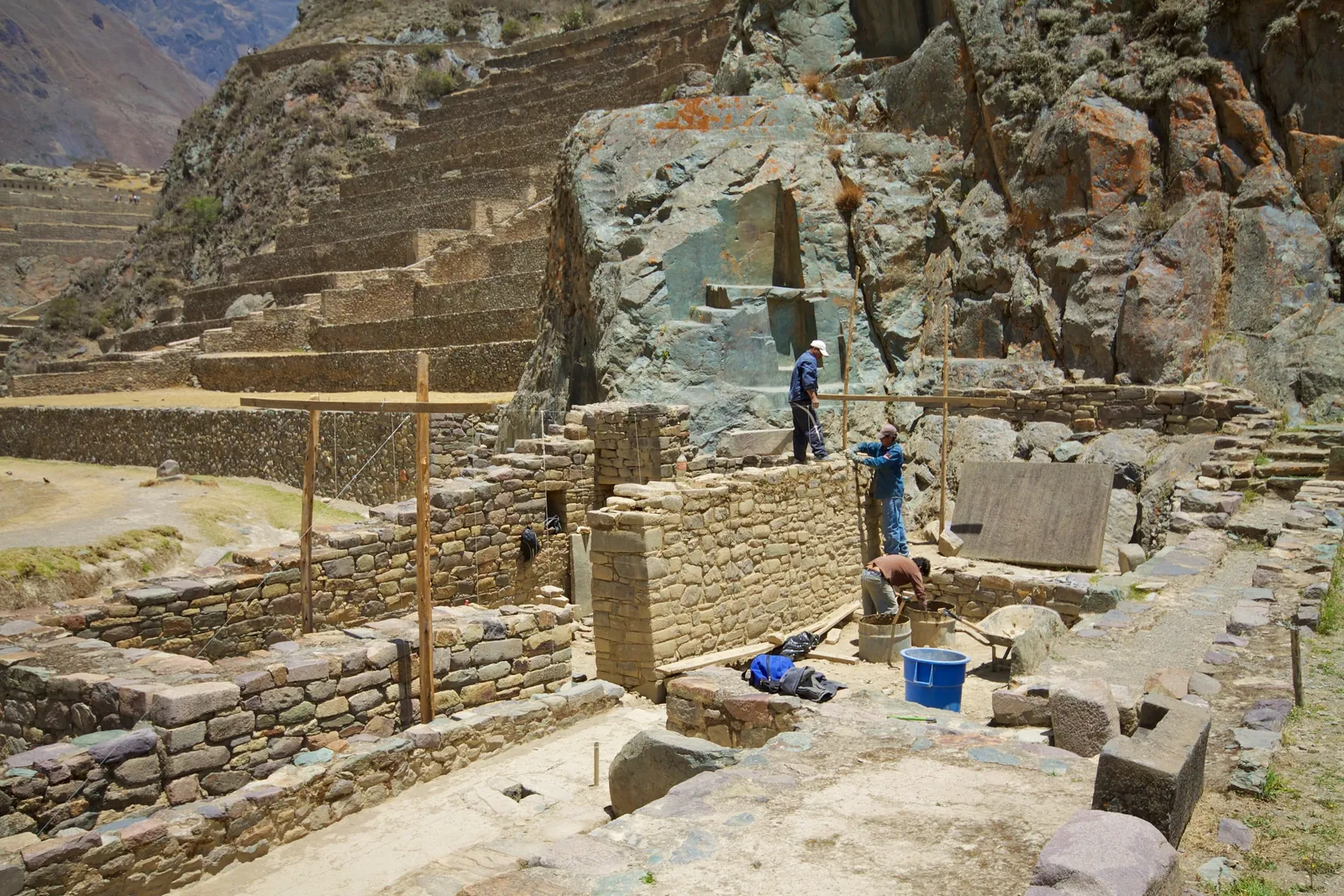
Ollantaytambo is the valley’s most rewarding overnight. Its old core is one of the few places where people still live within an Inca street grid — narrow cobbled lanes, original stone walls, water channels running through them. Above the town rises the great terraced temple-fortress, where the Inca famously checked the Spanish advance in 1537.
Ollantaytambo is also where the railway to Machu Picchu begins for most travellers, which makes it the natural last stop of a valley itinerary. Stay the night here rather than rushing back to Cusco: the town is quietest and most atmospheric once the day-trip buses have gone.
How the valley fits a journey
On the Andes to Antarctica journey, the Sacred Valley is given its own time rather than treated as a transit corridor. There is a sound physiological reason: nights spent lower in the valley help travellers acclimatise more comfortably than nights in Cusco, and they break the ascent before the demanding country beyond.
If you have only one day, choose either the Pisac-and-Chinchero side or the Moray-Maras-Ollantaytambo side rather than trying to cross the whole valley. If you have two, you can do both, sleep in Ollantaytambo, and step onto the Machu Picchu train already rested and adjusted.
Quick answers
How many days do you need in the Sacred Valley?
One day covers the headline sites in a rush; two days is far better and lets you split the valley into its eastern stretch around Pisac and Chinchero and its western stretch around Moray, Maras and Ollantaytambo. Two days also means a night at the valley’s lower altitude, which most travellers find helps with acclimatisation.
Is the Sacred Valley easier than Cusco for altitude?
Generally yes. The valley floor sits at roughly 2,800 to 3,000 metres, several hundred metres below Cusco, so the air is noticeably kinder. Chinchero is an exception at about 3,760 metres. Many itineraries deliberately place early nights in the valley for this reason before returning to Cusco.
Can you reach Machu Picchu from the Sacred Valley?
Yes. Ollantaytambo, at the western end of the valley, is the main railway gateway to Machu Picchu, with trains running down to Aguas Calientes. Many travellers spend their last valley night in Ollantaytambo and board the train there, rather than returning to Cusco first.
Let the reading become a route.
When an article sparks something, our planners are the next step. Tell us what you are dreaming of.