Sossusvlei and Deadvlei: Climbing the Red Dunes of the Namib
The dunes around Sossusvlei are among the tallest on Earth, and the white clay pan of Deadvlei holds nine-hundred-year-old trees. Here is how the landscape formed, when its light is best, and how to walk it well.
Sossusvlei is a clay and salt pan deep in the Namib-Naukluft Park, ringed by some of the highest dunes in the world — several rise more than 300 metres, and the most photographed of them, often called Big Daddy, tops 325. Deadvlei, a short walk away, is a separate white pan studded with the blackened skeletons of camel-thorn trees that died perhaps six to seven centuries ago and never decayed, because the desert air is too dry to rot them.
The short answer for any traveller: come for sunrise. The dunes glow deepest orange in the first and last hour of light, the air is cool enough to climb, and the long shadows give the sand its sculpted, knife-edged form. By mid-morning the colour flattens and the sand becomes too hot underfoot. Plan to be at the gate when it opens and you will see the Namib at its most extraordinary.
Why the dunes are red
The sand of the Namib is ancient, and its colour is a record of age. Grains carried into the desert over millions of years — much of it originally washed down the Orange River and blown inland from the coast — are coated in a thin film of iron oxide. The longer a grain has been exposed, the more it oxidises, and the redder it becomes. The oldest dunes, furthest inland, are a deep rust; younger sand nearer the sea is paler and more yellow.
These are mostly star dunes and linear dunes, shaped by winds that arrive from several directions across the year. That multi-directional wind is why they pile so high and hold their position over long spans of time, rather than marching steadily across the landscape as simpler crescent dunes do. The result is a dune field that has been recognisably itself for a very long time.
Deadvlei and the trees that would not rot
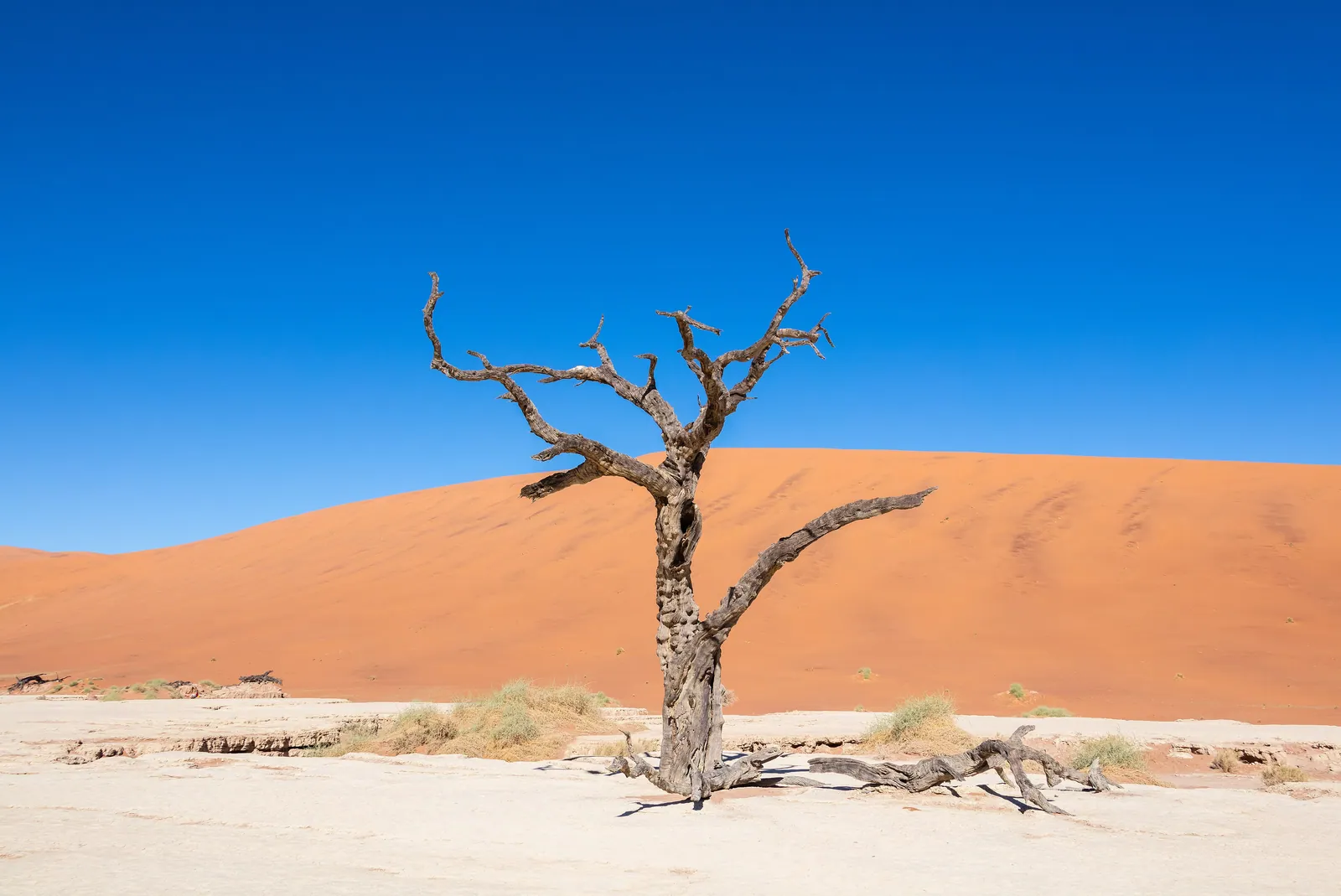
Deadvlei — the name means dead marsh — was once fed by the Tsauchab River, which flooded occasionally and allowed camel-thorn trees to grow. Then the climate shifted and the dunes encroached, cutting the river off from the pan. The trees died, but in the bone-dry air they did not decompose. They simply stood, scorched black by the sun, and they have stood for an estimated 600 to 700 years.
The visual effect is unforgettable: charcoal trees on a cracked white floor of clay, against orange dunes and a hard blue sky. It is one of the most distinctive scenes in Africa, and it exists because of a precise and rare combination — a clay pan that holds a flat pale surface, trees preserved by aridity, and the towering dunes behind them. The walk in from the car park is short but crosses soft sand; allow time and water.
Climbing a dune, and which one to choose
Walking up a dune is harder than it looks, because the sand gives way beneath each step — the trick is to follow the windward ridge, where the sand is firmer, rather than the soft face. Big Daddy is the giant beside Deadvlei and a serious climb of around an hour; the reward is a fast, knee-deep run straight down the face into the pan. Dune 45, named for its distance in kilometres along the access road, is lower, closer to the gate and a popular gentler option.
Whichever you choose, climb early. Sand temperatures rise quickly after sunrise, and the soft ascent is genuinely strenuous. Sturdy shoes, or bare feet on the cooler morning sand, plus sun protection and more water than you think you need, are the essentials. There is no shade on a dune.
Getting in: the gate, the road and the last stretch
Sossusvlei sits inside the Namib-Naukluft Park, and access is gated. The most rewarding rhythm is to stay inside the park boundary so you can reach the gate the moment it opens at sunrise, ahead of day visitors driving from outside. A sealed road runs roughly 60 kilometres from the Sesriem gate towards the pans.
The final five kilometres to Sossusvlei itself are deep, soft sand that requires a high-clearance four-wheel-drive vehicle; ordinary cars park at the 2x4 lot, and a shuttle covers the last stretch. On The Great Rift journey this section is handled by guides who know the road and the timing, so travellers arrive at the pans in the best light without managing the logistics themselves.
Sesriem Canyon and the wider landscape
Close to the park gate, Sesriem Canyon offers a complete change of scale — a narrow gorge perhaps a kilometre long and up to 30 metres deep, carved by the Tsauchab River into layers of conglomerate rock over millions of years. It is cool, shaded and easily walked, and it makes a natural counterpoint to the open dunes, often visited in the harsher light of late morning when the dune colour has faded.
The whole region rewards a slow eye. Beyond the famous pans lie gravel plains, isolated inselberg mountains and, after rare rain, brief flushes of grass and desert flowers. The Namib does not give up its drama all at once; it asks the traveller to look, and to be there at the right hour.
Quick answers
What is the difference between Sossusvlei and Deadvlei?
They are two separate clay pans within the same dune field. Sossusvlei is the larger pan at the end of the access road and floods occasionally after exceptional rain. Deadvlei is a smaller white pan a short walk away, famous for its ancient blackened trees, which still stand because the river that once fed them was cut off by encroaching dunes.
When is the best time of day to visit the dunes?
Sunrise, without question. The dunes glow their deepest orange in the first hour of light, the air is cool enough to climb, and long shadows reveal the sand's sculpted ridges. Colour and contrast flatten by mid-morning, and the sand becomes uncomfortably hot. Late afternoon offers a second, shorter window of good light.
Do you need a four-wheel-drive to reach Sossusvlei?
For the final five kilometres, yes — that stretch is deep, soft sand. Ordinary vehicles can drive the sealed road to a 2x4 car park, from where a shuttle covers the last section. On an escorted journey this is arranged for you, so the only thing to plan for is an early start.
Let the reading become a route.
When an article sparks something, our planners are the next step. Tell us what you are dreaming of.