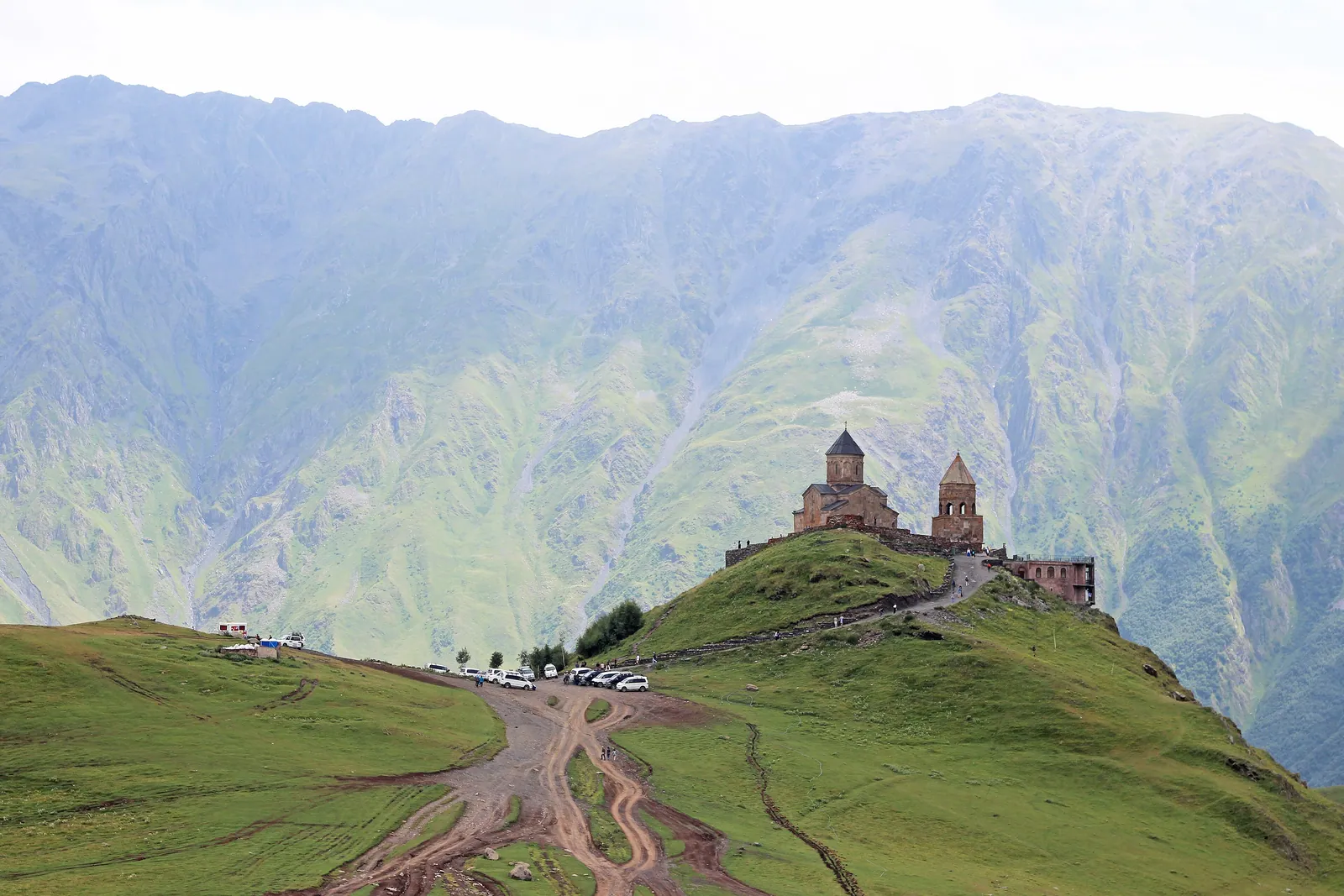
The Caucasus Mountains and the Road to Kazbegi
The Greater Caucasus is one of Europe's last great mountain frontiers. A drive north from Tbilisi to Kazbegi and the church beneath Mount Kazbek is the simplest way to stand among them.
The Greater Caucasus is the mountain wall that runs for some twelve hundred kilometres between the Black Sea and the Caspian, forming much of the boundary between Europe and Asia. Its peaks rise higher than the Alps, and along Georgia's northern edge they make a landscape of glaciers, gorges and stone villages that feels genuinely remote.
The most accessible way to enter that world is the road from Tbilisi to the town of Stepantsminda — long known as Kazbegi — where a small medieval church stands on a green spur beneath the snows of Mount Kazbek. It is a half-day's drive, and one of the most rewarding mountain journeys in the region.
A mountain range between two seas
The Caucasus is divided into two ranges, the Greater and the Lesser, with Georgia spread across the southern slopes of the Greater and the valleys between. These are young, sharp mountains: the highest summit, Mount Elbrus in Russia, exceeds 5,600 metres, and Georgia's own peaks include several above 5,000.
The range has always been as much a human frontier as a physical one. Its valleys shelter a remarkable density of distinct peoples and languages, and its passes controlled movement between the steppe to the north and the civilisations to the south. Trade, armies and pilgrims all funnelled through a handful of crossings — which is exactly why the road to Kazbegi exists.
The Georgian Military Road
The route north from Tbilisi follows the historic Georgian Military Road, the strategic highway built along an ancient passage through the mountains. It is one of the great scenic drives of the Caucasus, climbing steadily from lowland vineyards into ever steeper country.
Along the way it passes the medieval fortress of Ananuri above a reservoir, the mineral springs that stain the rock orange near Pasanauri, and the high Jvari Pass at around 2,400 metres, often the point where the air turns cold and the snow begins. The descent on the far side opens suddenly onto the valley of Kazbegi, with the great mountain ahead — a reveal that ranks among the finest moments of any journey through Georgia.
Kazbegi and the Gergeti Trinity Church
Stepantsminda sits at roughly 1,740 metres in a broad valley, a working town that serves as the base for the surrounding peaks. Above it, on a green hill at about 2,170 metres, stands the Gergeti Trinity Church — a single fourteenth-century stone church and bell tower, isolated against the sky with Mount Kazbek rising white behind it.
The walk up from the town takes a couple of hours on foot, climbing steadily; many travellers ride up by sturdy vehicle instead, the track being rough but passable. However you arrive, the setting is the reward: a small, austere medieval building, a wide silence, and the 5,054-metre cone of Kazbek — one of the Caucasus' highest summits and, in legend, the rock to which Prometheus was chained.
Walking, weather and altitude
Kazbegi is mountain country, and the weather behaves accordingly. Clear mornings often give way to cloud by afternoon, so the early hours are the best chance of seeing the peak unveiled; summer days can be warm in the valley and cold on the hill above. Layers and a windproof outer are sensible at any time of year.
The altitudes here are moderate — the church sits well below the heights where serious altitude sickness sets in — but the climb is a genuine ascent, and the thinner air makes it harder work than the distance suggests. Take it slowly, carry water, and there is no need for technical equipment: this is hill-walking, not mountaineering.
Kazbegi on The Silk Road Reborn
On The Silk Road Reborn, the drive up the Georgian Military Road to Kazbegi is the moment the journey meets the Caucasus directly — the mountain barrier that, for centuries, shaped every route between the steppe and the south. Standing beneath Kazbek, the geography of the whole region clicks into place.
We time the visit for the best of the light and the weather, and treat the day as a chance to slow down rather than to summit anything. The point is not conquest; it is to spend unhurried time in one of the last great mountain wildernesses on Europe's edge, with a fourteenth-century church for company and a five-thousand-metre peak overhead.
Quick answers
How do you get from Tbilisi to Kazbegi?
Kazbegi (Stepantsminda) lies about 150 kilometres north of Tbilisi along the Georgian Military Road, a drive of roughly three hours depending on conditions and stops. The road is paved and scenic but mountainous, crossing the Jvari Pass at about 2,400 metres, where snow and weather can slow progress in the colder months. It is comfortably done as part of a guided journey with stops along the way.
Do you have to hike to the Gergeti Trinity Church?
Not necessarily. The church sits on a hill above the town at about 2,170 metres; reaching it on foot takes roughly two hours of steady uphill walking. Many visitors instead take a rugged four-wheel-drive vehicle up the rough track. Walking is the more satisfying approach if you are fit and the weather is kind, but a vehicle makes the church accessible to almost everyone.
Is altitude a concern around Kazbegi?
Not seriously. The town sits at about 1,740 metres and the Gergeti church at around 2,170 metres — well below the altitudes where altitude sickness usually becomes an issue. The climb up to the church is still a real ascent, so the thinner air makes it feel strenuous; walk slowly and stay hydrated. Mount Kazbek itself, at 5,054 metres, is a serious mountaineering objective and not part of an ordinary visit.
Let the reading become a route.
When an article sparks something, our planners are the next step. Tell us what you are dreaming of.