The Gardens of Marrakech
In a city at the edge of an arid plain, gardens are not decoration but an art form. From the famous Majorelle to the centuries-old Menara, here are the green spaces of Marrakech and how to read them.
Marrakech sits on a dry plain in the rain shadow of the High Atlas, and yet it is one of the great garden cities of the Islamic world. Its gardens — from the blue-walled Jardin Majorelle to the vast historic olive groves of the Menara and Agdal — are the result of centuries of skill in capturing and channelling water, and they are central to understanding the city.
These are not gardens in the European lawn-and-flowerbed sense. The Moroccan garden tradition treats shade, water and fragrance as the essentials, and an enclosed green space as a refuge from heat and noise. Seen that way, the gardens of Marrakech become not a pleasant aside but one of the most revealing things a traveller can visit.
Water, the foundation of the city's gardens
Marrakech could not have become a garden city without a remarkable system for moving water. From its medieval foundation, the city drew on khettaras — gently sloping underground channels that carried water from the Atlas foothills and the water table to the city by gravity, with minimal loss to evaporation. This hidden infrastructure fed cisterns, fountains and the great irrigated gardens.
Understanding this changes how the gardens read. A pool in a Marrakech garden is rarely ornamental alone; historically it was a reservoir, holding irrigation water and cooling the air. The classic Islamic garden, with its straight water channels dividing planted quarters, expresses an idea of paradise — but it is also a precise, practical machine for sustaining greenery in a hot, dry land.
The Jardin Majorelle
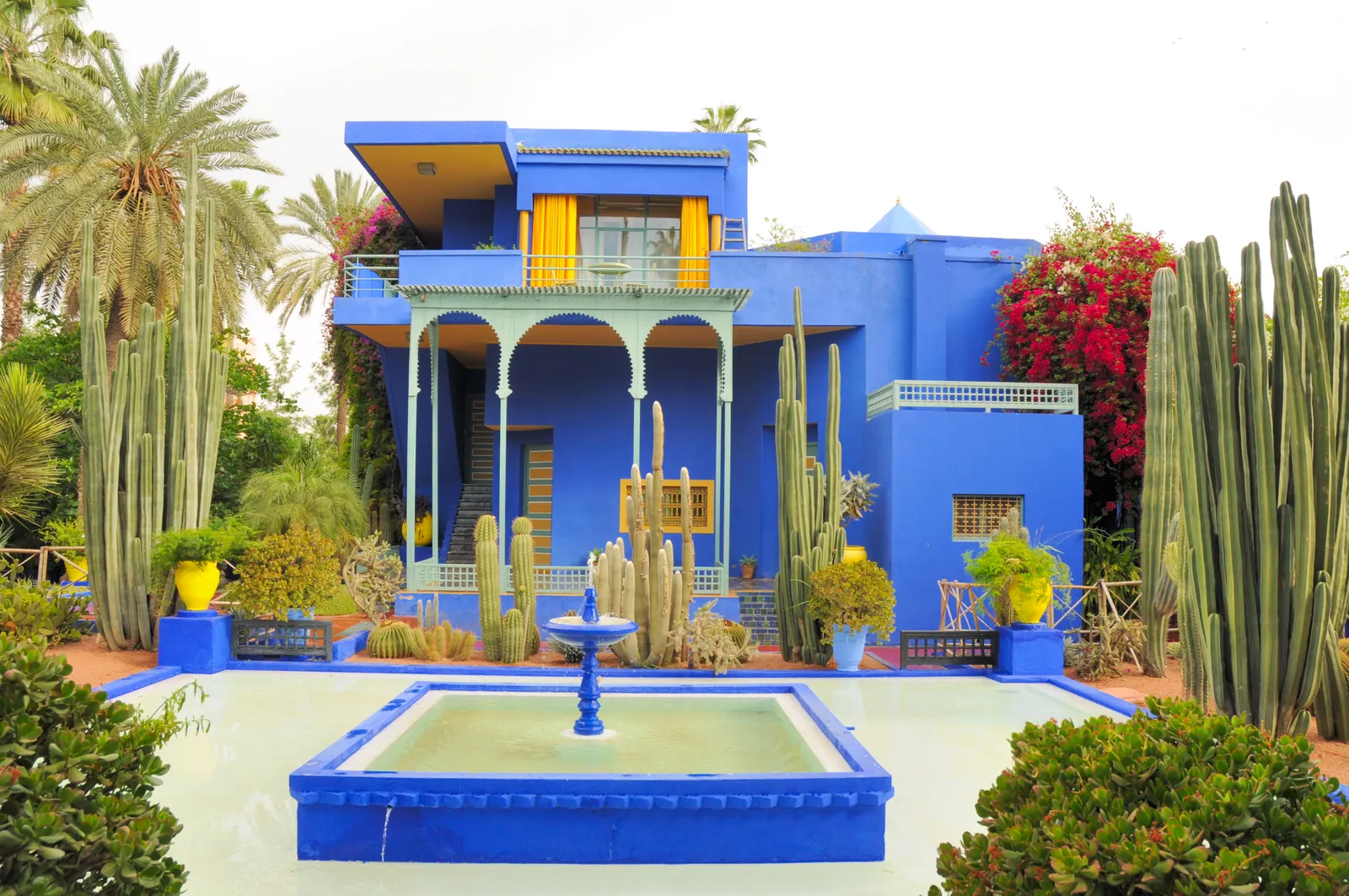
The Jardin Majorelle is the most visited garden in Marrakech, and the most photographed. It was created from the 1920s onward by the French painter Jacques Majorelle, who spent four decades developing a botanical garden of cacti, palms, bamboo and bougainvillea, and who gave his name to the intense cobalt blue — Majorelle Blue — that washes the garden's villa and planters.
After falling into neglect, the garden was bought and restored in the 1980s by the couturier Yves Saint Laurent and his partner Pierre Bergé, who had long loved Marrakech. Today it draws very large numbers of visitors, so an early arrival is wise. The same site holds a Berber museum, and the nearby Musée Yves Saint Laurent makes a natural pairing for a morning.
The historic royal gardens
Long before Majorelle, Marrakech had its great gardens. The Menara, west of the medina, dates in essence to the twelfth-century Almohad period: a vast olive grove arranged around an enormous rectangular irrigation basin, with a later pavilion at one end. The classic view — the pool, the pavilion and, beyond, the snow-capped Atlas — is one of the city's defining images.
South of the medina, the Agdal gardens are an even larger expanse of orchards and olive groves, also Almohad in origin, fed by the same Atlas water and historically a royal estate. Within the city, the Menara and Agdal were inscribed alongside the medina as part of its UNESCO World Heritage listing — recognition that the gardens are inseparable from the historic city itself.
Courtyards and quieter green corners
Not every garden in Marrakech is grand. The medina's gardens are often small and private — the planted courtyards at the heart of riads and palaces, where a single fountain and a few orange or lemon trees create a cool, scented room open to the sky. The Bahia Palace, with its sequence of courtyards and a riad garden, shows the form at a refined scale.
Among the calmest public spaces is Le Jardin Secret, a restored historic complex in the medina with two courtyard gardens, one Islamic and formal, the other more exotic in planting. Together these smaller gardens make the point that in Marrakech greenery is woven through the city at every scale, from the royal basin to the household patio.
The gardens on The Long Way East
On The Long Way East, the journey from Madrid that crosses from Spain into Morocco, the gardens of Marrakech are given real time rather than a hurried photo stop. There is a thread worth following here. The journey passes through Andalusia, where the gardens of the Alhambra and the Generalife express the same Islamic tradition of water, shade and enclosure.
To walk the Menara or a riad courtyard after seeing those Spanish gardens is to recognise a shared inheritance carried across the strait. We pair the famous Majorelle with at least one of the historic royal gardens and the quieter courtyards of the medina, so that a traveller meets the full range of the form — and understands why a city on a dry plain became a city of gardens.
Quick answers
Is the Jardin Majorelle worth visiting despite the crowds?
Yes, though timing matters. The Jardin Majorelle is compact and extremely popular, so it is best visited early in the day, soon after opening, when the light is good and the paths are quieter. Pre-booked timed tickets help. Pairing it with the adjacent Berber museum and the nearby Musée Yves Saint Laurent makes for a satisfying and well-rounded morning.
Which Marrakech garden is the oldest?
The Menara and Agdal gardens are the oldest, both originating in the twelfth-century Almohad period, making them roughly eight hundred years old. They are essentially vast irrigated olive groves and orchards arranged around great water basins. The Jardin Majorelle, by contrast, is a twentieth-century botanical garden, created from the 1920s onward.
Why does an arid city like Marrakech have so many gardens?
Because of water engineering and a strong cultural tradition. From its medieval foundation, Marrakech was supplied by khettaras — underground channels that carried water from the Atlas foothills by gravity — feeding cisterns and irrigated gardens. Combined with the Islamic ideal of the enclosed garden as a refuge and an image of paradise, this allowed a city on a dry plain to become famous for its greenery.
Let the reading become a route.
When an article sparks something, our planners are the next step. Tell us what you are dreaming of.