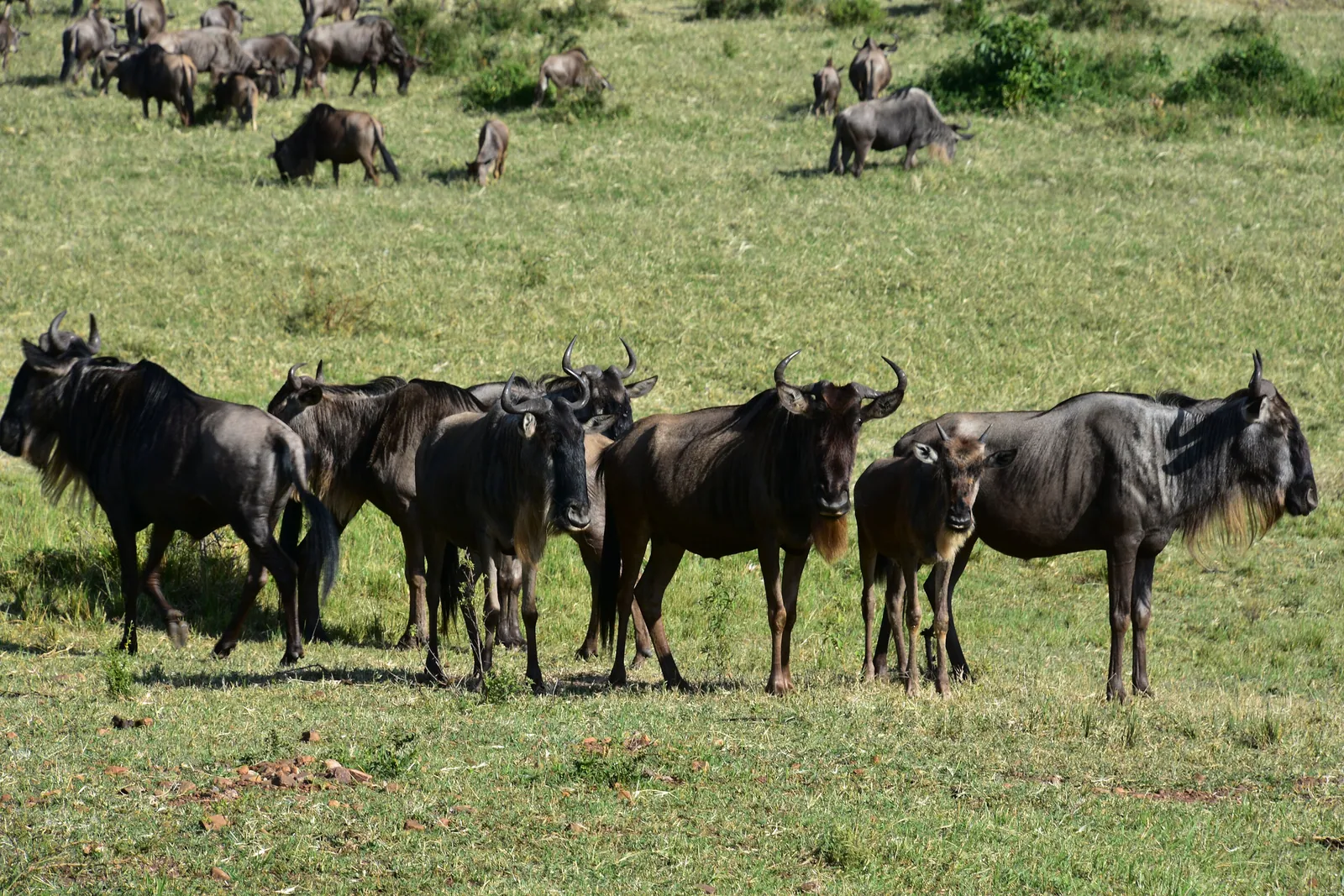
The Great Migration, Month by Month
The wildebeest migration is not an event but a year-long circuit, and the herds are somewhere different every month. Here is where the great herds move across the Serengeti through the calendar, and what each season offers a traveller.
There is a persistent myth that the Great Migration happens once a year, at a fixed time, in a fixed place. It does not. Roughly 1.3 million blue wildebeest, joined by several hundred thousand zebra and gazelle, move in a continuous clockwise loop through the Serengeti–Mara ecosystem every month of the year, following the rain and the grass it brings. There is no off-season — only different chapters of the same migration.
What changes is where the herds are and what they are doing. In the new year they are calving on the short-grass plains of the southern Serengeti; by mid-year they are massing along the rivers of the western corridor and the north; later they are grazing the Maasai Mara before turning south again. Knowing the calendar is how you place yourself in the right part of the ecosystem at the right time.
January to March: calving on the southern plains
In the early months of the year the herds gather on the short-grass plains of the southern Serengeti and the adjoining Ngorongoro Conservation Area, around Ndutu. These plains are mineral-rich, fertilised by ancient volcanic ash, and the short grass lets the wildebeest watch for predators while they graze. It is here, in a tight window of roughly two to three weeks centred on February, that some 400,000 calves are born — the most concentrated birthing event of any large mammal on Earth.
For a traveller this is a season of abundance rather than drama. The plains are green from the short rains, the light is soft, and the sheer density of newborns draws lions, cheetahs, hyenas and jackals into the open. It is the finest time of year to watch predator and prey in the same wide frame, and the calving grounds reward patience over the chase.
April to May: the long rains and the move north
April and May bring the long rains, the wettest stretch of the Tanzanian year. The plains lose their short-grass appeal as the grasses grow tall and coarse, and the herds begin drifting north and west, often strung out in the long columns that give the migration its name. The going can be muddy, some camps close, and afternoon storms are common.
This is the quietest tourist season, and for travellers who do not mind rain it has real rewards: lush green country, dramatic skies, far fewer vehicles, and lower-season value. The herds are on the move and harder to pin to one spot, but the western Serengeti begins to fill as the columns press towards the Grumeti.
June to July: the western corridor and the first rivers
As the land dries in June, the migration concentrates in the western corridor and confronts the first major obstacle of its year: the Grumeti River. The Grumeti is not as wide as the rivers further north, but its pools hold large crocodiles, and the herds bunch nervously on its banks before crossing. June and July are prime months for these western crossings.
By July the leading edge of the migration is pushing into the northern Serengeti, towards the Kenyan border. The dry season is now properly underway: grass is shortening again, water is scarce, and game of every kind clusters around the remaining rivers — making this one of the most productive general game-viewing periods of the year.
August to October: the Mara River and the northern drama
From August into October the herds are concentrated in the far northern Serengeti and across the border in Kenya's Maasai Mara, and the defining feature of these months is the Mara River. The crossings here are the spectacle the migration is famous for: thousands of wildebeest plunging down steep banks into crocodile water, driven by an instinct that overrides apparent terror.
Crossings are unpredictable — a herd may mass at the water for hours and then turn away, or surge across with no warning — so this is a season that rewards time in the field and a guide who reads the signs. The northern Serengeti, less visited than the Mara side, offers these crossings with notably thinner crowds.
November to December: the short rains and the return south
When the short rains arrive in November, fresh grass greens the southern plains again, and the herds respond almost immediately, streaming back south through the eastern Serengeti. By December the leading animals are once more on the short-grass plains around Ndutu, and the great loop is closing.
November and December are an underrated time to travel: the landscape is renewed and green, the herds are visibly on the move, the worst crowds have gone, and the cycle is poised to begin again with the February calving. It is, in a sense, the migration's quiet overture.
Why the herds move at all
The migration is not a journey to a destination; it is a permanent search for two things — grazing and water — across an ecosystem of roughly 30,000 square kilometres. Wildebeest can detect rainfall and the flush of new grass it brings from a considerable distance, and the herd follows that green wave around the calendar.
Because the timing depends on rain, the calendar above is a reliable pattern, not a timetable. A late or early rainy season shifts everything by weeks. On The Great Rift journey, the Serengeti is timed to intersect the herds at their most rewarding phase for that season, and our guides track herd reports daily rather than trusting the date alone.
Quick answers
When is the best time to see the Great Migration?
There is no single best time, because the herds move all year. For the river crossings, August to October in the north is the classic window. For the calving and the densest predator action, January to March on the southern plains is unmatched. The right month depends entirely on which chapter of the migration you most want to witness.
Can the migration be seen in a single safari?
You see one chapter of it, not the whole loop — the herds cover thousands of kilometres over the year. A well-timed safari places you alongside the herds wherever they are that month, whether that is the calving plains, a river crossing or the columns on the move. No itinerary can show you the entire circuit at once.
Is the migration timing guaranteed?
No. The herds follow the rain, and rainfall varies year to year, so the migration can run early or late by several weeks. Reputable operators track current herd positions rather than relying on a fixed calendar, and build flexibility into where camps are placed for that season.
Let the reading become a route.
When an article sparks something, our planners are the next step. Tell us what you are dreaming of.