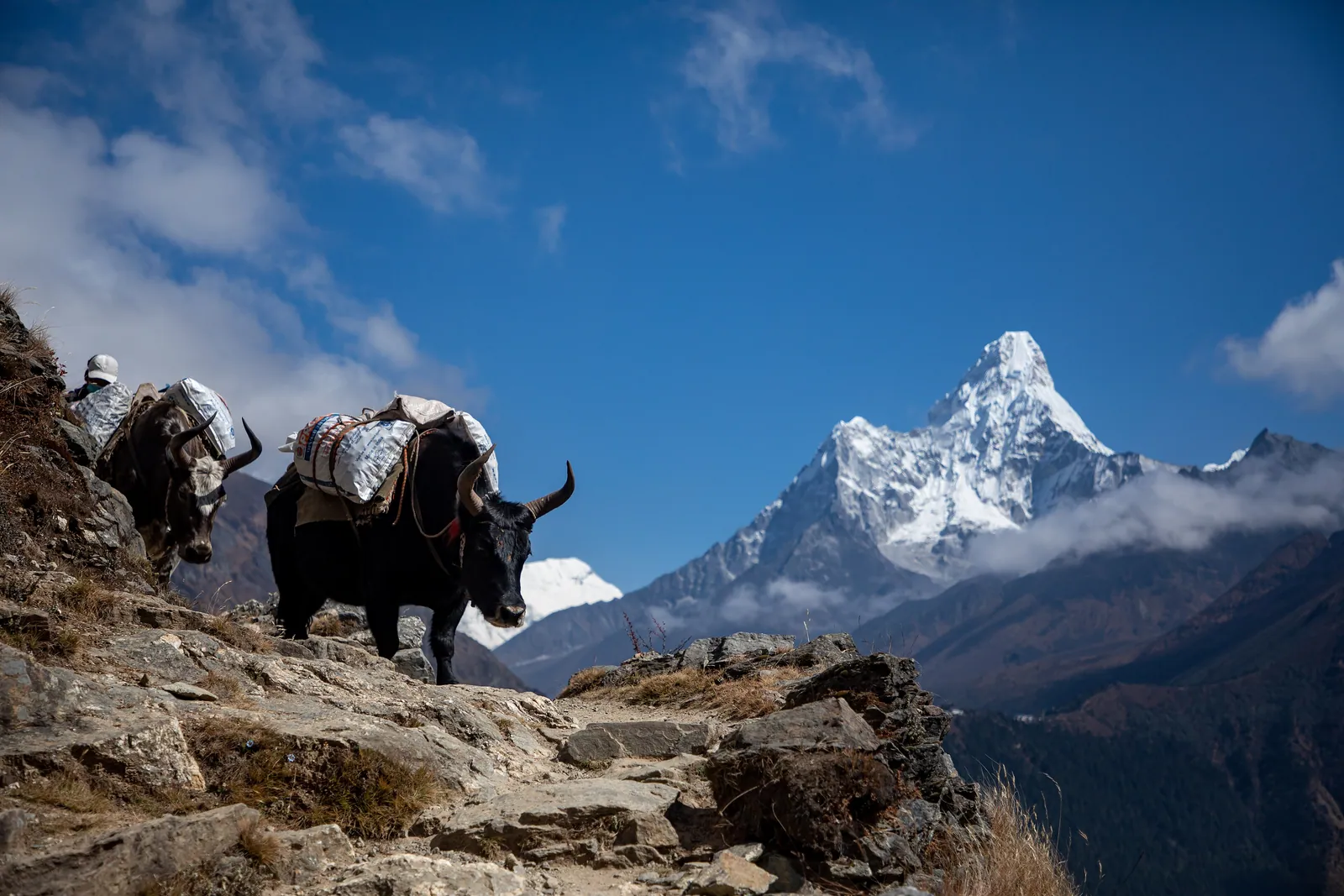
The Khumbu and the Great Peaks of the Himalaya
The Himalaya holds all fourteen of the world's 8,000-metre peaks, and the Khumbu valley sits beneath the greatest of them. A traveller's guide to the giants — how they were formed, what they are called, and how to see them well.
The Himalaya is the highest mountain range on Earth, and every one of the planet's fourteen peaks above 8,000 metres stands within it or its immediate neighbour, the Karakoram. The Khumbu, the Sherpa homeland in north-eastern Nepal, lies directly beneath the highest of all — Everest — and within sight of several of its rivals.
You do not need to climb anything to stand among these mountains. The valleys and ridge viewpoints of the Khumbu and the wider Himalaya let an unhurried traveller see the great peaks at close range, on foot, from villages that have lived in their shadow for centuries. This is a guide to what you are looking at.
How the Himalaya was made
The Himalaya exists because two continents collided. Around fifty million years ago the Indian plate, drifting north, met the Eurasian plate and drove into it; with nowhere else to go, the crust buckled and rose. That collision has never stopped, which is why the range is still climbing — Everest grows by a few millimetres a year — and why the region is seismically active.
Look closely at the high rock and the story is written into it. Marine limestone, full of the fossils of ancient sea creatures, sits near the summit of Everest itself: stone that formed on a sea floor, now nearly nine kilometres above the waves. The greatest mountains on Earth are, in part, a vanished ocean turned on its end.
The eight-thousanders
Mountaineers reserve a special word for the fourteen peaks that rise above 8,000 metres: the eight-thousanders. All of them lie in the Himalaya and the Karakoram, in a band crossing Nepal, China, India and Pakistan. Above roughly 8,000 metres lies the 'death zone', where the air holds too little oxygen to sustain human life for long — the reason these summits remain the preserve of serious, well-supported expeditions.
Everest, at 8,849 metres, is the highest; K2 in the Karakoram the second and most feared; Kangchenjunga, on the Nepal–India border, the third. The Khumbu alone is ringed by giants — Lhotse, Makalu and Cho Oyu all stand within the region. A traveller will not climb them, but from the right valley can watch their summit plumes catch the morning sun.
Everest, by its names
The mountain carries three names, and each tells you something. To Tibetans and the Sherpa it is Chomolungma, often rendered 'Goddess Mother of the World'; to Nepalis it is Sagarmatha; the English name honours George Everest, a 19th-century Surveyor General of India, and was applied by the survey that first measured the peak's height from afar.
For a respectful traveller, the local names are worth using. They reflect the fact that these mountains are not blank summits to the people who live beneath them but sacred presences, woven into prayer and pilgrimage. The Khumbu's monasteries face the peaks deliberately, and to the Sherpa the high mountains are deities to be honoured before they are challenged.
The Khumbu and the Sherpa
The Khumbu is the valley system below the southern side of Everest, and its people are the Sherpa — a community of Tibetan origin who settled here some five centuries ago and who have become, through skill and altitude-bred endurance, the indispensable partners of Himalayan mountaineering. Namche Bazaar, the valley's main town, is a natural amphitheatre of lodges and shops at around 3,440 metres.
Above Namche the valley climbs past Buddhist monasteries, prayer-flag ridges and Sherpa villages toward the foot of the great peaks. The classic viewpoints — ridge tops and high hamlets, not summits — open onto Everest and its neighbours without a single technical step. It is mountain travel that rewards the eye and the patient walker, not the climber.
Seeing the giants without climbing
The Long Way East crosses the Tibetan plateau on the northern flank of the range, where the classic viewpoints toward Everest open across the high desert and the road passes climb well above 5,000 metres. The mountains are reached slowly, after long acclimatisation, and the high passes are crossed by day rather than slept on.
Nothing about seeing the great peaks well requires risk. It requires height gained gently, clear morning light, and time to stand still. We pace the high sections so you arrive adjusted and unhurried, carry oximeters and oxygen as a matter of routine, and treat the viewpoints as places to linger — because the giants reward the traveller who simply stops and looks.
Quick answers
How many mountains over 8,000 metres are there, and where?
There are fourteen peaks above 8,000 metres, all in the Himalaya and the adjacent Karakoram, spread across Nepal, China, India and Pakistan. Everest is the highest at 8,849 metres, followed by K2 and Kangchenjunga. They are the preserve of major mountaineering expeditions; a travelling journey views them from valleys and ridge viewpoints rather than approaching the summits.
Can I see Everest on a Viajes Globales journey?
Yes. The Long Way East crosses the Tibetan plateau on the northern side of the range, reaching classic high-desert viewpoints toward Everest. These are reached on foot and by road after careful acclimatisation, with no technical climbing involved. The views depend on clear weather, which is why the journey times the high sections for the most reliable seasons.
Why is the area above 8,000 metres called the death zone?
Above roughly 8,000 metres the air pressure is so low that the body cannot take in enough oxygen to sustain itself for long, even at rest — it slowly deteriorates. Climbers can pass through only briefly and usually with bottled oxygen. No part of a Viajes Globales journey enters this zone; our highest points are road passes and viewpoints around 5,000 metres.
Let the reading become a route.
When an article sparks something, our planners are the next step. Tell us what you are dreaming of.