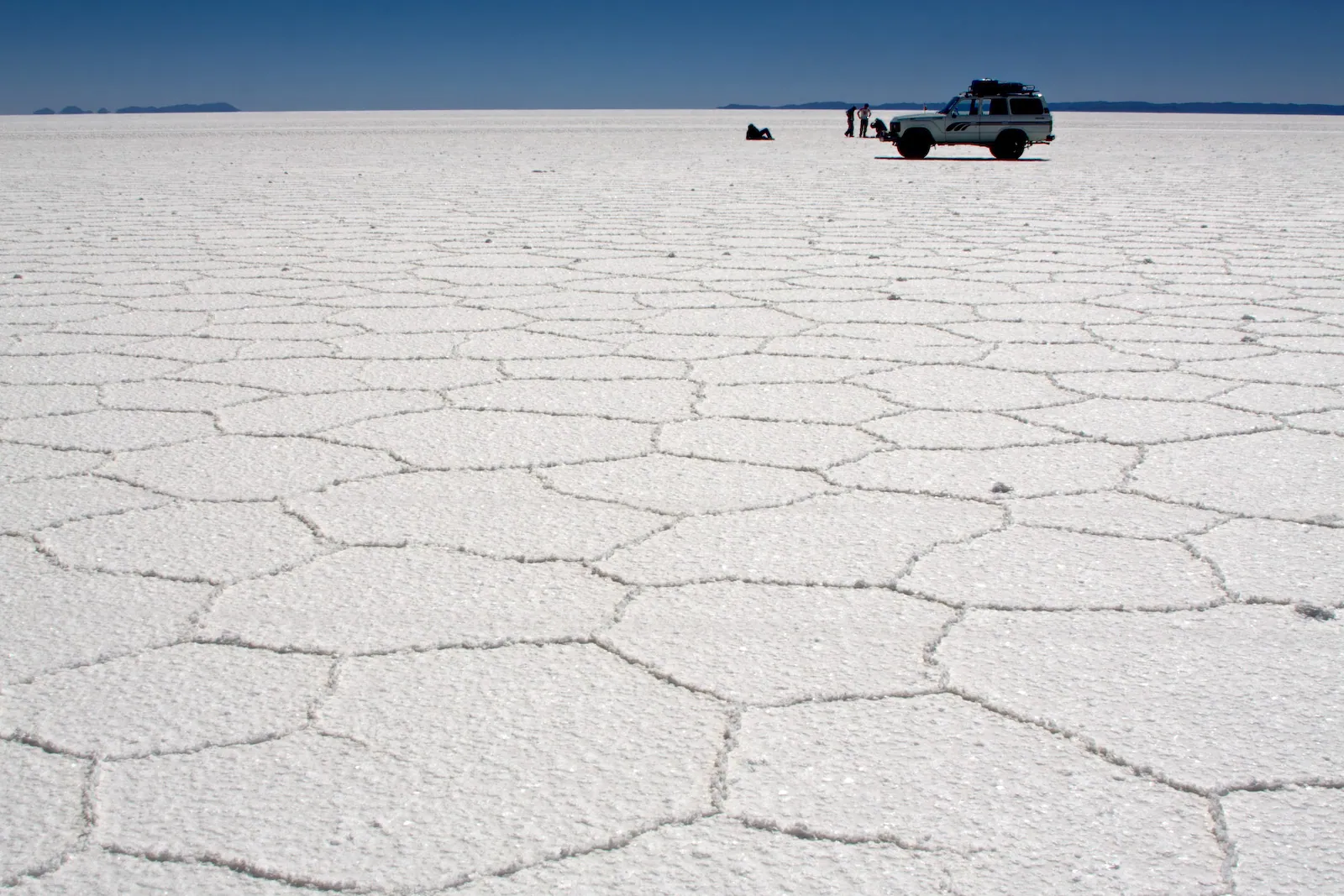
The Lithium Beneath the Salt: Uyuni’s Other Treasure
Beneath the Salar de Uyuni lies one of the largest lithium resources on Earth — the metal that powers electric cars and phones. A traveller’s guide to the science, the stakes and what it means for the salt flat.
The Salar de Uyuni is famous for its white surface, but its economic significance lies in the brine beneath it. Concentrated in that subsurface liquid is an enormous quantity of lithium — the light metal at the heart of the rechargeable batteries in phones, laptops and electric vehicles. Bolivia is reckoned to hold one of the world’s largest lithium resources, much of it under this single flat, and Uyuni sits within the so-called Lithium Triangle spanning Bolivia, Chile and Argentina.
Yet a vast resource is not the same as easy production, and Bolivia has long extracted only a small fraction of what lies beneath the salar. The reasons are partly chemical — Uyuni’s brine is genuinely difficult to process — and partly about water, infrastructure and the choices a country makes about a resource it considers part of its national patrimony.
How lithium comes to be under a salt flat
Lithium-rich salt flats form where mineral-laden water drains from surrounding volcanic mountains into a closed basin with no outlet to the sea. Over very long spans of time the water evaporates in the dry, high-altitude air, leaving its dissolved salts behind. Lithium, leached from volcanic rock, becomes concentrated in the brine that saturates the salar’s crust and the sediments below it.
The Salar de Uyuni, the dried bed of vast prehistoric lakes on the altiplano, is a textbook example. The familiar white surface is mostly common salt; the lithium of interest is in the briny liquid held within and beneath that crust, alongside other valuable elements such as potassium and magnesium.
Why Uyuni’s lithium is hard to extract
The conventional way to win lithium from brine is to pump it into a sequence of large evaporation ponds and let the sun concentrate it over many months. Uyuni complicates this in two ways. First, its brine has a relatively high ratio of magnesium to lithium, and separating magnesium from lithium is technically awkward and costly. Second, the salar lies in the wetter, southern part of the altiplano, so the rainy season interrupts the evaporation that the whole process depends on.
Together these factors make Uyuni’s lithium more difficult and expensive to produce than the brine of, for example, Chile’s Atacama. It is one reason Bolivia’s output has remained modest despite the scale of the resource, and why newer, faster extraction technologies have drawn so much interest.
A national resource and a global demand
Bolivia has approached its lithium as a strategic national asset, pursuing state-led development rather than simply opening the salar to foreign mining companies. Industrial activity is concentrated at the southeastern edge of the salar, and the country has weighed partnerships and competing technologies as it tries to scale up production.
The backdrop is surging global demand: the shift to electric vehicles and renewable-energy storage has made lithium far more sought-after than it once was. That demand is precisely why a remote Bolivian salt flat now features in conversations about the world’s energy future.
What this means for the salar and its people
Lithium development raises real questions for the altiplano. Brine extraction uses water in a region that is already arid and where local communities, herders and wildlife — including the flamingos of the nearby lagoons — depend on scarce supplies. Communities around the salar also seek a fair share of the benefits from a resource lying beneath their land.
For now, industrial operations occupy a limited area at the salar’s edge, and the immense white expanse that draws travellers remains overwhelmingly intact. But the salt flat is, increasingly, two things at once — an extraordinary landscape and an industrial frontier — and understanding that tension is part of understanding the place.
Seeing the salar with this in mind
On the Andes to Antarctica journey, travellers cross the Salar de Uyuni for its sheer scale and strangeness, but knowing what lies beneath adds a quieter dimension. The brine under the crust connects this silent, remote flat to the battery in the phone in your pocket and to the global transition away from fossil fuels.
Our guides can point out where extraction activity is concentrated and explain how Bolivia is navigating the choices involved. A great journey does not look away from this complexity; it lets the landscape be appreciated and understood at the same time.
Quick answers
Does the Salar de Uyuni really hold a lot of lithium?
Yes. Bolivia is estimated to hold one of the largest lithium resources in the world, much of it concentrated in the brine beneath the Salar de Uyuni. The salar sits within the Lithium Triangle of Bolivia, Chile and Argentina. However, a large resource is not the same as large-scale production.
Why doesn’t Bolivia produce more lithium from Uyuni?
Several reasons. Uyuni’s brine has a high magnesium-to-lithium ratio, making it harder and costlier to process. The salar also lies in a wetter zone, so the rainy season disrupts the solar-evaporation method. Bolivia has additionally chosen a state-led approach, and infrastructure and technology have developed gradually.
Will lithium mining spoil the salt flat for visitors?
Industrial operations are currently concentrated in a limited area at the salar’s southeastern edge, and the vast white expanse that travellers come to see remains largely intact. The more pressing concerns are water use in an arid region and ensuring local communities share in the benefits.
Let the reading become a route.
When an article sparks something, our planners are the next step. Tell us what you are dreaming of.