The Medina of Marrakech, Explained
Marrakech's old city is a walled medieval medina, a World Heritage site, and one of the great urban survivals of the Islamic world. Here is what it is, how it is organised, and how to read it on the ground.
The medina of Marrakech is the historic walled core of the city — a dense, roughly oval quarter of about six hundred hectares enclosed by some nineteen kilometres of pink earthen ramparts. Founded in the eleventh century, it is still a living city: people are born, work, worship and trade inside the walls, exactly as they have for nine hundred years. It is not a museum, and that is the point.
To a first-time visitor the medina can seem like a single bewildering maze. It is not. It has a clear logic — a great public square, a principal mosque, trade quarters, residential lanes and gates — and once that structure is understood, the apparent chaos resolves into a city that can be read. Learning to read it is the most rewarding thing a traveller can do in Marrakech.
A city founded on the caravan routes
Marrakech was founded around 1070 by the Almoravids, a Berber dynasty whose empire stretched across the Maghreb and into Spain. Its position was deliberate: at the edge of the Haouz plain, in sight of the High Atlas, it commanded the routes between the Sahara to the south and the cities of the north. For centuries it was a meeting point of trans-Saharan trade, and a capital of successive Moroccan dynasties.
That history is written into the medina's monuments. The Koutoubia Mosque, the Almoravid Qubba, the later Saadian Tombs and the Bahia and Badi palaces each belong to a different chapter of the city's story. The whole medina was inscribed as a UNESCO World Heritage site in 1985, recognised not for a single building but as a complete and outstanding example of a historic Islamic city.
How the medina is organised
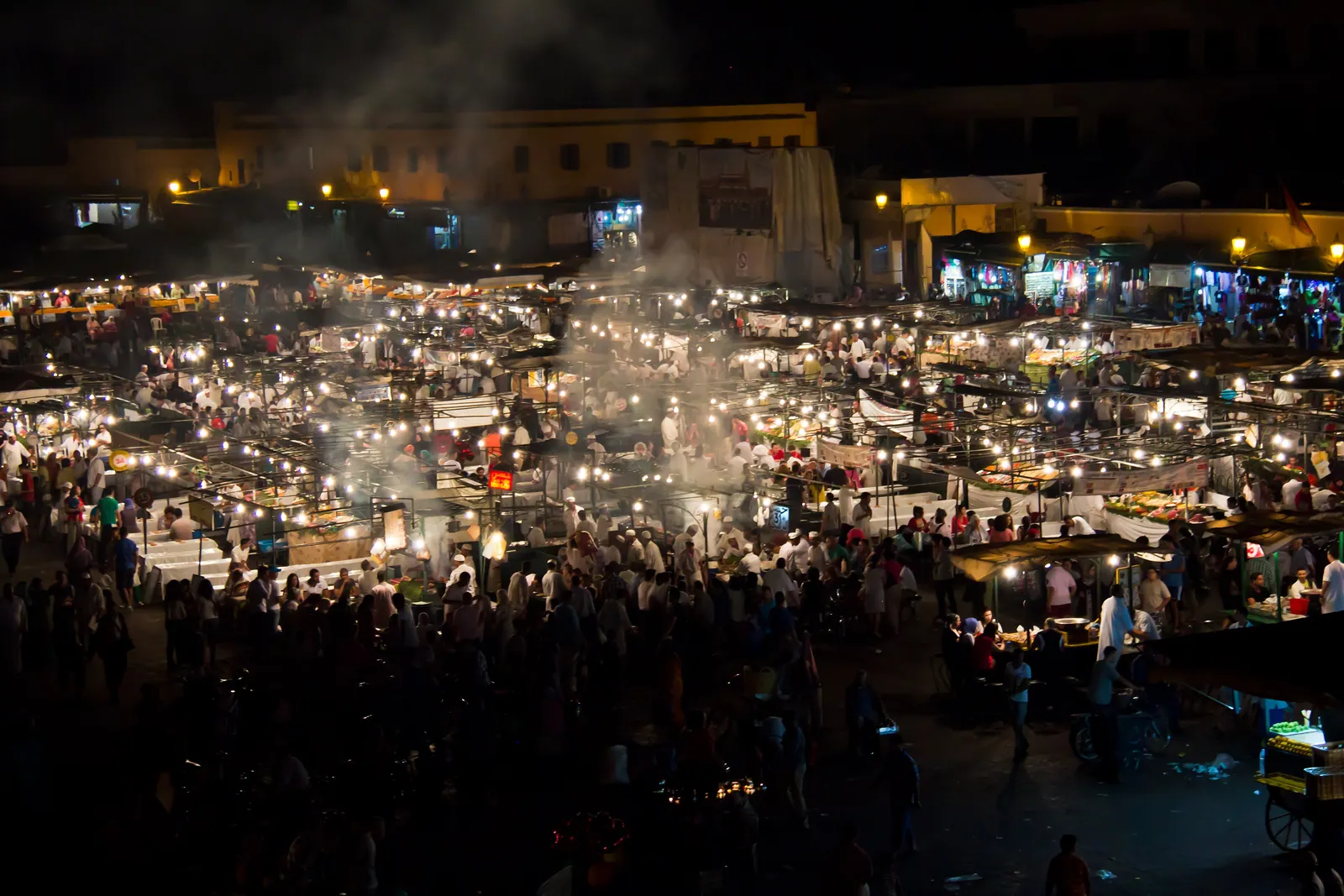
A traditional Moroccan medina follows a recognisable pattern, and Marrakech is a clear example. At its heart is the great open space of Jemaa el-Fnaa, the public square; beside the religious and civic core spread the souks, the covered market streets, traditionally grouped by trade. Beyond the commercial zone lie the residential quarters, quieter lanes of inward-facing houses gathered around small neighbourhood units.
Each neighbourhood, or derb, historically had its own essentials close at hand: a mosque, a fountain, a hammam or bathhouse, a communal oven and a Quranic school. This decentralised pattern meant daily life could be lived within a few hundred metres. Recognising it helps a visitor understand that the medina is not one undifferentiated maze but a cluster of villages woven together.
The walls and the gates
The ramparts that define the medina were begun in the twelfth century and are built of rammed earth — the reddish pisé that gives Marrakech its enduring nickname, the Red City. They run for roughly nineteen kilometres and are pierced by a series of monumental gates, the babs, each historically the controlled point of entry for a particular road into the city.
Bab Agnaou, near the Kasbah quarter, is the finest of them, a carved stone gateway from the Almohad period. The gates remain useful landmarks today: when navigating the medina, knowing which bab you are nearest is one of the simplest ways to orient yourself against the city's edge and find your way back out.
Finding your way
The medina's streets are not laid out on a grid, and few of the smaller lanes are signed. Rather than fighting this, a traveller does better to navigate by landmarks. The minaret of the Koutoubia, tall and visible from much of the medina, is the great fixed reference; the square of Jemaa el-Fnaa is the central hub from which the main souk streets run roughly north.
Lanes narrow and widen, and a passage that looks like a dead end often turns. Mopeds share even the tightest streets, so it pays to stay aware. Getting briefly lost is part of the experience and rarely a problem — the medina is small enough that walking in one direction will bring you to a wall, a gate or the square. On a guided journey a local guide leads the first exploration, after which the city feels far less daunting.
The medina on The Long Way East
On The Long Way East, the journey that begins in Madrid and crosses from Spain into Morocco, Marrakech is the great southern destination, and the medina is its heart. After Andalusia and the strait, the city offers a fully living example of the Islamic urban tradition whose echoes the journey has already met in Córdoba and Granada.
We base ourselves inside the walls, in a riad in the medina, precisely so that the old city is not a day excursion but the place you wake and return to. Mornings begin on foot among the souks and monuments; the rhythm is slow, attentive and unhurried — the only way a medina of this density is properly understood.
Quick answers
What is a medina?
A medina is the old walled quarter of a North African or Middle Eastern city — the historic, pre-modern core, as distinct from the newer districts that grew up outside the walls. Marrakech's medina is a particularly complete example: enclosed by earthen ramparts, organised around a central square and mosque, with covered market streets and residential neighbourhoods, and still fully inhabited today.
Is it easy to get lost in the Marrakech medina?
The medina's lanes are unplanned and largely unsigned, so brief disorientation is common and entirely normal. It is rarely a real problem: the quarter is compact, and walking consistently in one direction will bring you to a rampart, a gate or the central square of Jemaa el-Fnaa. The Koutoubia minaret is visible from much of the medina and serves as a reliable landmark.
Why is Marrakech called the Red City?
The nickname comes from the colour of its buildings and walls, which are largely built of rammed earth and pisé in a distinctive reddish-pink. The great ramparts that enclose the medina are the clearest example. Local building regulations have long encouraged this warm earthen tone, which is why the city reads as a single coherent colour from the air and from the surrounding plain.
Let the reading become a route.
When an article sparks something, our planners are the next step. Tell us what you are dreaming of.