The Registan of Samarkand, Explained
Three vast madrasas around a single public square, built across two and a half centuries. Here is how to read the Registan of Samarkand — what each building is, who raised it, and why it remains the most famous square in Central Asia.
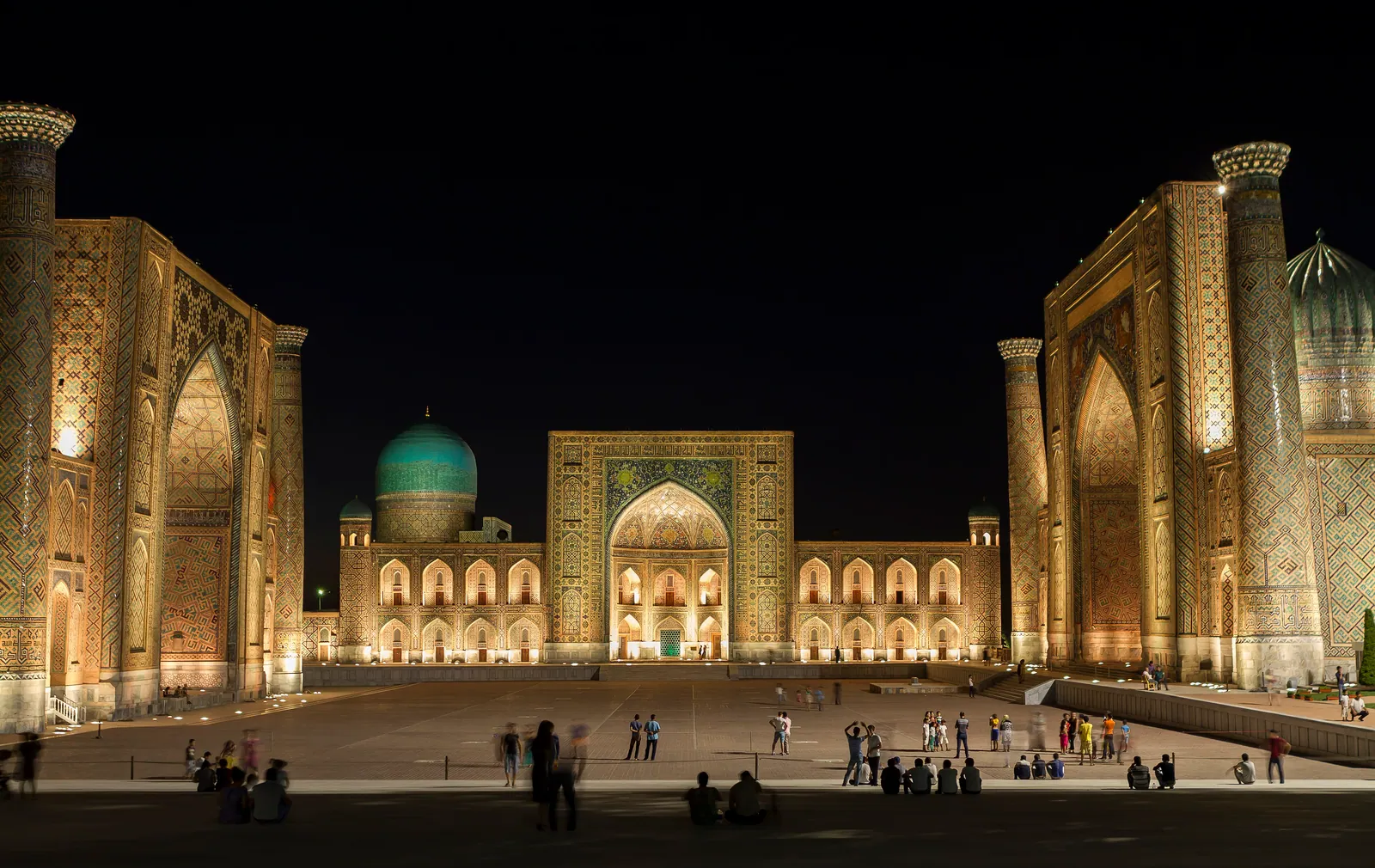
The Registan is a public square in the heart of Samarkand framed on three sides by enormous madrasas — Islamic colleges — their facades sheathed in blue and gold tilework. It is not a single monument but an ensemble, assembled over roughly 250 years, and it is the image most people carry of the Silk Road itself.
To stand in the Registan is to read three chapters of one story at once. The oldest building dates to the 1410s, the youngest to the 1660s, and each reflects the rulers and tastes of its age. Knowing which is which — and what you are looking at — turns a beautiful square into a legible one. It is the centrepiece of our Samarkand destination and a fixed point on The Silk Road Reborn.
What the word means
Registan means sandy place — from reg, sand. The square earned the name because a canal channel once spread sand across the ground here. For centuries this was the civic and commercial heart of Samarkand: a marketplace, a gathering point, the stage for royal proclamations and, less romantically, public executions.
What survives today is the architectural frame around that civic space. Three madrasas enclose the square on its west, east and north sides, leaving the south open. They were never planned as a set; each was built to face the others, so that later rulers were in effect answering their predecessors across the sand.
The Ulugh Beg Madrasa, 1417-1420
The oldest of the three stands on the west side. It was commissioned by Ulugh Beg, grandson of the conqueror Timur, who ruled Samarkand as governor and then sultan and was himself a serious astronomer and mathematician. His madrasa was a genuine centre of learning, teaching theology alongside astronomy and the exact sciences, and Ulugh Beg is said to have taught there in person.
Architecturally it set the template the square would follow: a towering portal, or pishtaq, flanked by minarets, with two storeys of student cells arranged around an inner courtyard. Its tilework favours geometric star patterns and crisp Kufic calligraphy — restrained, mathematical, very much in the spirit of its founder.
The Sher-Dor and Tilya-Kori, 1619-1660
Nearly two centuries later, the ruler Yalangtush Bahadur commissioned two more madrasas under the Shaybanid and Astrakhanid dynasties. The Sher-Dor Madrasa, on the east side, was built to mirror the Ulugh Beg opposite it. Its name means having tigers: its portal carries two striped big cats chasing white deer beneath rising suns with human faces — a startling depiction of living creatures on a religious building, and the Registan's most photographed detail.
The Tilya-Kori Madrasa closed the north side around 1660. Its name means gilded, and the interior earns it: the mosque chamber is lined with tilework finished in gold leaf, the dome painted to flatten into a hypnotic disc when seen from below. The Tilya-Kori also served as the city's principal congregational mosque, so it combined college and Friday prayer hall in one.
How to read the tilework
The Registan's surfaces are not random ornament; they follow a grammar. Three broad families of decoration recur: geometric patterns built from interlocking stars and polygons, flowing vegetal arabesques, and calligraphy carrying Quranic verse. Figurative imagery, as on the Sher-Dor, is the rare exception that proves the rule.
The techniques are worth distinguishing too. Some passages are cuerda seca — tiles painted in several colours separated by a greasy line that keeps the glazes from bleeding. Others are true mosaic faience, cut piece by piece from monochrome tiles and assembled like a jigsaw, the more laborious and luminous method. A guide who points out the difference changes how the whole square looks.
Standing in the square today
Much of what visitors see has been stabilised and rebuilt. Earthquakes, neglect and the passage of centuries left the Registan badly damaged by the 1800s; the leaning minarets were straightened and the structures consolidated through extensive Soviet-era restoration in the 20th century. The square is now part of the UNESCO World Heritage listing for Samarkand.
Visit early, before the light goes flat and the crowds thicken, or return at dusk when the facades are lit. Each madrasa can be entered, its courtyard quieter than the square outside, its former student cells now mostly small workshops and craft stalls. On The Silk Road Reborn we time Samarkand so that the Registan is seen more than once, in more than one light — it rewards the second look.
Quick answers
What are the three buildings of the Registan?
All three are madrasas — Islamic colleges. The Ulugh Beg Madrasa on the west dates from 1417-1420; the Sher-Dor Madrasa on the east was built 1619-1636 to mirror it; and the Tilya-Kori Madrasa on the north, completed around 1660, also served as the city's main Friday mosque. Together they enclose the square on three sides.
Why does one building have tigers on it?
The Sher-Dor Madrasa, whose name means having tigers, carries two striped big cats chasing deer beneath human-faced suns on its portal. Figurative images of living creatures are unusual on Islamic religious architecture, which makes the Sher-Dor's facade the Registan's most distinctive and most photographed feature.
Is the Registan original or reconstructed?
Both. The buildings are genuinely centuries old, but earthquakes and neglect left them severely damaged by the 19th century. Extensive restoration, much of it during the Soviet period, straightened the leaning minarets, rebuilt collapsed sections and reconstructed lost tilework. The ensemble is part of the UNESCO World Heritage site of Samarkand.
Let the reading become a route.
When an article sparks something, our planners are the next step. Tell us what you are dreaming of.