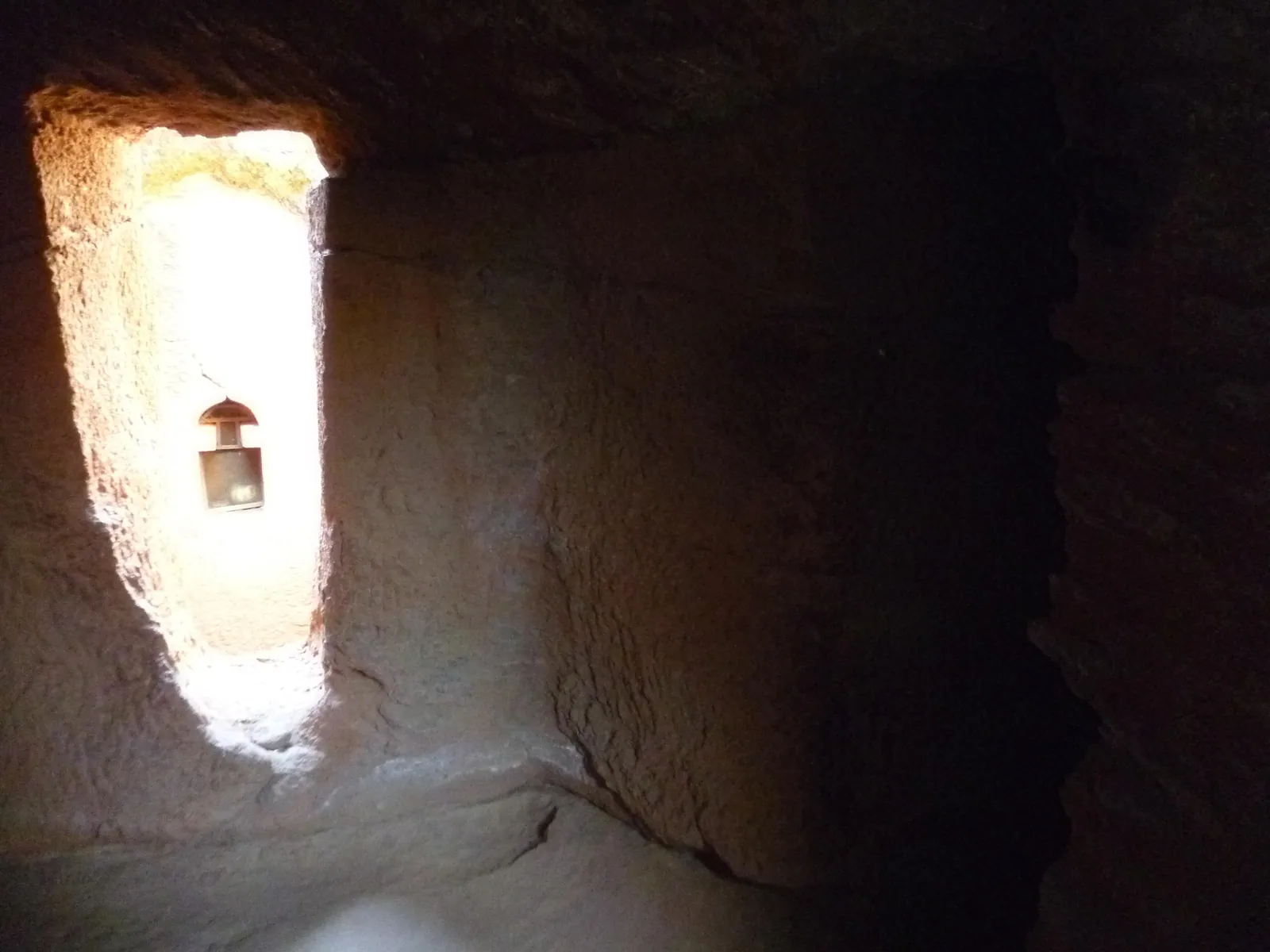
The Rock-Hewn Churches of Lalibela: A City Carved Downward
At Lalibela, eleven medieval churches were not built up from the ground but cut down into it — sculpted from solid volcanic rock. Here is how they were made, what they mean, and how to walk among them with care.
Lalibela is a town in the Ethiopian highlands, around 2,500 metres above sea level, where eleven monolithic churches were carved directly out of the living bedrock in roughly the twelfth and thirteenth centuries. They were not assembled from blocks or quarried stone. Each was excavated from the top down: masons cut trenches into a slab of soft red volcanic tuff, isolated a block, and then hollowed it into a finished church with doors, windows, columns and decorated ceilings — all from a single piece of rock.
The result is a place still very much alive. Lalibela remains an active centre of the Ethiopian Orthodox Tewahedo Church, served by white-robed priests and visited by pilgrims who have walked for days. Recognised as a UNESCO World Heritage Site, it is among the holiest places in Ethiopian Christianity, and one of the most extraordinary feats of architecture anywhere — a cathedral district sculpted, in effect, in reverse.
How you carve a church out of the earth
The technique is subtractive rather than additive. Where a conventional building rises by adding material, a rock-hewn church appears by removing it. Workers first scored the outline of the structure on a level expanse of rock, then chiselled deep vertical trenches on every side until a free-standing block stood isolated in its own pit. Only then did they begin the interior, tunnelling inward and downward to shape naves, aisles, pillars and vaulted roofs.
This means there is no margin for error. A misplaced cut cannot be patched, because the church is one continuous piece of stone — floor, walls and ceiling are the same rock. The tuff of the Lalibela area is soft enough to work with hand tools yet hardens on exposure to air, which is precisely what made the undertaking possible. Drainage channels cut around and below the churches carry away highland rain, a quiet piece of engineering that has helped them survive eight centuries.
The eleven churches and how they are grouped
The churches fall into two main clusters separated by a channel known as the Jordan, after the river of the Holy Land — for Lalibela was conceived as a symbolic New Jerusalem. The northern group includes Bete Medhane Alem, often described as the largest rock-hewn church in the world, and Bete Maryam, much loved by pilgrims. The eastern group gathers several smaller churches linked by trenches and tunnels.
Standing apart is Bete Giyorgis, the Church of Saint George, the most photographed of all. Cut in the shape of a Greek cross and set deep in its own square pit, it is reached by a sloping passage and appears, from the rim above, as a perfect cruciform roof flush with the ground. Many of the churches are joined by a warren of passages, so that a visit becomes a slow procession from light into shadow and back.
King Lalibela and the New Jerusalem
Tradition attributes the churches to King Lalibela of the Zagwe dynasty, who is said to have ordered their creation after the capture of Jerusalem made pilgrimage to the Holy Land dangerous for Ethiopian Christians. The town itself, formerly called Roha, was renamed for him. Many local place names — the Jordan, a hill called Calvary — deliberately map the geography of Jerusalem onto the Ethiopian highlands.
Historians debate the exact span of construction; the churches may have taken shape over a longer period and several reigns rather than in one king's lifetime. What is not in doubt is the intent: to build a place of pilgrimage so complete that the faithful need never leave Ethiopia to walk where their faith began.
A living sanctuary, not a ruin
Lalibela is not a museum. Mass is sung, incense burns, and priests guard ancient processional crosses and illuminated manuscripts within the churches. The clergy wear white cotton robes; pilgrims, often elderly and barefoot, press their foreheads to the stone. During Genna — Ethiopian Christmas, celebrated in early January — tens of thousands gather, and the trenches fill with chant through the night.
For a traveller this asks for a particular kind of attention. Shoes are removed before entering each church, so socks are practical on cold or wet stone. Modest dress, covering shoulders and knees, is expected of everyone. Photography of people and of services should always follow a quiet request first. The churches are dim by design, lit by narrow windows and shafts of daylight, and the experience rewards stillness rather than haste.
Lalibela on a highland journey
Lalibela sits naturally within a wider arc of the Ethiopian highlands, and on The Great Rift journey it is approached as a single, unhurried chapter rather than a checklist of eleven stops. A full day allows the churches to be seen in changing light — the cool of early morning, when priests open the doors and pilgrims arrive, is the finest time, before the high sun floods the open pits.
Because Lalibela lies at altitude, travellers benefit from arriving already adjusted to highland air; our itineraries pace the ascent so that the town is enjoyed rather than endured. A knowledgeable local guide is invaluable here, both to read the iconography carved and painted into the rock and to move respectfully through a place where worship and visiting share the same narrow passages.
Quick answers
Were the churches of Lalibela really carved from a single rock?
Yes. Each of the eleven monolithic and semi-monolithic churches was excavated from solid volcanic rock, with floor, walls, columns and roof all part of one continuous piece of stone. Workers cut down from the surface, isolating a block and then hollowing its interior. Nothing was assembled from quarried blocks.
When is the best time to visit Lalibela?
Early morning offers the gentlest light and the most active worship, as priests open the churches and pilgrims arrive. The dry months from roughly October to March bring more reliable conditions. Genna, the Ethiopian Christmas in early January, is spectacular but extremely crowded, so travellers should weigh atmosphere against quiet.
What should I wear when visiting the churches?
Dress modestly, covering shoulders and knees, as Lalibela is an active religious site. Shoes are removed before entering each church, so wear socks you can slip on and off easily, especially as the stone floors are cold. Always ask before photographing priests, pilgrims or services.
Let the reading become a route.
When an article sparks something, our planners are the next step. Tell us what you are dreaming of.