The Salar de Atacama: Chile's Great Salt Flat
Chile's largest salt flat is a vast crust of white set between volcanoes — a feeding ground for flamingos, a reservoir of lithium, and one of the strangest landscapes in the Atacama. What it is, and how to read it.
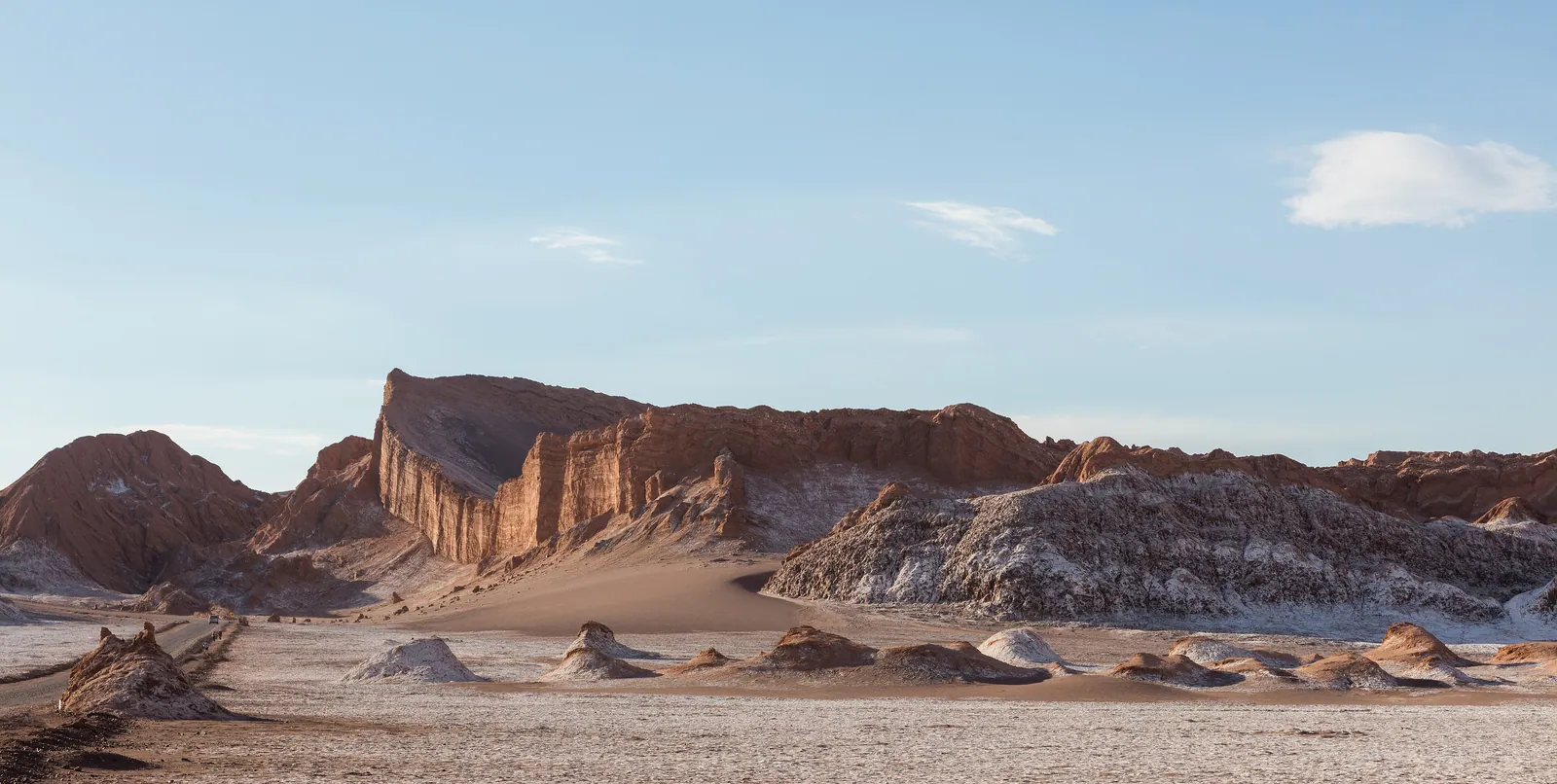
Spread across the basin south of San Pedro de Atacama lies the Salar de Atacama, the largest salt flat in Chile and one of the largest in the world. It is a vast, blinding crust of white and grey, several thousand square kilometres of it, hemmed in by volcanoes and the wall of the Andes.
The salar is not the smooth, billiard-table salt flat that photographs of Bolivia's Uyuni have made famous. It is rougher, crustier and stranger — and it is alive, with brine just beneath the surface, flamingos feeding in its shallows and, far below, one of the planet's great reserves of lithium. This is a guide to reading Chile's great salt flat.
How a salt flat forms
A salt flat is what is left when a lake dries up and cannot drain. The Salar de Atacama sits in a closed basin — a low point in the desert with no river leading out to the sea. Water reaches it as snowmelt and groundwater from the surrounding Andes, carrying dissolved minerals, but the only way out for that water is to evaporate.
When water evaporates, the minerals stay behind. Over an immense span of time, in the relentless dryness of the Atacama, that process has left a thick crust of salts across the basin floor. The result is the salar: not a clean sheet of table salt but a complex, lumpy pavement of different minerals, with pockets of dense brine still held in the ground beneath it.
Why this salt flat looks rough, not smooth
Travellers who arrive expecting a mirror-flat white plain are often surprised. Much of the Salar de Atacama's surface is a jagged, broken crust — sharp ridges and knobs of salt that crunch and crack underfoot. This texture comes from the way the crust grows and is reworked: salt crystallising, dissolving slightly when rare moisture arrives, and recrystallising, buckling the surface as it goes.
The texture is part of the salar's character. Where Bolivia's Uyuni is famous for its smooth, reflective expanse, the Salar de Atacama is famous for its harsh, fissured one — a landscape that looks less like a frozen lake and more like a vast field of grey coral, stretching to a horizon of perfect volcanic cones.
Laguna Chaxa and the flamingos
Improbably, this crust of salt holds water and life. In places the brine reaches the surface as shallow lagoons, and the most visited of them lies within the Laguna Chaxa sector of the Los Flamencos National Reserve. Here, thin sheets of mineral water spread across the white, and three species of flamingo — Andean, Chilean and the rare James's — wade and feed in the shallows.
Laguna Chaxa is a half-day excursion from San Pedro, and it is most rewarding at the day's edges. At sunrise and sunset the low light turns the salt pink and gold, the volcanoes glow on the horizon, and the flamingos feed in good numbers — heads down, bills sweeping the brine for the tiny shrimp and algae that colour their feathers. It is one of the Atacama's great wildlife hours.
Lithium under the crust
The Salar de Atacama has a second, very modern significance. The brine held beneath its surface is exceptionally rich in lithium, the light metal at the heart of the rechargeable batteries that power phones and electric cars. The salar holds one of the largest and most concentrated lithium resources on Earth, and parts of it are now an active extraction zone.
For a traveller, this means a corner of the basin away from the tourist sectors is industrial landscape: evaporation ponds in geometric blues and greens, where lithium-rich brine is pumped up and concentrated by the same desert sun that built the salar. It sits, not always comfortably, alongside the reserve's flamingos — a reminder that even the planet's emptiest-looking places are caught up in its busiest questions.
The salar on a grand journey
On Andes to Antarctica and The Pacific Arc, a visit to the Salar de Atacama is part of the Atacama Desert leg — typically the Laguna Chaxa sector, reached on a guided half-day trip from a San Pedro lodge, timed for the soft light and the feeding flamingos at dawn or dusk.
It is, helpfully, one of the desert's gentler excursions. The salar floor sits at roughly the same altitude as San Pedro, so unlike El Tatio or the high lagoons it asks nothing of a traveller still adjusting to the thin air. That makes it a fine outing for the early part of an Atacama stay — a chance to stand in the heart of Chile's great salt flat while the body readies itself for the heights to come.
Quick answers
What is the Salar de Atacama?
The Salar de Atacama is the largest salt flat in Chile, a vast crust of salts covering several thousand square kilometres of a closed desert basin south of San Pedro de Atacama. It formed as mineral-laden snowmelt collected in a basin with no outlet to the sea and evaporated over an immense span of time, leaving the salt behind. Brine still lies beneath the surface, and flamingos feed in its shallow lagoons.
Is the Salar de Atacama like the Uyuni salt flat in Bolivia?
They are different in character. Bolivia's Salar de Uyuni is famous for its smooth, mirror-like surface. The Salar de Atacama is rougher — a jagged, fissured crust of salt that crunches underfoot, formed by salt repeatedly crystallising and recrystallising. Both are large salt flats ringed by volcanoes, but the Atacama's is harsh and coral-like rather than flat and reflective.
Can you see flamingos at the Salar de Atacama?
Yes. The Laguna Chaxa sector of the Los Flamencos National Reserve, within the salar, is one of the best places in the desert to see flamingos. Three species feed in the shallow brine — Andean, Chilean and the rare James's. It is a guided half-day trip from San Pedro de Atacama, and is most rewarding at sunrise or sunset, when the light is soft and the birds feed in numbers.
Let the reading become a route.
When an article sparks something, our planners are the next step. Tell us what you are dreaming of.