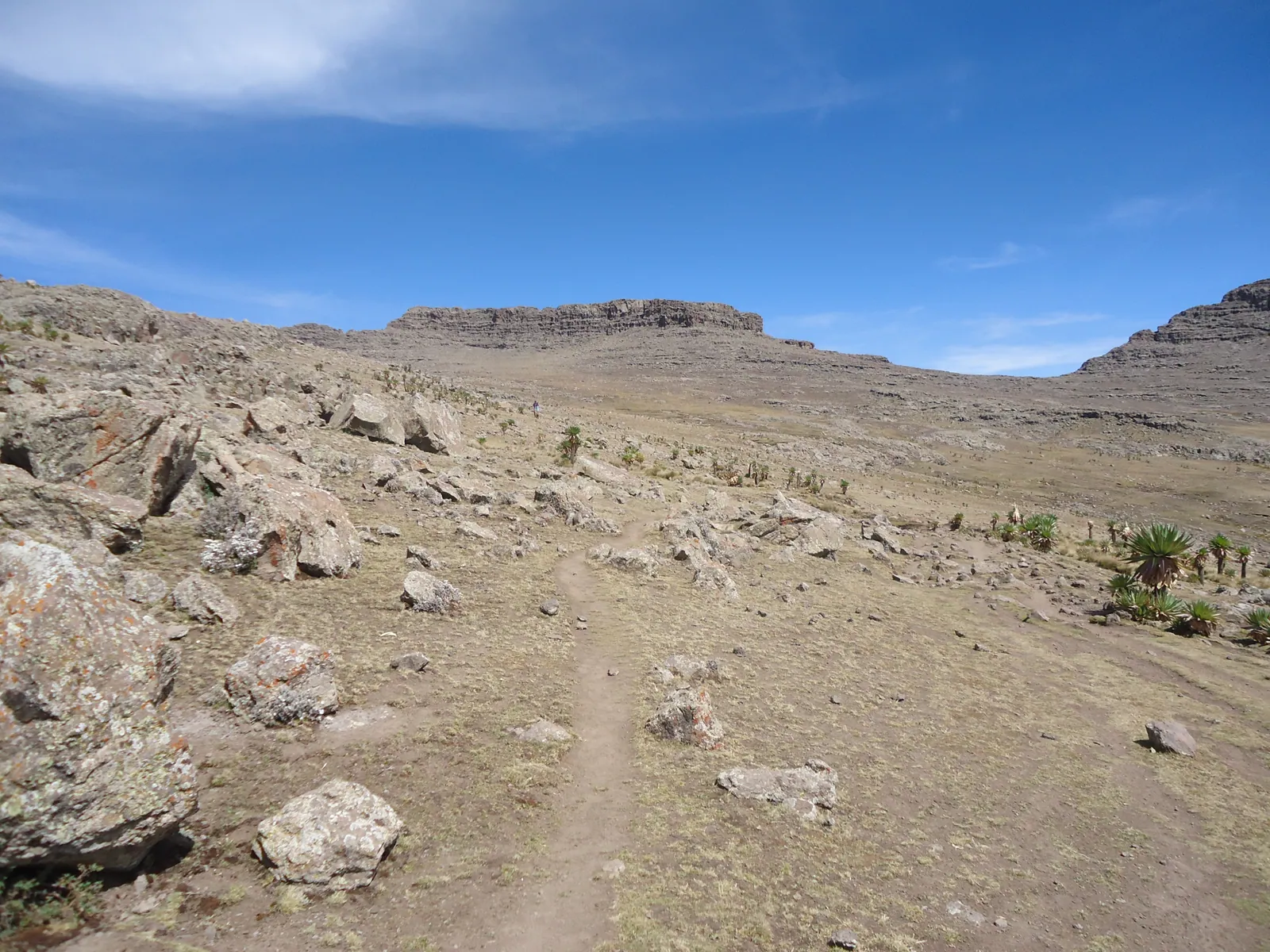
The Simien Mountains and the Gelada: A Highland of Cliffs and Grass-Eating Primates
The Simien Mountains rise in a wall of eroded basalt above the highlands, home to the gelada — the world's only grass-grazing primate — and wildlife found nowhere else. Here is what shaped this landscape.
The Simien Mountains in northern Ethiopia are not mountains in the usual sense of isolated peaks. They are the eroded remains of a vast ancient lava plateau, sliced by millions of years of weathering into a dramatic escarpment of pinnacles, gorges and sheer cliffs that fall away for a thousand metres or more. Ras Dejen, the highest summit, reaches 4,550 metres, making it the tallest mountain in Ethiopia and one of the highest in Africa.
The range is protected as Simien Mountains National Park, a UNESCO World Heritage Site. Its great draw is wildlife found almost nowhere else on Earth: the gelada, a primate that lives in large troops and grazes on grass; the endangered Ethiopian wolf; and the Walia ibex, a wild goat that exists only here. To walk the escarpment is to move along the edge of a continent, with the Rift Valley world spread out below.
How the Simien escarpment was carved
Tens of millions of years ago, immense outpourings of basalt lava built a high plateau across much of the Ethiopian highlands. Since then, water, frost and the slow tug of gravity have worn that plateau back, eating into its edges to leave the jagged escarpment seen today. The flat-topped summits and table mountains are surviving fragments of the original lava surface; the cliffs and spires below are what erosion has exposed.
This same uplift and volcanism is bound up with the geology of the East African Rift, the great fracture in the continent that runs through Ethiopia. The result is a landscape of abrupt verticals — grassland and heath on the plateau above, dizzying drops at its rim — and a climate that, at altitude, can swing from warm sun to cold mist and frost within a single day.
The gelada: a primate that lives on grass
The gelada is one of the Simien's defining sights. Often called the bleeding-heart monkey for the hourglass patch of bare skin on its chest, it is the only primate in the world whose diet is dominated by grass — blades, seeds and roots, cropped methodically as the troop moves across the plateau. Geladas spend their days on the open grassland and retreat each night to roost on the cliff faces, safe from predators.
They live in some of the largest groupings of any primate, bands that can merge into herds hundreds strong. Geladas are generally relaxed around quiet walkers, grazing and grooming as visitors pass at a respectful distance. They should never be fed or approached closely: they are wild animals, and the experience of sitting near a foraging troop as the light moves over the escarpment is best left undisturbed.
Ethiopian wolf and Walia ibex
Two further animals make the Simien internationally important. The Walia ibex, a sturdy wild goat with sweeping ridged horns, is endemic to these mountains — it lives nowhere else in the world — and picks its way along ledges on the escarpment. Decades of protection have helped its numbers recover from a perilous low, though it remains a species to be valued and watched from a distance.
The Ethiopian wolf, the rarest canid in the world, also ranges in the high country here. Slender and russet-coated, it hunts rodents across the Afro-alpine moorland and is found only in a handful of Ethiopian highland enclaves. Sightings are never guaranteed, but the possibility is part of what makes a Simien traverse so compelling for travellers who care about wildlife.
Walking the high country
The Simien is, above all, a place to be travelled slowly on foot. Trails follow the rim of the escarpment, linking viewpoints where the plateau simply ends and the land falls away into haze. Lammergeier vultures and thick-billed ravens ride the updraughts along the cliffs, and giant lobelia plants — strange, columnar and several metres tall — punctuate the Afro-alpine grassland.
Days are warm in the sun and nights genuinely cold, sometimes below freezing, so layered clothing is essential. The altitude is real: even gentle walking feels harder above 3,000 metres, and travellers do best when they have already spent time adjusting in the highlands. National park rules mean an official scout accompanies visitors, and a measured pace turns the Simien from a test of stamina into one of the great walking landscapes of Africa.
The Simien on The Great Rift journey
Within The Great Rift journey the Simien is treated as a highland counterpoint to Ethiopia's churches and valley lakes — a chapter of cliff edges, cold air and endemic wildlife. The itinerary allows time at altitude so that the escarpment can be walked comfortably, and the wildlife met without rushing.
Because weather on the plateau shifts quickly, our guides plan walks around the clear, calm mornings, when geladas are out grazing and the views run uninterrupted to the horizon. The aim is not to summit at speed but to spend unhurried hours on the rim of the highlands, in one of the few places where a traveller can sit quietly among wild primates.
Quick answers
What makes the gelada unique?
The gelada is the only primate in the world that grazes mainly on grass, cropping blades, seeds and roots as the troop moves across the highland plateau. It also lives in exceptionally large social groups and roosts on cliff faces at night. It is found only in the Ethiopian highlands.
How high are the Simien Mountains, and is altitude a concern?
The highest peak, Ras Dejen, reaches 4,550 metres, and most walking takes place above 3,000 metres. Altitude makes even moderate effort feel harder, so travellers benefit from acclimatising in the highlands first and walking at a steady, unrushed pace. Days are warm and nights can fall below freezing.
Will I see Ethiopian wolves in the Simien?
Possibly, but sightings are never guaranteed. The Ethiopian wolf is the rarest canid in the world and lives only in scattered highland areas, including the Simien. It hunts rodents across high moorland. Patient travellers may glimpse one, but the gelada and Walia ibex are far more reliably seen.
Let the reading become a route.
When an article sparks something, our planners are the next step. Tell us what you are dreaming of.