The Temples of Kyoto Worth Your Time
Kyoto has some two thousand temples and shrines, and no traveller should attempt them all. This is a considered shortlist — the dozen sites that reward a slow visit, and how to string them into days that make sense.
If you have a week in Kyoto, you have time for perhaps eight to twelve temples — not the two thousand the city contains. The honest answer to “which ones” is that a handful of sites are genuinely unmissable, a second tier rewards a particular interest, and the rest are best discovered by accident on the walk between them. This article names the first two groups and leaves the third to chance.
Kyoto’s greatest temples are not interchangeable. Some are vast hilltop complexes built for spectacle; others are small Zen courtyards built for stillness. Choosing well means matching the site to the hour and the mood — a quiet rock garden in the early morning, a golden pavilion when the light is low — and resisting the urge to tick every famous name in a single exhausting day.
The unmissable handful
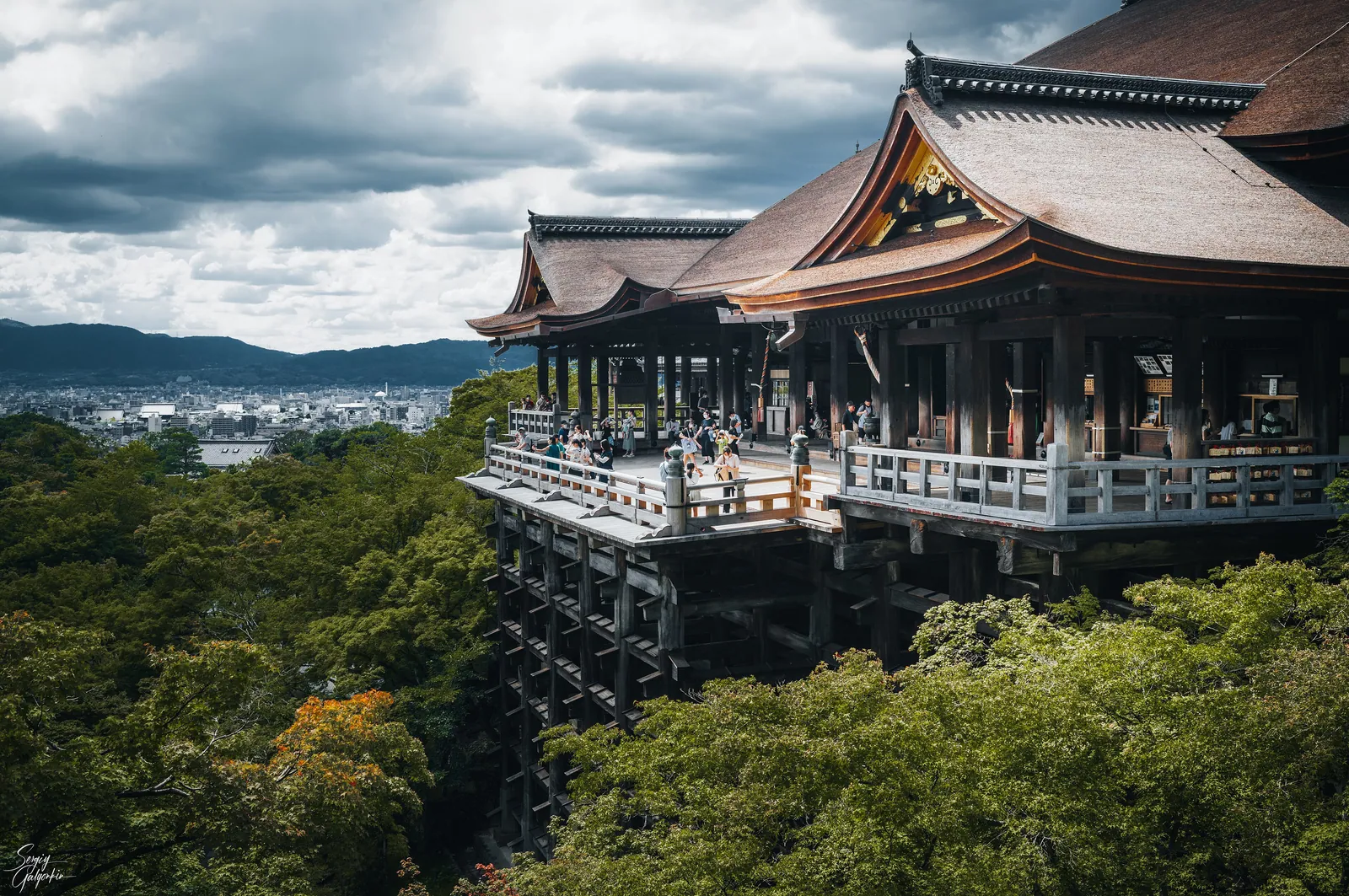
Five sites form the core of any first visit. Kiyomizu-dera, founded in the eighth century, spreads across a wooded hillside on a great wooden stage that juts above the maples — go at opening or stay for the evening illuminations to avoid the daytime press. Kinkaku-ji, the Golden Pavilion, is small and famously crowded, but the gold leaf doubling itself in the pond is a sight that earns its fame; twenty minutes is enough. Ryōan-ji, nearby, holds Japan’s most celebrated rock garden — fifteen stones in raked gravel, arranged so that one is always hidden from view.
Add Ginkaku-ji, the so-called Silver Pavilion, whose understated buildings and cones of raked sand reward the unhurried, and Tenryū-ji in Arashiyama, the foremost of Kyoto’s five great Zen temples. On The Long Way East, the slow Arashiyama day is built around exactly this temple: its fourteenth-century garden by the monk Musō Soseki borrows the surrounding mountains into its composition, and its veranda is one of the finest places in the city simply to sit.
For Zen and the rock garden
Travellers drawn to Zen should look beyond Ryōan-ji to the great monastic compounds of the Rinzai school. Daitoku-ji is not one temple but a walled precinct of more than twenty sub-temples, several with exquisite small gardens and a few open to the public on a rotating basis; it is a place to wander rather than to schedule. Tōfuku-ji, in the city’s south-east, has a celebrated set of four modern gardens by the designer Mirei Shigemori and a maple valley that turns spectacular in late autumn.
These temples ask for a different pace. A rock garden is composed to be looked at from a fixed point — usually a wooden veranda — and to be read slowly, the way one reads a poem. Arriving early, sitting down, and giving the garden twenty unhurried minutes will tell you more than walking three temples in the same time.
The sites with a view, and the sites with a walk
Some of Kyoto’s temples are worth the visit as much for their setting as their architecture. Eikan-dō and Nanzen-ji sit at the foot of the eastern hills, linked by the Philosophers’ Path, a canal-side walk lined with cherry trees that is itself one of the city’s pleasures. Nanzen-ji also hides a surprise: a red-brick aqueduct, built in the Meiji era, striding incongruously through the temple grounds.
Higher up, the lesser-visited temples of the north-west and the Ōhara valley — Sanzen-in among them — trade crowds for moss, maple and quiet. If your week allows one half-day away from the famous core, this is where to spend it.
Temples or shrines — and the difference
Kyoto’s sacred sites divide between Buddhist temples and Shintō shrines, and the distinction is worth knowing. Temples (their names usually end in -ji or -dera) house Buddhist images and are tended by monks; shrines (-jingū, -jinja, or -taisha) are dedicated to kami, the spirits of the Shintō tradition, and are marked by the torii gate at their entrance. The most famous shrine of all, Fushimi Inari Taisha, is treated in its own article in this series.
Many sites blend the two, a legacy of centuries when the religions were formally intertwined. As a visitor you need not parse the theology, but a few courtesies apply everywhere: bow slightly as you pass through a temple gate or torii, keep your voice low, remove your shoes where signs or a raised step indicate, and never photograph an active service or a person at prayer.
Building a sensible temple day
The trap in Kyoto is geography. The famous temples are scattered across three sides of the city, and a day that hops between the far north-west, the eastern hills and the southern valley will be spent mostly in taxis. Cluster instead. A classic eastern day links Ginkaku-ji, the Philosophers’ Path, Nanzen-ji and the Gion district on foot. A north-western day pairs Kinkaku-ji and Ryōan-ji, both reachable by a single bus line.
Two or three temples in a morning, a long lunch, and one more in the soft light of late afternoon is a humane and rewarding pace. It is also how a Viajes Globales week in Kyoto is built — a city where the temptation to see everything is precisely the thing that stops you seeing anything well.
Quick answers
How many temples can I realistically see in a day?
Two or three, well, with time for an unhurried lunch in between. Each major temple deserves forty-five minutes to an hour, and travel between distant sites eats the rest. Travellers who attempt six temples in a day usually remember none of them clearly. Cluster sites by neighbourhood and let the pace stay generous.
Do Kyoto temples charge admission?
Most of the famous Buddhist temples charge a modest entry fee, typically a few hundred yen, and many close their gates by late afternoon — often 4.30 or 5pm. Shintō shrines are usually free and some, like Fushimi Inari, are open at all hours. Carry coins, and check closing times so a long-planned visit is not lost.
What is the etiquette inside a temple?
Bow slightly when passing through the main gate, keep your voice low, and remove your shoes wherever a raised wooden floor or a sign indicates — slip-on shoes make this easy. Photography is fine in most gardens and grounds but forbidden inside many halls and during services. Never photograph monks or worshippers without consent.
Let the reading become a route.
When an article sparks something, our planners are the next step. Tell us what you are dreaming of.