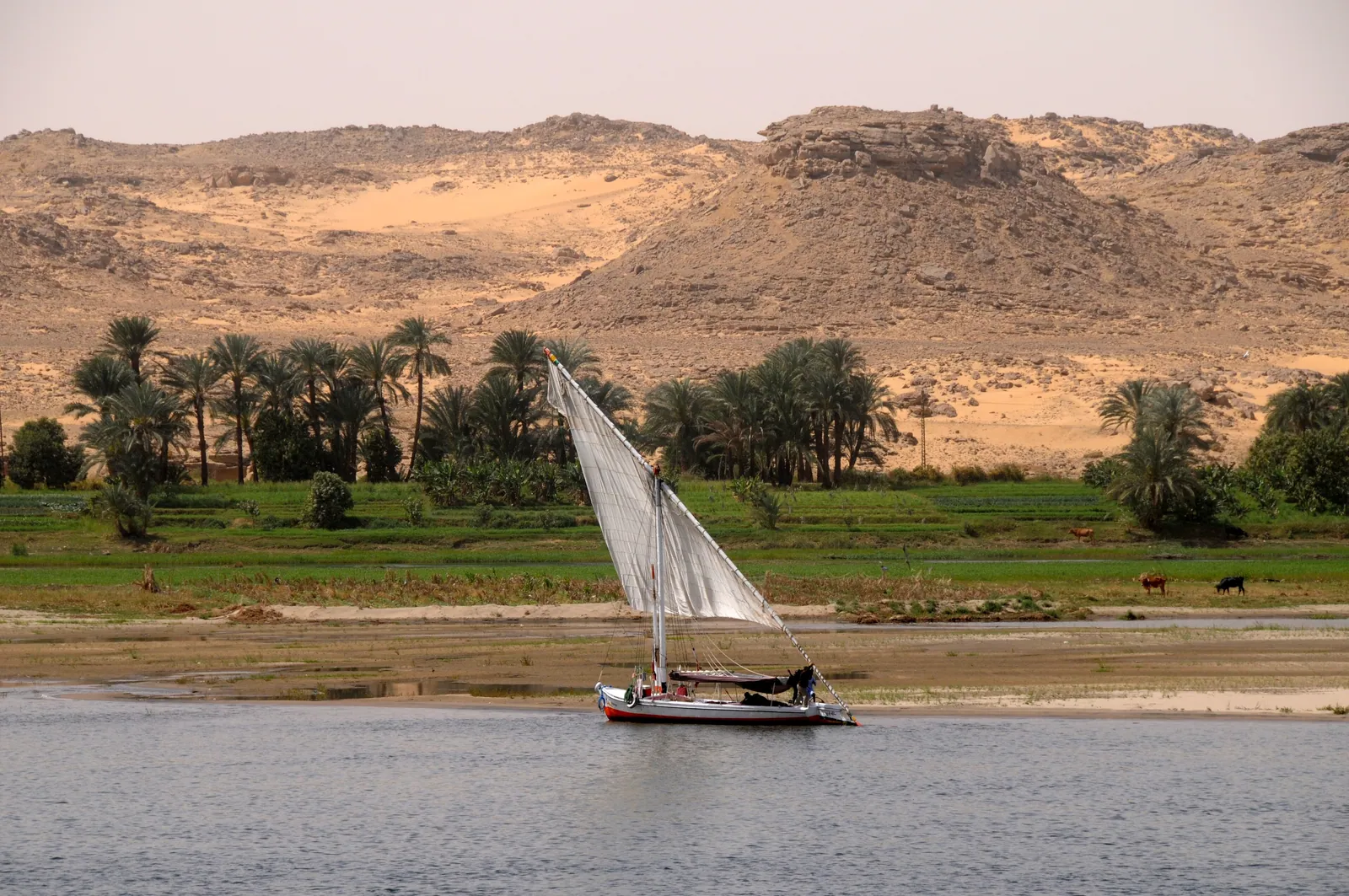
The Valley of the Kings
For five centuries the pharaohs of Egypt's New Kingdom were buried not under pyramids but deep inside a desert valley behind Luxor. Here is why they hid their tombs, what is painted on the walls, and how to visit.
The Valley of the Kings is a remote, dry valley in the hills on the west bank of the Nile opposite Luxor. For roughly five hundred years, from about 1539 to 1075 BCE, it served as the royal cemetery of the New Kingdom — the era of Egypt's greatest pharaohs, including Thutmose III, Hatshepsut, Seti I, Ramesses II and the boy-king Tutankhamun.
The defining choice here was concealment. Where the Old Kingdom kings advertised their tombs with pyramids visible for miles, the New Kingdom pharaohs cut theirs as hidden corridors deep into solid rock, hoping to defeat the tomb robbers. They mostly failed — but they left behind the most richly decorated burial chambers in the world, and one tomb that survived nearly intact.
Why the pharaohs stopped building pyramids
A pyramid is, for a robber, a map. By the start of the New Kingdom every Old and Middle Kingdom pyramid had been broken into and emptied, and the message was clear: a conspicuous monument over a treasure-filled tomb was an invitation. The pharaohs changed strategy completely.
They separated the two functions a pyramid had combined. The visible monument — the mortuary temple where the king's cult was maintained — was built down on the edge of the floodplain, in full public view. The burial itself was hidden, cut deep into the rock of a discreet valley behind the cliffs, its entrance concealed and guarded. Temple and tomb, once one structure, were now kilometres apart.
What is inside the tombs
A royal tomb here is a descending sequence of corridors, stairs and chambers driven into the limestone, ending in the burial hall where the sarcophagus stood. The walls and ceilings are covered in funerary texts and images — the Book of the Dead, the Book of Gates, the Amduat — illustrated guides intended to carry the king safely through the hours of the night and the trials of the underworld.
Because the tombs were sealed and underground, much of the painting keeps astonishing freshness — deep blues, ochres and greens, and ceilings of golden stars on a dark sky. The tomb of Seti I is the longest and finest; the tomb of Nefertari, in the nearby Valley of the Queens, is often called the most beautiful painted chamber in all of Egypt.
Tutankhamun and the great discovery
Tutankhamun was a minor pharaoh who died young, around 1323 BCE, and whose small tomb was soon hidden under debris and forgotten. That obscurity saved it. When Howard Carter found and opened it in 1922, it was the only royal tomb in the valley to survive substantially intact, packed with more than 5,000 objects, including the famous nested coffins and the solid gold funerary mask.
The find is a measure of what every other tomb here once held — and lost. The treasures themselves are no longer in the valley: the Tutankhamun collection has moved to the Grand Egyptian Museum near Giza, so a full appreciation of the valley now pairs the tombs at Luxor with the museum at Cairo.
Visiting the valley today
More than sixty tombs have been numbered in the valley, but only a rotating handful are open at any time, to spread wear and limit the humidity that visitors' breath adds to the painted plaster. A general ticket admits you to three tombs; a few of the finest — Seti I, Tutankhamun, Ramesses V and VI — need separate tickets and are well worth them.
The valley is hot, bright and almost shadeless, and the tomb corridors are warm and can be steep. Early morning is far kinder than midday for both comfort and crowds. Photography rules change periodically, so it is worth checking the current policy and buying any photo permit on arrival.
The valley on a Nile journey
On The Great Rift, the painted tombs of the Valley of the Kings are part of the Nile chapter, visited from the dahabiya during the unhurried sail between Luxor and Aswan. We treat Luxor's west bank as its own day — tombs in the cool of the morning, the mortuary temples after — rather than folding it into the east-bank temples.
Where it adds to the experience, we pair the valley with the nearby mortuary temple of Hatshepsut at Deir el-Bahari and the Valley of the Queens, so the New Kingdom system of hidden tomb and public temple can be seen whole. It is one of the clearest lessons in ancient Egyptian thinking the journey offers.
Quick answers
Why were the pharaohs buried in the Valley of the Kings instead of pyramids?
By the New Kingdom, every pyramid in Egypt had been robbed, because a pyramid clearly marked where the treasure lay. The pharaohs responded by hiding their burials as concealed rock-cut tombs in a remote valley, while building their public mortuary temples separately down on the floodplain. The aim was security, though most tombs were still eventually plundered.
How many tombs can you visit in the Valley of the Kings?
A standard ticket admits you to three tombs, chosen from those open on the day. Several of the most spectacular tombs — including Seti I, Tutankhamun, and Ramesses V and VI — require separate additional tickets. Open tombs are rotated to limit damage from heat and humidity.
Are Tutankhamun's treasures still in the valley?
No. Tutankhamun's mummy remains in his tomb, but the famous treasures — the gold mask, the nested coffins, the jewellery and furniture — have been moved to the Grand Egyptian Museum near Giza. Seeing the tomb at Luxor and the collection at Cairo together gives the fullest picture.
Let the reading become a route.
When an article sparks something, our planners are the next step. Tell us what you are dreaming of.