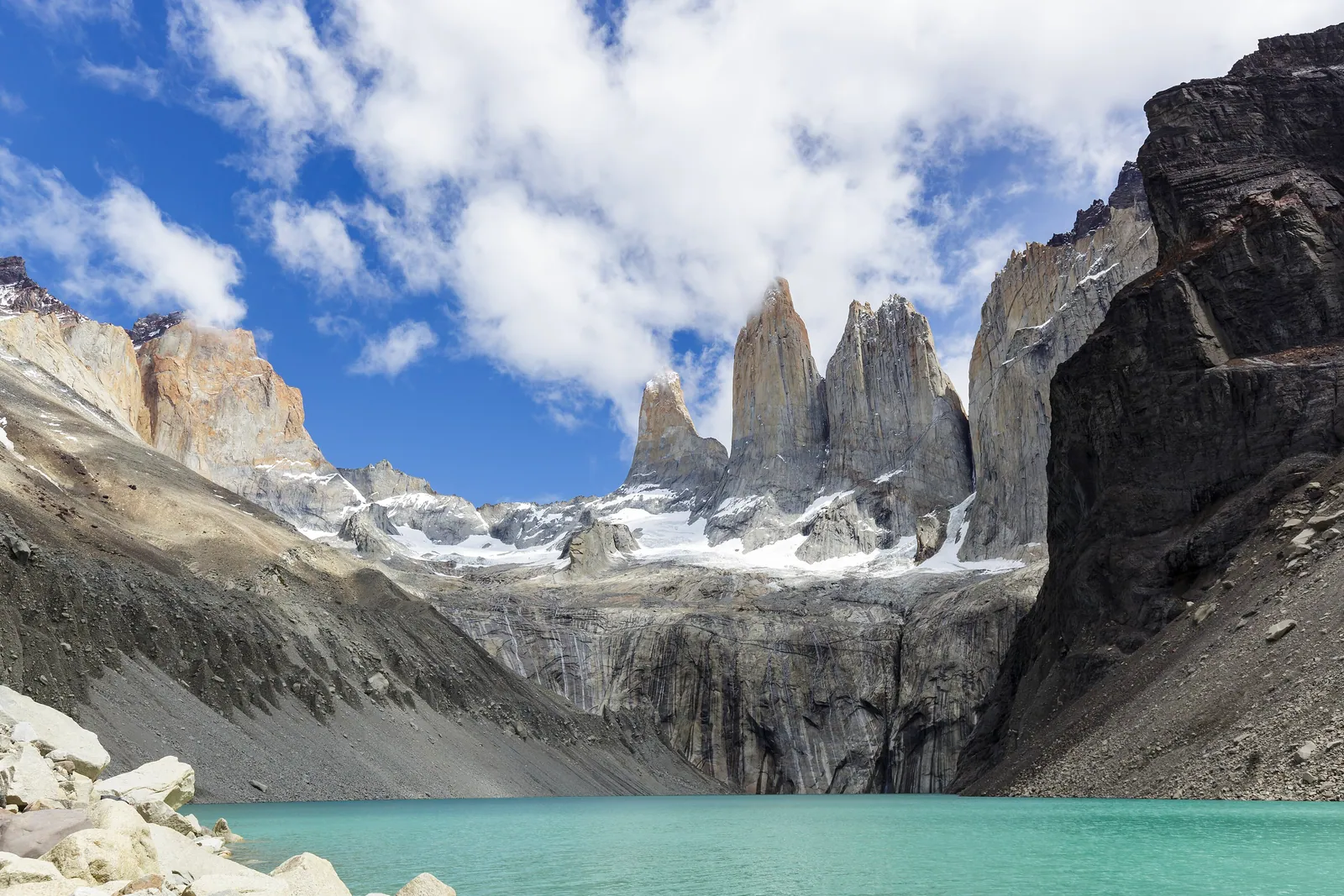
The W Trek: Walking the Heart of Torres del Paine
The W is the most loved multi-day walk in Chilean Patagonia — three valleys, three landmark views, and roughly 80 kilometres of trail. Here is how the route works, what each day asks, and how to walk it well.
The W Trek is a four- or five-day walk through the southern half of Torres del Paine National Park, and its name is literal: traced on a map, the route draws a rough W as it climbs into three valleys and drops back to the lakeshore between each. Most walkers cover something between 70 and 100 kilometres depending on the variant, sleeping in a chain of refugios and campsites, and never carrying more than a day's needs because their luggage moves separately or stays put.
It earns its fame honestly. In a single trek you stand beneath the granite towers that give the park its name, walk the hanging balcony above the Cuernos, and climb into the French Valley with its avalanche-raked amphitheatre. The W is strenuous but not technical — no ropes, no exposure — which is why it suits fit, ordinary travellers rather than only mountaineers, and why it forms the Patagonian heart of our Andes to Antarctica journey.
What the three arms of the W are
The W has three upward strokes, each ending at a marquee view. The eastern arm climbs to the Base Torres lookout, where the three towers rise straight from a milky glacial tarn. The central arm pushes up the French Valley between Paine Grande and the Cuernos, a corridor loud with the crack of distant avalanches. The western arm runs to Grey Glacier, where icebergs the colour of cobalt drift down a grey lake from the Southern Patagonian Ice Field.
Between the arms you walk the connecting lakeshore trails — long, rolling, often wind-blown stretches beside Lago Nordenskjöld and Lago Pehoé. These linking sections are less dramatic than the valley climbs but they are where the scale of the park settles on you: hours of walking with the Cuernos turning slowly on your shoulder.
East to west, or west to east?
Both directions are walked, and the choice shapes the trip. Walking east to west, you begin with the hardest and most famous climb — the steep ascent to the towers — on relatively fresh legs, and you finish gently at Grey Glacier. Walking west to east saves the towers for a grand finale but asks for that big climb on tired legs near the end.
Most guided trips, ours included, run east to west and time the towers for a dawn arrival. The light at sunrise can set the granite glowing a deep rose, the so-called alpenglow, for a few short minutes. It is weather-dependent and never guaranteed — Patagonia promises nothing — but the early start gives you the best chance and clears the lookout before the day's crowds arrive.
The days, distances and effort
A five-day W is comfortably paced. A representative itinerary climbs to the Base Torres lookout and back (about 19 kilometres, a long day with 800 metres of ascent), then transfers and walks the Cuernos shore, climbs the French Valley to the Británico viewpoint (a demanding 20-plus kilometres if walked to the upper lookout), and finishes with the trail to Grey Glacier and back.
None of it is technically difficult, but the days are long and the footing is rocky, rooty and frequently wet. Expect six to nine hours of walking on the bigger days. The single most underestimated factor is the wind, which on exposed sections can genuinely knock a walker off balance — trekking poles are not optional here, they are a safety item.
Where you sleep: refugios and the booking trap
The W is a hut-to-hut walk. A string of refugios — Central, Chileno, Frances, Paine Grande, Grey and others — offer bunk-room beds, hot meals and, at most, hot showers, run by two concessionaires within the park. You can also camp at designated sites. There is no wild camping in Torres del Paine, and rangers enforce it.
The hard part is logistical. Beds are limited, demand far outstrips supply in high season, and the park requires proof of booked accommodation for every night before it will let you start. Independent walkers routinely find the huts sold out months ahead. Travelling with us removes that scramble entirely: the refugio chain, the catamaran across Lago Pehoé and the transfers are reserved as one package long before you arrive.
Walking it well
Pack for four seasons in a single day, because that is what Patagonia routinely delivers — sun, sleet, wind and calm can all visit one afternoon. A windproof, waterproof shell, warm layers, gloves and a hat earn their place even in summer. Good broken-in boots and gaiters handle the mud; sunglasses and high-factor sunscreen handle the fierce southern light.
Pace yourself against the wind rather than the clock, drink more than you think you need, and start the long days early. On our trips a guide walks with the group and a second support arrangement carries the heavier gear between refugios, so you walk with a light daypack. The reward for that lightness is simple: you can lift your eyes from the trail and actually watch the towers arrive.
Quick answers
How fit do I need to be to walk the W Trek?
You need solid general fitness and comfort with long days on foot, but not mountaineering experience. The W involves five to nine hours of walking on rocky, uneven trails with climbs of several hundred metres, repeated over four or five days. If you can hike a full day with a daypack on consecutive days at home, you are ready. There is no technical climbing or exposure.
When is the best time to walk the W?
The trekking season runs roughly from November to March, the southern spring and summer, when the refugios are open and days are long. December to February is warmest and busiest; November and March are quieter and cooler, with a higher chance of unsettled weather. Whenever you go, expect strong wind and rapidly changing conditions on any given day.
Do I have to carry all my gear and food?
Not on a supported trip. The W is walked refugio to refugio, so meals are provided at the huts and you carry only a daypack with layers, water and the day's essentials. On our Andes to Antarctica journey the accommodation, the Lago Pehoe catamaran and transfers are pre-booked, and heavier luggage is handled separately so each walking day stays light.
Let the reading become a route.
When an article sparks something, our planners are the next step. Tell us what you are dreaming of.