The Wildlife of Patagonia: Guanacos, Pumas and the Condor's Country
Patagonia's wildlife is shaped by wind, distance and open space. Here is what lives at the end of the Americas — from the herds of the steppe to the great cat that hunts them.
Patagonia is not a jungle teeming at every turn; it is a vast, spare, wind-scoured landscape where wildlife is spread thin across enormous country. That openness is the gift. Animals here are visible at great distances, set against grassland, lake and mountain, and watching them feels less like a search than a slow reading of a wide horizon.
The headline residents are four: the guanaco that grazes the steppe in herds, the puma that hunts it, the Andean condor riding the thermals above, and the rarely seen huemul deer of the forests. Around them moves a supporting cast of flamingos, foxes, armadillos and seabirds. This is a guide to meeting them on the southern legs of Andes to Antarctica.
The guanaco: the keystone of the steppe
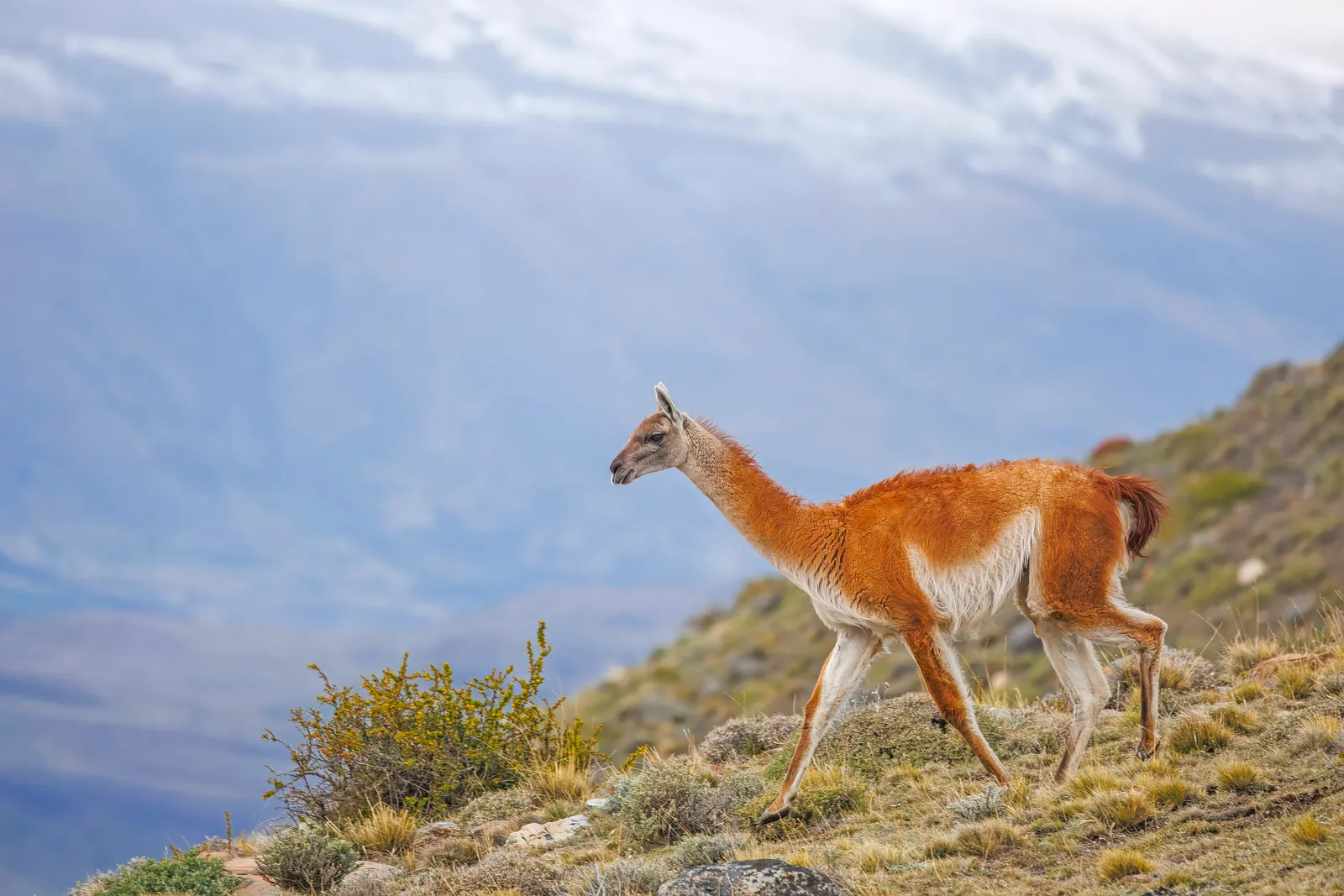
The guanaco is the wild ancestor of the llama and the most characteristic large animal of Patagonia. A slender, fawn-and-white camelid built for wind and distance, it lives in family groups led by a single dominant male, with bachelors gathering in loose, restless herds nearby. Its alarm call is a strange, high whinny that carries across the grassland.
Guanacos are superbly adapted to a hard place: their blood carries far more red cells than ours, letting them thrive at altitude and run hard at speed. In Torres del Paine they have become abundant and confiding, grazing in plain view — which has, in turn, drawn back the predator that depends on them.
The puma: watching the great cat of the south
Patagonia, and Torres del Paine in particular, has become one of the finest places on Earth to see a wild puma. Decades of protection and a healthy guanaco population have produced an unusual density of cats, and unusually relaxed behaviour, so that sightings of mothers with cubs or a puma at a kill are now a realistic hope rather than a fantasy.
Pumas are crepuscular, most active in the soft light of dawn and dusk, and finding them is genuine skill: specialist trackers scan ridgelines, read the alarm of guanacos and birds, and know the cats' favoured ground. A sighting asks for patience, distance and quiet — the cat sets the terms, and a good guide will always keep you within them.
The Andean condor and the birds of prey
Few sights match an Andean condor overhead. With a wingspan approaching three and a half metres, among the largest of any land bird, it barely beats a wing, instead riding thermals and ridge-lift for hours in search of carrion. Adults show a striking ruff of white at the neck; males carry a fleshy crest.
Watch for condors along cliffs and over the open hills, often in the company of black-chested buzzard-eagles and the hovering, kestrel-like chimango and crested caracaras. Condors are long-lived and slow to breed, raising a single chick every other year, which makes the species sensitive — its presence over Paine is a sign of a landscape still working.
The huemul, the fox and the smaller residents
The huemul, a stocky Andean deer, is Patagonia's rarest large mammal and one of its most precious — endangered, shy, and a national emblem of Chile. It keeps to forest edges and steep valleys, and a glimpse of one is a quiet privilege rather than an expectation.
More readily seen are the South American grey fox and the larger culpeo, trotting the steppe at dawn; armadillos rooting in the grass; and the ungainly, ostrich-like Darwin's rhea, or ñandú, striding in small parties with its striped chicks. Lakes and lagoons hold Chilean flamingos, black-necked swans, upland geese and crested ducks — colour scattered across an austere land.
Where the land meets the sea
Patagonia's coasts add a whole second fauna. The Atlantic shore, around peninsulas such as Valdés, hosts breeding southern right whales in winter and spring, along with colonies of southern elephant seals, sea lions and Magellanic penguins. The Pacific fjords shelter dolphins, sea lions and seabirds among the channels.
These coastal stretches are the natural hinge between the Patagonian and Antarctic chapters of a southern journey. As Andes to Antarctica turns from the steppe toward the Drake Passage, the wildlife shifts with the latitude — from guanaco and condor to penguin, seal and the great whales of the Southern Ocean.
Quick answers
What is the best time to see wildlife in Patagonia?
The austral spring and summer, roughly November to March, are best overall: weather is kindest, guanacos have young, birds are breeding and the steppe is busy with life. Pumas can be seen year-round, though some specialists favour the cooler shoulder months when cats range more in daylight. Coastal whales peak in winter and spring.
How likely am I to see a puma in Torres del Paine?
More likely than almost anywhere else, but never guaranteed — pumas are wild and wide-ranging. With a dedicated tracker, a few days in the right area and willingness to be out at dawn and dusk, sightings are a realistic hope. Patience and good local knowledge make the difference.
Are guanacos and llamas the same animal?
No. The guanaco is a wild camelid native to South America. The llama is its domesticated descendant, bred over thousands of years by Andean peoples. Guanacos are slimmer and uniformly coloured, live in wild herds, and in Patagonia are the main prey of the puma.
Let the reading become a route.
When an article sparks something, our planners are the next step. Tell us what you are dreaming of.