The World's Great Animal Migrations: An Atlas of Movement
Migration is the planet's oldest answer to a changing season. From a million wildebeest on the Serengeti to a butterfly that crosses a continent, here is a traveller's atlas of the great journeys other animals make.
A migration is, at heart, a simple bargain: the cost of a long and dangerous journey is paid because the destination offers more food, safer breeding ground, or kinder weather than staying put ever could. What looks like wanderlust is in fact one of evolution's most disciplined strategies, repeated by mammals, birds, fish and insects on every continent and in every ocean.
For a traveller, the great migrations are the surest wildlife spectacle on Earth, because they are governed by season rather than luck. Arrive in the right place at the right month and the animals are not a possibility but close to a promise. This atlas maps the migrations our journeys are built to meet — and a few of the world's other wonders worth knowing.
The wildebeest: the migration most people mean
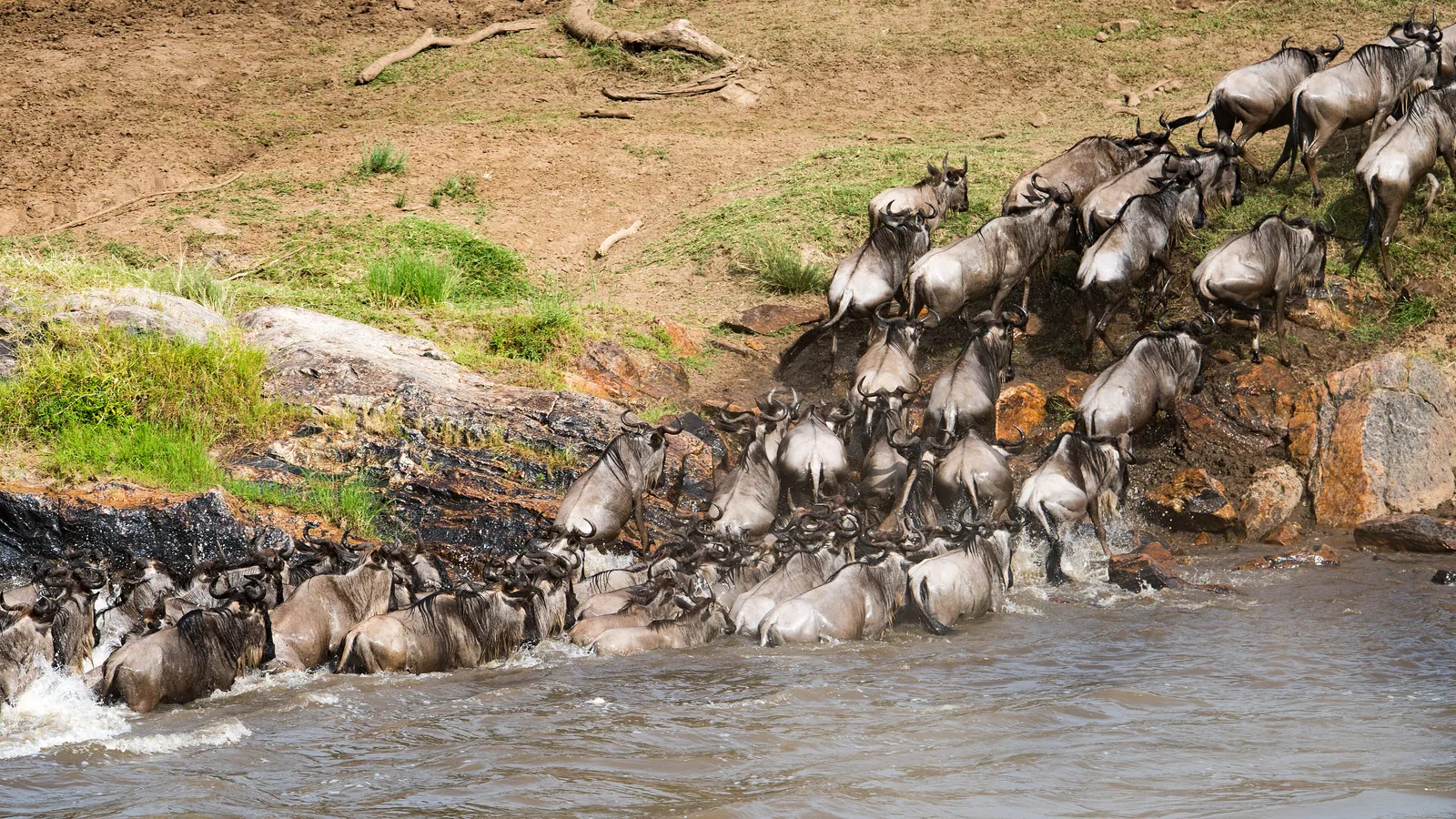
When people speak of the great migration without qualification, they mean the year-round circuit of roughly 1.3 million blue wildebeest, joined by several hundred thousand zebra and gazelle, across the Serengeti-Mara ecosystem of Tanzania and Kenya. It is the largest movement of land mammals left on the planet.
The herds follow the rains and the new grass in a vast clockwise loop: calving on the short-grass plains of the southern Serengeti around February, drifting north and west through the long rains, and reaching the crocodile-haunted Mara River between roughly July and October. Our Great Rift journey is timed to intersect this circuit, and where you meet it depends entirely on your month of travel.
Caribou and the great northern herds
In the Arctic, barren-ground caribou make one of the longest overland migrations of any land mammal — herds such as the Porcupine herd of Alaska and the Yukon travel well over a thousand kilometres a year between winter forests and the calving grounds of the coastal tundra.
The northern hemisphere holds other mass movements too: the saiga antelope of the Central Asian steppe, and historically the bison of the North American plains, whose herds once darkened the horizon before they were all but destroyed in the nineteenth century — a reminder that migrations are fragile and can be undone.
The migrations of the sea
The ocean's migrations are largely invisible from shore, which is part of their mystery. Humpback whales travel up to roughly 8,000 kilometres each way between polar feeding grounds and tropical breeding waters — the longest migration of any mammal. Grey whales, southern right whales and others trace their own long routes between cold larders and warm nurseries.
Off South Africa's Wild Coast, the winter sardine run sends billions of fish north in shoals kilometres long, pursued by dolphins, sharks, gannets and whales in one of the densest feeding events on Earth. Smaller and stranger migrations abound: Christmas Island's red crabs flood to the sea to spawn, and salmon climb rivers to the gravel beds where they hatched.
Birds: migration at the largest scale
No group migrates more spectacularly than birds. The Arctic tern holds the record, shuttling from Arctic breeding grounds to Antarctic waters and back — a round trip that can exceed 70,000 kilometres a year, meaning it sees more daylight than any other creature.
Billions of songbirds, raptors and shorebirds move along great flyways each spring and autumn, navigating by sun, stars and the Earth's magnetic field. Several of our journeys cross these corridors: the wetlands of the Pacific Arc and the Great Rift's lakes are staging posts on routes that link continents, and a quiet morning with binoculars often reveals travellers as far-flung as the ones carrying the binoculars.
The monarch and the migrations of the small
The most astonishing migration of all may belong to an insect that weighs less than a gram. The monarch butterfly of North America flies up to 4,000 kilometres to overwinter in a few high fir forests of central Mexico — and no single butterfly completes the round trip. It takes three to five generations to make the journey home, meaning each returning monarch navigates to a forest it has never seen, guided only by inheritance.
Migrations of the small are everywhere once you look: dragonflies crossing oceans, locusts sweeping continents, and the nightly vertical migration of plankton, the largest movement of biomass on the planet. Scale, in the world of migration, is no measure of wonder.
Why migrations are worth protecting
A migration depends on an entire chain of places — breeding ground, stopover, wintering ground — and on the freedom to move between them. Break one link with a fence, a dam, a drained wetland or a warming sea, and the whole journey can collapse. This is why conservationists increasingly speak of protecting corridors, not just parks.
Travelling to see a migration well, and with operators who fund the landscapes that sustain it, is one way a visitor becomes part of the case for keeping these routes open. The herds and the flocks have kept their appointments for millennia; the work of our age is simply to leave the road clear.
Quick answers
What is the largest animal migration on Earth?
By sheer biomass, the daily vertical migration of ocean plankton — rising to feed near the surface at night and sinking by day — moves more living matter than any other. Among animals we can watch, the wildebeest migration is the largest movement of land mammals, while the Arctic tern makes the longest individual journey of any creature.
Are animal migrations predictable enough to plan a trip around?
Largely, yes — that is their great gift to travellers. Migrations are driven by season, so timing your visit to the right month puts the odds firmly in your favour. Weather can shift events by a few weeks, which is why our itineraries target a window rather than a single date, and why local guides matter.
Why do animals migrate at all?
Migration is a response to seasonal change. Animals move to follow food as it grows or fails, to reach safer breeding grounds, or to escape harsh weather. The journey is costly and dangerous, so it persists only where the destination reliably offers more than staying behind would — a bargain refined over countless generations.
Let the reading become a route.
When an article sparks something, our planners are the next step. Tell us what you are dreaming of.