The World's Great Markets and Bazaars
A market is the fastest way to read a city — its food, its crafts, its rhythms of buying and bargaining. A guide to the great markets and bazaars along our journeys, and how to understand them.
If you have only one free morning in an unfamiliar city, spend it in the market. Nowhere else does a place reveal itself so quickly: what it eats, what it makes, what it values, and how its people talk to one another. A market is a working portrait of a culture, drawn fresh every day.
This is a guide to some of the great markets and bazaars along our journeys — the covered grand bazaars of Asia, the highland markets of the Andes, the souks of Morocco — and to the simple etiquette that lets a traveller move through them with confidence rather than as prey.
The covered bazaars of the old Silk Road
The grand covered bazaar is one of the enduring inventions of the Islamic and Silk Road world: a roofed labyrinth of lanes, organised by trade, where for centuries merchants have dealt in textiles, metalwork, spices, carpets and gold. Istanbul's Grand Bazaar, with its thousands of shops under painted vaults, is among the oldest and largest covered markets on earth, in continuous commerce since the fifteenth century.
Further east, the bazaars of Uzbekistan keep an older rhythm. Bukhara's trading domes — the toqi, built at crossroads as covered markets in the sixteenth century — still shelter craftsmen and sellers, and Samarkand's Siab Bazaar is a working food market where the city buys its bread, its dried apricots and its famous round non. On The Silk Road Reborn, these markets are not a shopping stop but a direct line to the trade that built the cities.
The souks of Marrakech
The souks of Marrakech spread north from the great square of Jemaa el-Fnaa into a dense warren of specialised lanes — the dyers' souk hung with skeins of drying wool, the slipper-makers, the metalworkers whose hammering you hear before you see them. The organisation by craft is ancient and practical: it let buyers compare, and let guilds regulate quality.
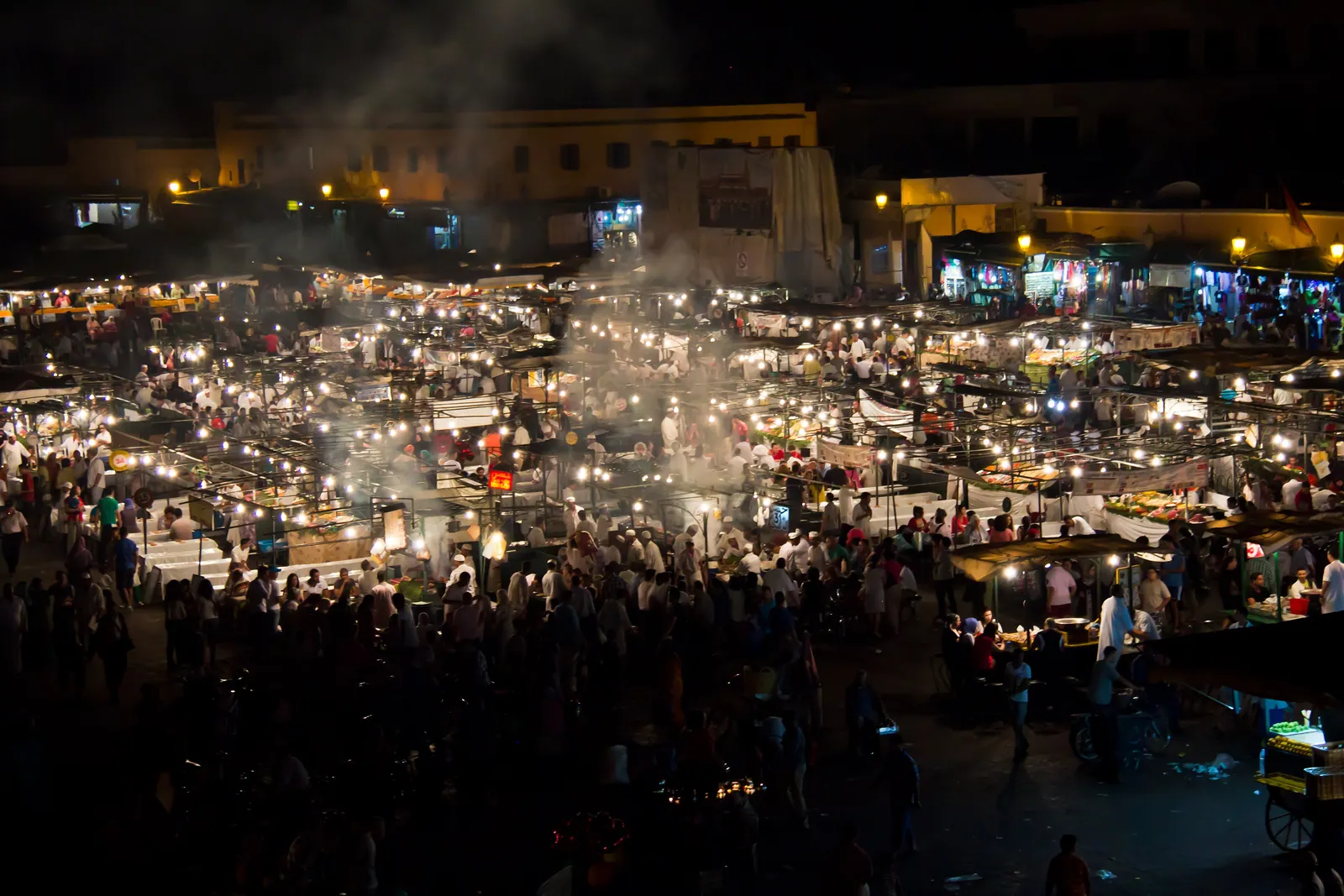
Jemaa el-Fnaa itself, recognised by UNESCO for its living tradition of storytellers, musicians and performers, transforms at dusk into an open-air kitchen of food stalls. The square is the theatrical front; the souks behind it are the workshop. A first-time visitor does well to accept that getting a little lost is part of it — the lanes are a puzzle by design — and to carry a landmark or a phone map for the way out.
The highland markets of the Andes
Andean markets run to a weekly rhythm, and the great market days are social occasions as much as commercial ones — the day the highland communities come down to town. Pisac, in Peru's Sacred Valley, holds a large and famous market; Chinchero's is quieter and more traditional. Across the border in Ecuador, the Saturday market at Otavalo is one of the most renowned indigenous markets in South America.
The most rewarding part of an Andean market is often not the textile stalls aimed at visitors but the produce section — the dozens of varieties of potato, the heaps of corn, the herbs and the dried goods — and the food stalls where the town eats lunch. On Andes to Antarctica, a Sacred Valley chapter that catches a market day offers one of the most natural encounters with highland life.
The art of the bargain
In many of the world's markets, bargaining is not a trap but the normal and expected way of agreeing a price — and approached in the right spirit it is a pleasure rather than a battle. The principle is simple: a price is a conversation. Show genuine interest, ask the price, make a friendly counter-offer well below it, and settle somewhere in between.
Bargain only for things you actually intend to buy; walking away after a vendor has met your price is poor form. Keep it good-humoured — a smile and patience achieve far more than hard tactics — and keep a sense of proportion, since the sum in dispute is often small to a traveller and meaningful to a seller. And know where bargaining does not apply: in food markets, fixed-price shops and cooperatives, the marked price is the price.
Eating your way through a market
Markets are some of the best places to eat, and a few sensible habits make them safe as well as delicious. Favour stalls that are busy with local customers, where turnover is high and the food is cooked fresh and hot in front of you. Fruit you peel yourself is a reliably good choice; be more cautious with anything lukewarm or long-sitting.
Beyond the practical, eating in a market is the point: the spice pyramids of a Silk Road bazaar, the bread ovens of Samarkand, the grilled-meat smoke of Jemaa el-Fnaa, the soup stalls of an Andean market town. Our guides will steer you to the stalls worth trusting — and a market lunch, eaten elbow to elbow with the town, is often the meal a traveller remembers.
Quick answers
Is bargaining expected in every market?
No. Bargaining is normal in the souks and bazaars of Morocco, Turkey and Central Asia, and in the craft sections of Andean markets. It does not apply in food and produce markets, in fixed-price shops, or in cooperatives, where the marked price is the price. When unsure, ask your guide what is customary.
How do I avoid getting lost in a place like the Marrakech souks?
Accept that some disorientation is part of the experience — the lanes are deliberately a maze. Note a landmark near your entry point, carry an offline phone map, and remember that the souks generally drain back toward the main square, Jemaa el-Fnaa. Our guides lead the first visit, after which most travellers are happy to explore.
Is it safe to eat at market food stalls?
Often it is some of the best eating you will do, with sensible habits. Choose stalls busy with local customers, where food is cooked fresh and served piping hot. Be cautious with lukewarm or long-standing dishes, and favour fruit you peel yourself. Our guides know which stalls in each market are worth trusting.
Let the reading become a route.
When an article sparks something, our planners are the next step. Tell us what you are dreaming of.