Three Thousand Years of Ancient Egypt: A Primer
Cleopatra lived closer in time to us than to the builders of the Great Pyramid. A short, clear primer on how ancient Egypt was organised — its kingdoms, dynasties and the long arc from the first pharaoh to the last.
Ancient Egyptian civilisation lasted roughly 3,000 years, from the unification of the country around 3100 BCE to the death of Cleopatra in 30 BCE. That span is so vast it distorts the imagination: the pyramids of Giza were already more than 2,500 years old when Cleopatra was born — she stands closer to the smartphone than to the pharaohs who raised them.
Egyptologists make this immensity manageable with a simple framework: a sequence of thirty-odd dynasties, gathered into three great 'Kingdoms' of stability — Old, Middle and New — separated by looser 'Intermediate Periods'. Carry that skeleton in your head and every temple, tomb and museum case in Egypt suddenly has a place to belong.
How Egyptian history is divided
The basic unit is the dynasty — a line of rulers, usually but not always a single family. The system of numbered dynasties comes from an Egyptian priest, Manetho, writing in Greek in the 3rd century BCE, and Egyptologists still use his thirty-one dynasties today.
Above the dynasties sit the broad eras. The three Kingdoms — Old, Middle and New — are the periods of a strong, unified state and great monument-building. Between and around them lie the Intermediate Periods, times of divided rule or foreign control, and before them all the Predynastic and Early Dynastic centuries when Egypt was first taking shape. It is a framework of rhythm: unity, fracture, unity again.
The Old Kingdom — the age of pyramids
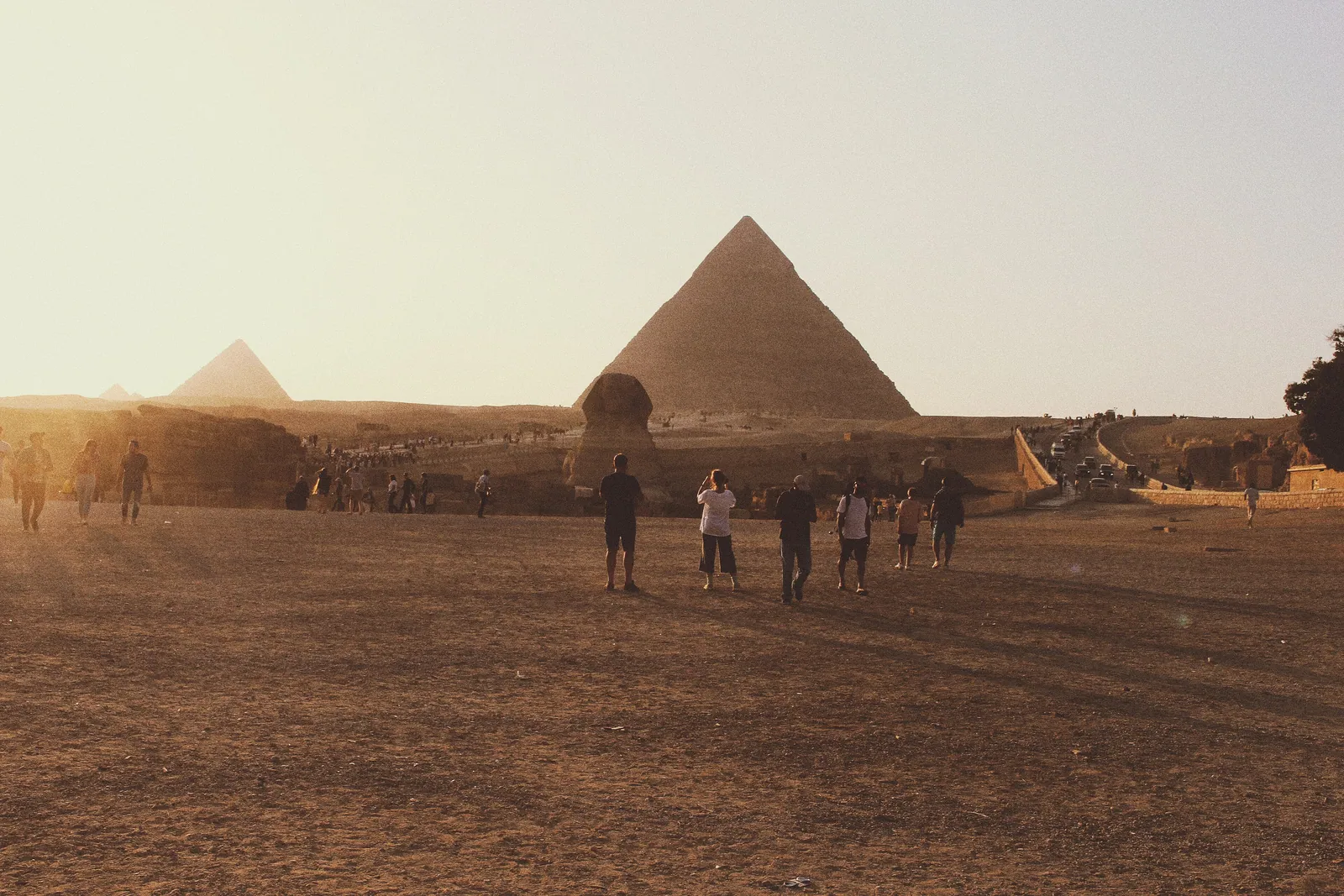
The Old Kingdom, roughly 2700 to 2200 BCE, is the age of the pyramid. It opens with the Third Dynasty and Djoser's Step Pyramid at Saqqara — the first monumental stone building in the world, designed by the architect Imhotep — and climaxes in the Fourth Dynasty with the smooth-sided pyramids of Giza.
This was a period of strong central kingship, with the pharaoh regarded as a living god and the state organised around his tomb. It ended in fragmentation as the central treasury weakened and provincial governors grew independent — the First Intermediate Period, a time later Egyptians remembered as chaos.
The Middle and New Kingdoms
The Middle Kingdom, around 2050 to 1650 BCE, reunified Egypt under Theban rulers and is often regarded as the classical age of its literature and language. It gave way to the Second Intermediate Period, when much of the north fell under the rule of the Hyksos, a people of Levantine origin.
The New Kingdom, roughly 1550 to 1070 BCE, is Egypt at its imperial height — the era of Hatshepsut, Thutmose III, the heretic king Akhenaten, Tutankhamun and Ramesses II. Its kings were buried in the hidden tombs of the Valley of the Kings, and its wealth raised the temples of Karnak and Luxor. Most of what a traveller pictures as 'ancient Egypt' belongs to these five centuries.
Decline, Persia, and the Ptolemies
After the New Kingdom came the long Third Intermediate and Late Periods — centuries of divided rule, Nubian and Libyan dynasties, and two spells of conquest by the Persian Empire. Egypt remained recognisably itself, but it was no longer the master of its own affairs.
In 332 BCE Alexander the Great took Egypt from Persia, and after his death one of his generals founded the Ptolemaic dynasty, a Greek-speaking royal house that ruled from the new city of Alexandria for nearly 300 years. The last of them was Cleopatra VII; with her death in 30 BCE Egypt became a province of Rome, and 3,000 years of pharaonic rule came to an end.
Reading the timeline on a journey
Egypt's monuments are scattered across this whole span, and a journey up the Nile is, in effect, a walk through the dynasties. The Great Rift opens in the Old Kingdom at Giza and Saqqara, then sails into the New Kingdom heartland of Thebes, and ends among the Ptolemaic and Roman temples of the south at Edfu, Kom Ombo and Philae.
Knowing roughly where each site sits on the timeline transforms the experience. A traveller who can place Djoser before Khufu, and Ramesses II long after both, sees not a jumble of old stones but a civilisation visibly inventing, perfecting and reinventing itself over a hundred generations.
Quick answers
How long did ancient Egyptian civilisation last?
About 3,000 years, conventionally dated from the unification of Upper and Lower Egypt around 3100 BCE to the death of Cleopatra VII in 30 BCE, after which Egypt became a Roman province. It is one of the longest-lived civilisations in human history.
What are the Old, Middle and New Kingdoms?
They are the three great eras of a strong, unified Egyptian state. The Old Kingdom (c. 2700–2200 BCE) is the age of the pyramids; the Middle Kingdom (c. 2050–1650 BCE) is a classical age of literature; and the New Kingdom (c. 1550–1070 BCE) is Egypt's imperial peak. Between them lie the looser Intermediate Periods of divided or foreign rule.
Was Cleopatra Egyptian?
Cleopatra VII ruled Egypt but belonged to the Ptolemaic dynasty, a Greek-speaking royal house descended from one of Alexander the Great's generals. She is said to have been the first of that dynasty to learn the Egyptian language. She lived in the 1st century BCE — far closer in time to the present day than to the builders of the Giza pyramids.

Let the reading become a route.
When an article sparks something, our planners are the next step. Tell us what you are dreaming of.